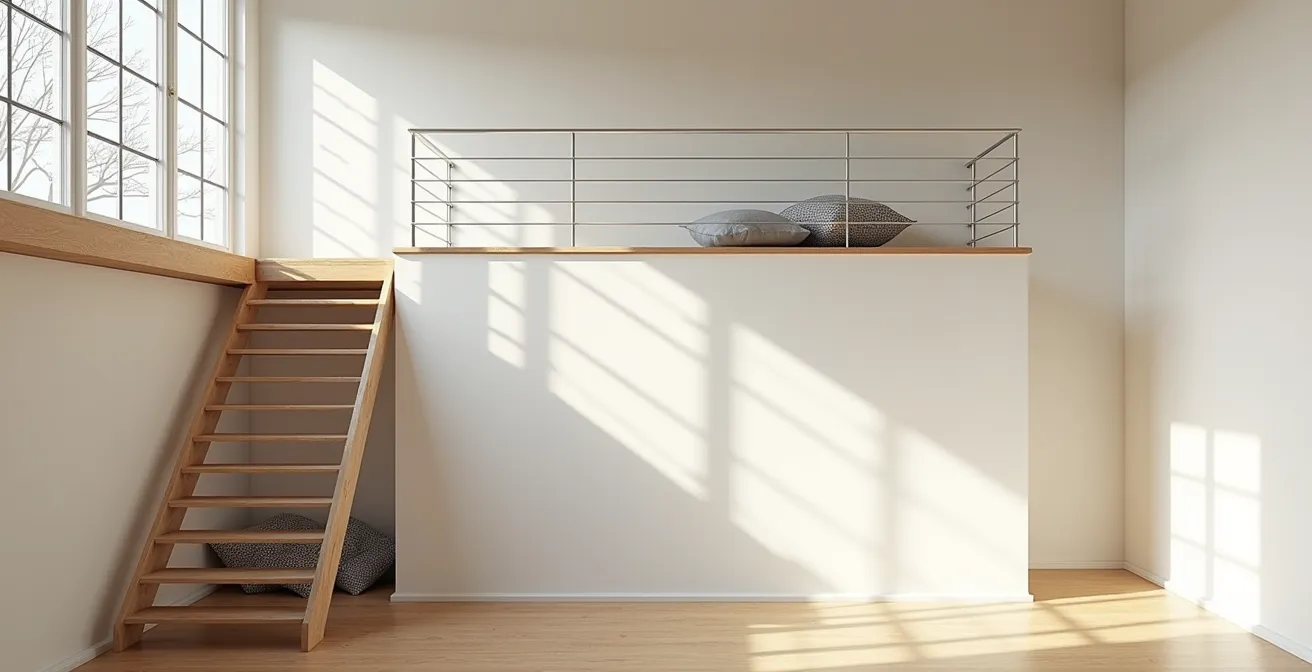
Building a legal mezzanine is less about construction and more about understanding the physics of safety and space that underpin building codes.
- Structural integrity is non-negotiable; your loft’s existing walls are likely not designed to support a new floor without independent columns.
- Your choice of stairs is dictated by “means of egress” rules, directly impacting your floor plan and daily usability.
Recommendation: Treat this guide as your first consultation. Before buying any materials, engage a structural engineer to translate these principles into a formal plan for your specific space.
The allure of a mezzanine in a high-ceilinged loft is undeniable. It’s the promise of a new bedroom, a secluded office, or a cozy reading nook seemingly conjured from thin air. Many loft owners dream of this vertical expansion, seeing it as the most efficient way to gain square footage. The internet is filled with inspiring photos and DIY guides that make it look like a weekend project. However, this is where a critical, and often costly, misunderstanding begins.
From a structural architect’s perspective, a mezzanine is not furniture; it is a fundamental alteration of the building’s frame and a change to its life-safety systems. The most common mistake is assuming that your existing walls can bear the new weight. This approach ignores the fundamental concept of a ‘load path’—the journey a force takes to the ground. Without a dedicated support system, you risk not just code violations but catastrophic failure. The challenge isn’t simply building a platform; it’s integrating a new structure legally and safely into an existing one.
This guide moves beyond generic advice like “check local codes.” Instead, we will explore the core architectural and engineering principles *behind* those codes. You will learn to think like an architect, focusing on load distribution, safe access, and even the thermodynamics of your newly shaped space. By understanding the ‘why,’ you can make informed, creative, and—most importantly—safe decisions to legally and beautifully expand your home.
To navigate this project successfully, we will deconstruct the process into key decisions and regulatory considerations. The following sections break down everything from the foundational structure to the final lighting touches, providing a clear roadmap for your project.
Summary: A Step-by-Step Architectural Guide to Loft Mezzanines
- Why Your Walls Might Not Support the Weight of a Sleeping Platform?
- How to Choose Between a Ladder and a Spiral Staircase for Daily Access?
- Glass vs Metal Railings: Which Makes the Mezzanine Look Bigger?
- The Heating Trap: Why Mezzanines Get Too Hot and How to Cool Them?
- What to Put Under the Stairs: Turning Dead Space into a Wardrobe
- Why Your Heating Bill Is High Even Though the Windows Are Closed?
- Why Legroom and Table Space Are Critical for Laptop Work?
- How to Use LED Lighting to Regulate Your Sleep and Energy Levels?
Why Your Walls Might Not Support the Weight of a Sleeping Platform?
This is the single most critical question, and the answer begins with understanding two concepts: dead loads and live loads. The dead load is the weight of the mezzanine structure itself—the beams, joists, and flooring. The live load is everything else: you, your furniture, your books, and your guests. Your loft’s existing walls were designed to support the roof and themselves (a dead load), not an entirely new floor filled with activity.
The principle we follow is creating a new, independent load path. Imagine the weight of your mezzanine as water pouring onto a surface; you must create dedicated channels (columns) to guide that weight directly to the building’s foundation, bypassing the existing walls entirely. Attaching a mezzanine directly to wall studs is like asking a picket fence to stop a car. The studs are designed for vertical compression within the wall system, not for the shear forces a heavy platform exerts.
Building codes provide a baseline for this. For instance, the building code minimum for a light storage mezzanine is 125 pounds per square foot (PSF). A simple 10×10 foot (100 sq ft) sleeping loft must therefore be engineered to support at least 12,500 pounds—the weight of roughly three cars. This load must be transferred through properly sized columns to concrete footings that can handle the pressure, which may even require reinforcing your loft’s concrete slab. Relying on your walls is not a calculated risk; it’s a structural certainty for failure.
How to Choose Between a Ladder and a Spiral Staircase for Daily Access?
Your access method isn’t just an aesthetic choice; it’s governed by a critical life-safety concept called “means of egress.” This is a building code term for a continuous and unobstructed path of exit from any point in a building to a public way. In an emergency, like a fire, you must be able to escape quickly and safely. A simple ladder, while space-efficient, is not considered a valid means of egress for a habitable space like a sleeping loft in most jurisdictions.
This regulatory constraint immediately narrows your options. While a ship’s ladder or alternating tread stair feels like a clever compromise, their use is highly restricted. For example, ship’s ladders are often only permitted for accessing unoccupied mechanical spaces. For a mezzanine intended for daily use, you will almost always be choosing between a standard staircase and a spiral staircase. A standard staircase is the safest and most comfortable option, especially for carrying items, but it consumes the most floor space. A spiral staircase offers a good balance, saving significant floor space while still complying with code as a means of egress, provided its dimensions (tread width, riser height) meet specific requirements.
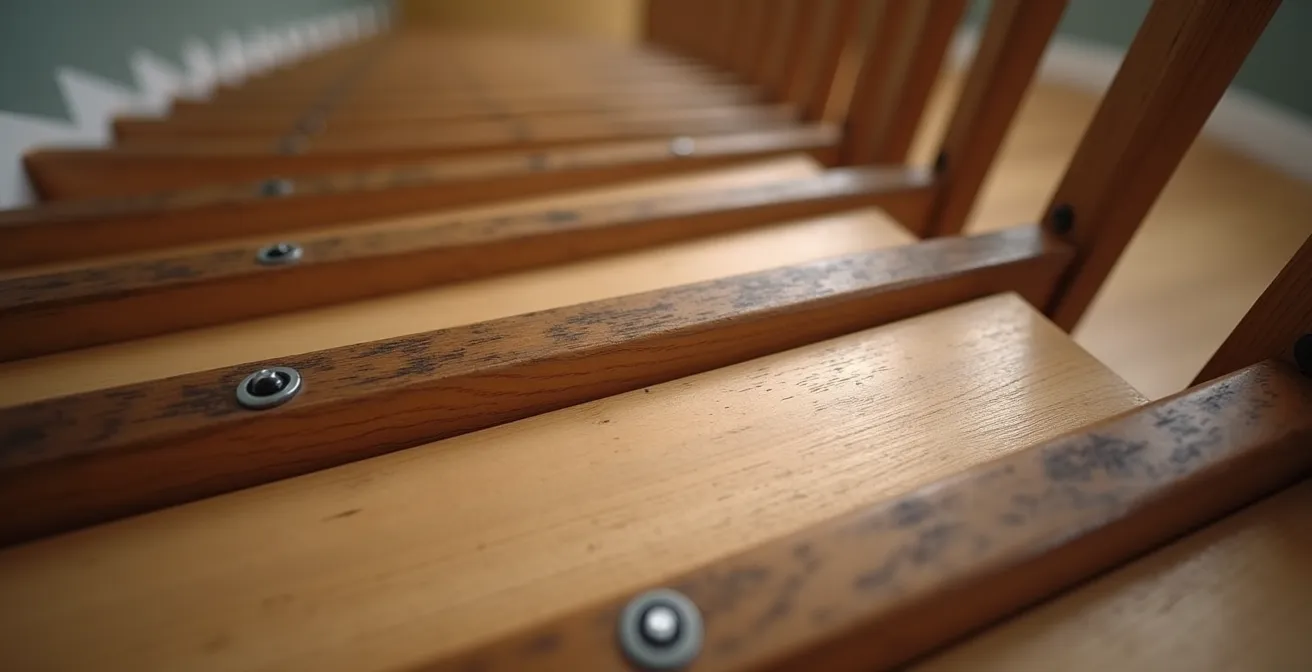
The illustration shows alternating tread stairs, a compact solution that can sometimes be approved for very small mezzanines with low occupancy, but this varies greatly by location. The choice ultimately depends on your local code’s interpretation of a habitable space. The table below, based on common building code principles, breaks down the typical applications and limitations of each access type.
| Access Type | Code Requirements | Best For | Limitations |
|---|---|---|---|
| Alternating Tread Stairs | Allowed for mezzanines under 250 sq ft serving max 5 occupants | Space-constrained areas | 50-70 degree angle |
| Ship’s Ladder | Not allowed as means of egress for any mezzanines | Only for control rooms under 250 sq ft or unoccupied roofs | Limited to specific uses |
| Standard Stairs | Required for most mezzanines | Regular daily access | Requires more floor space |
| Spiral Stairs | Allowed when standard stairs not feasible | Moderate space savings | Difficult for carrying items |
Glass vs Metal Railings: Which Makes the Mezzanine Look Bigger?
The railing is your mezzanine’s most visible feature from below, defining its character and relationship with the main living area. The choice between glass and metal is a classic trade-off between perceived openness and material presence. Glass railings are the undisputed champion for making a space feel larger. By providing a nearly invisible barrier, they preserve sightlines and allow light to pass through unobstructed, integrating the mezzanine seamlessly with the loft.
However, this transparency comes with practical considerations, primarily maintenance. Glass will show every fingerprint and smudge. In contrast, metal railings—whether vertical bars, wire mesh, or horizontal cables—offer more forgiving surfaces. They can also introduce a strong design element. A black steel railing can add an industrial edge that complements a loft aesthetic, while stainless-steel cables offer a minimalist look that is less obstructive than solid bars but more present than glass. Perforated metal can even create dynamic light and shadow patterns, adding texture to the space.
Regardless of the material, the railing’s primary function is safety. Regulations are strict on this point. For example, an OSHA-compliant guardrail must be able to resist forces up to 200 pounds applied in any direction at any point along the top. This dictates the strength of the material, the spacing of its supports, and the security of its connection to the mezzanine floor. The visual lightness you desire can never compromise this structural robustness.
Your Railing Selection Audit: A 5-Step Plan
- Interaction Points: List all areas where the railing impacts your space—sightlines from your sofa, the feel of the handrail, how it frames a window, and its role as a visual boundary.
- Material Palette: Inventory your loft’s existing materials (e.g., exposed brick, polished concrete, wood species) to create a coherent palette for your railing choice.
- Design Goal Alignment: Compare options (glass, steel cable, solid panels) against your primary goals. Are you prioritizing maximum light, an industrial feel, or absolute child safety?
- Emotional Impact Analysis: Evaluate each option’s feel. Does frameless glass feel open but precarious? Do steel bars feel secure but cage-like? Which choice creates a unique statement versus a generic solution?
- Integration & Maintenance Plan: Create a final action plan. If you choose glass, what is your strategy for keeping it clean? If metal, how will its finish be maintained and coordinated with other fixtures?
The Heating Trap: Why Mezzanines Get Too Hot and How to Cool Them?
One of the most overlooked aspects of adding a mezzanine is its impact on your loft’s thermodynamics. The single biggest complaint from new mezzanine dwellers is the heat. This isn’t due to poor insulation; it’s a result of a physical phenomenon known as the stack effect. Hot air is less dense than cold air, so it naturally rises. In a double-height loft, your mezzanine acts as a tray, collecting all the warm air from the entire volume of the space. While the ground floor feels comfortable or even chilly, the upper level can become an uncomfortable, stuffy “hot zone.”
Simply opening a window on the mezzanine level often isn’t enough. To effectively combat the stack effect, you need to create active air circulation. The goal is to either force the hot air out or push it back down to mix with the cooler air below. One of the most effective solutions is an operable skylight or high-level clerestory window positioned directly above the mezzanine. This creates a natural chimney, allowing the hottest air to vent outside.

In addition to venting, mechanical solutions are key. A large-diameter ceiling fan is invaluable. By running it in a clockwise direction during cooler months, it gently pushes the trapped warm air from the ceiling back down into the living space, equalizing the temperature. In warmer months, running it counter-clockwise creates a cooling downdraft. For mezzanines with solid flooring, installing small, discreet vents in the floor can also help, allowing cooler air from below to rise and displace the hot air. Ignoring ventilation is planning for an unusable space for several months of the year.
What to Put Under the Stairs: Turning Dead Space into a Wardrobe
The space beneath your mezzanine staircase is not dead space; it’s a high-potential storage zone waiting for a creative solution. In a compact loft where every square foot matters, leveraging this awkward, angular volume is essential. The most common and effective use is for custom-built storage, transforming it from a dust-collecting void into a functional part of your home.
A built-in wardrobe is a perfect fit. By designing a system of graduated-depth cabinets and drawers that follow the angle of the stairs, you can create a seamless wall of storage. For a minimalist aesthetic, using handleless, push-to-open doors can make the entire installation disappear into the wall, providing massive storage capacity without visual clutter. This is an ideal location for clothes, shoes, and linens, keeping them out of sight but easily accessible.
Beyond clothing, the under-stair area can house a variety of functions. Here are a few creative ideas to maximize its utility:
- The Disappearing Home Office: Install a pull-out desk on heavy-duty drawer slides, complete with integrated power and shelving. When not in use, it slides away completely.
- The Pet Zone: Create a dedicated and cozy nook for a pet, with a built-in bed, feeding station, and storage for toys and food.
- The Library Nook: Integrate a series of deep shelves for books, combined with a small built-in bench or reading seat at the tallest end of the void.
- The Utility Closet: If located near the entrance, it’s the perfect spot for a concealed closet for coats, cleaning supplies, or even a stacked washer/dryer unit.
The key is custom fabrication. Off-the-shelf furniture will never fit the unique geometry of the space. Investing in custom millwork will yield a solution that is both incredibly efficient and a high-end design feature.
Why Your Heating Bill Is High Even Though the Windows Are Closed?
You’ve built your mezzanine, and while the upper level gets warm, you notice a surprising new problem: the lower level feels colder than ever, and your heating bills are climbing. You check the windows for drafts, but they seem sealed tight. The real culprit is often located directly above your head: the roof. The addition of a mezzanine fundamentally changes your loft’s relationship with its roof, a primary source of heat loss.
Before the mezzanine, the large volume of air in your double-height space acted as a buffer between you on the ground floor and the uninsulated roof surface far above. Now, your new mezzanine level has brought you into much closer proximity to this cold surface. As we’ve discussed, hot air rises to the mezzanine ceiling. If the roof assembly directly above it is poorly insulated, that collected heat is rapidly lost to the outside. This phenomenon turns your roof into a giant radiator in reverse, constantly sucking warmth out of the building.
Your thermostat, likely located on the colder ground floor, senses the drop in temperature and calls for more heat. The heating system works overtime to warm the lower level, but that new hot air simply rises, collects at the now-closer ceiling, and escapes through the roof again. You are now stuck in a vicious and expensive heating cycle. In many lofts, the biggest source of heat loss is an uninsulated roof, a problem made significantly worse by the presence of a mezzanine. Before undertaking a mezzanine project, a thorough inspection and, if necessary, an upgrade of your roof insulation is one of the smartest investments you can make for long-term comfort and energy efficiency.
Why Legroom and Table Space Are Critical for Laptop Work?
Using your new mezzanine as a home office is a fantastic use of space, but a loft office has unique ergonomic challenges. The compact footprint and potentially lower ceiling height demand careful planning to avoid creating a workspace that is uncomfortable or unproductive. The two most critical factors are legroom and usable desk surface.
First, consider vertical clearance. While you might not be standing at your desk all day, you need enough room to sit and stand comfortably. Building codes often mandate a minimum headroom. For example, OSHA requires a minimum vertical clearance above stair treads of 6 feet, 8 inches, and this is a good benchmark for a workspace as well. Anything less can feel claustrophobic and lead to stooping. This clearance also applies to the space *under* the desk. Ensure there’s ample, unobstructed room for your legs and feet to move.
Second, think about the load your office equipment creates. An office space has a different load profile than a simple storage area. Codes may specify a lower live load requirement, such as 50 PSF for office use, but you must account for concentrated loads. A heavy filing cabinet or a large printer places a significant weight on a very small footprint, which creates more stress on the structure than an evenly distributed load. Here are some tips for an ergonomic and functional mezzanine office:
- Cantilevered Desk: To maximize floor space, consider a “floating” desk that cantilevers over the mezzanine’s edge, “borrowing” airspace from the void below.
- Integrated Power: Build power outlets and USB ports directly into the mezzanine floor or desk structure to eliminate cable clutter.
- Bookshelf Railing: Use a sturdy, floor-to-ceiling bookshelf as part of your railing system to create a visual boundary from the living space while providing ample storage.
- Vertical Storage: Utilize the full wall height with a loft-style desk that incorporates tall shelving, maximizing your storage footprint.
Key takeaways
- Structural Independence: Your mezzanine must support its own weight (live and dead loads) via columns to the foundation, not by relying on existing walls.
- Egress Over Aesthetics: Your access method (stairs) is a life-safety feature governed by strict “means of egress” codes, which often preclude ladders for habitable spaces.
- Active Climate Control: A mezzanine creates a “hot zone” due to the stack effect; you must plan for active ventilation (fans, skylights) to ensure the space is usable.
How to Use LED Lighting to Regulate Your Sleep and Energy Levels?
If your mezzanine is destined to be a bedroom, the lighting strategy is paramount for its success. More than just illumination, lighting in a sleep space should support your body’s natural circadian rhythm. Modern LED technology gives you precise control to create an environment that can help you wake up energized and wind down peacefully.
Any mezzanine occupying over one-third of floor space underneath needs to follow separate fire code regulations with more rigorous standards.
– International Building Code, as cited in World Construction Today
The key is using tunable white LED strips. These are smart lights that can change their color temperature throughout the day. In the morning, you can program them to emit a bright, blue-toned light that mimics daylight, which helps to suppress melatonin production and signal to your body that it’s time to be alert. In the evening, the lights can automatically shift to a warm, dim, amber-toned glow, similar to a sunset or candlelight. This warm light encourages melatonin production, preparing your body for sleep.
A successful lighting plan relies on layering. Don’t depend on a single overhead fixture. Instead, combine different types of lighting for different functions:
- Ambient Lighting: Use tunable white LED strips hidden in a cove around the perimeter of the ceiling for soft, indirect, general illumination.
- Task Lighting: Install focused, downward-facing reading lights with a warm color temperature by the bed so you can read without filling the space with stimulating blue light.
- Safety Lighting: Place low-lumen, motion-activated guide lights near the stairs and along the path to the bathroom to ensure safe navigation at night without jolting you awake.
- Light Spill Control: Ensure all fixtures are properly shielded and directed downwards to prevent light from spilling into the living area below, maintaining a sense of separation and privacy.
By using lighting to define zones for work and sleep, you can transform your mezzanine from just an extra platform into a responsive and health-conscious environment.
Now that you understand the architectural principles behind a safe and functional mezzanine, the next logical step is to translate this knowledge into a concrete plan for your unique space. The most effective way to do this is by consulting with a licensed structural engineer or architect who can perform the necessary calculations and produce drawings for permitting.