
The frustrating truth is that many of your best recycling efforts are likely being wasted due to a broken and misunderstood system.
- Upstream choices—like preferring screwed-together products over glued ones—have a far bigger impact than downstream sorting.
- Contamination (like bagged recyclables or food residue) is the #1 reason entire truckloads of clean recyclables end up in landfills.
Recommendation: Shift your focus from “recycling more” to becoming a “Lifecycle Manager” for everything that enters your home.
As an environmentally conscious family, you’re already doing the right things. You diligently separate plastics, glass, and paper. You rinse containers and break down boxes. Yet, a nagging feeling persists: is it actually making a difference? You’re trying to move beyond simple recycling, but the path forward feels cluttered with guilt-inducing advice to simply “buy less” or vague tips that don’t fit a busy household.
The problem isn’t your effort; it’s the framework. We’ve been taught to focus on the end-of-life of a product—the recycling bin. But the real power lies in managing its entire journey. What if the key wasn’t just about better sorting, but about making smarter choices before an item even enters your home? What if you could diagnose a product’s true lifespan just by looking at it?
This is the core of a true circular economy at home. It’s about shifting your role from a passive consumer to a proactive Lifecycle Manager. This guide offers a systematic, guilt-free approach. We will deconstruct the myths of recycling, provide frameworks for making smarter upstream decisions, and offer practical solutions for managing waste streams—from old electronics to the “invisible” footprint of your digital life. It’s time to build a system that truly works.
This article will guide you through the practical steps and mindset shifts needed to transform your household’s approach to waste. The following sections break down key areas where you can make a significant, tangible impact.
Summary: How to Build a Real Circular Economy in Your Home (Beyond the Recycling Bin)
- Why 90% of Your “Recyclable” Plastic Actually Ends Up in Landfills?
- How to Turn Glass Jars into Functional Storage Without Looking Tacky?
- Glue or Screws: Which Product Design Feature signals a Longer Lifespan?
- The Recycling Bin Mistake That Contaminates the Whole Truckload
- What to Do With Broken Electronics: Finding E-Waste Drop-Offs Near You
- Where to Find Undervalued Vintage Rugs Before Dealers Buy Them?
- The Upgrade Mistake: Why Keeping Your Phone for 3 Years Cuts Emissions in Half
- How to Reduce Your “Invisible” Digital Carbon Footprint?
Why 90% of your “recyclable” plastic actually ends up in landfills?
The most common entry point into sustainability—plastic recycling—is also the most broken. You meticulously rinse a yogurt cup, check for the recycling symbol, and toss it in the bin, feeling you’ve done your part. The downstream reality, however, is that the system is failing. The plastic industry has promoted recycling for decades, yet industry documents show they’ve known since 1974 that there was no economically viable way to recycle most of it. The “recyclable” label is more of a marketing tool than a guarantee.
The core issue is market demand and contamination. Recycling is a business, not a charity. Only certain types of plastic, primarily #1 (PET) and #2 (HDPE), have strong, reliable markets. For most other types, it’s often cheaper for manufacturers to use virgin plastic than to process the recycled material. This economic truth was exposed when China’s National Sword policy stopped the import of foreign waste, causing the US plastic recycling rate to plummet.
Even for valuable plastics, a single mistake can ruin an entire batch. This is known as “wishcycling”—tossing in items you *hope* are recyclable, like greasy pizza boxes or plastic film. According to CleanHub’s 2024 Plastic Perspectives Report, while 87% of general recycling materials are returned to the market, only 5% of plastic is actually recycled. To be a true Lifecycle Manager, you must understand these limitations and focus your efforts where they matter.
- Check Resin Codes: Prioritize items made from #1 PET and #2 HDPE, as they have the highest chance of being recycled in most regions.
- Avoid ‘Wishcycling’: When in doubt, leave it out. Items like greasy food containers, ceramic mugs, or plastic bags can contaminate entire batches.
- Clean and Dry: Food residue is a primary source of contamination. All containers must be clean and dry before going into the bin.
- Remove Caps: Bottle caps are often made from a different type of plastic that contaminates the batch of PET bottles.
- Never Bag Recyclables: Plastic bags jam the sorting machinery at Material Recovery Facilities (MRFs) and are almost always sent to the landfill.
How to turn glass jars into functional storage without looking tacky?
Reusing glass jars is a classic zero-waste tip, but the reality often ends up as a chaotic collection of mismatched containers with stubborn label residue. The difference between a cluttered shelf and a beautifully curated pantry lies in a systematic approach. The goal is uniformity and intention, transforming a random assortment into a cohesive storage system. This is a perfect exercise in asserting control over a product’s second life.
The first step is professional-grade preparation. Stubborn labels and their sticky adhesive are the primary culprits of a “tacky” look. A simple soak in an oil-based solution is far more effective than water at breaking down the adhesive. Following this with a baking soda scrub not only removes any remaining residue but also neutralizes lingering odors from pickles or sauces, ensuring your jar is a truly blank slate for storing dry goods like lentils or flour.
Aesthetics come from consistency. Instead of a mess of different branded lids, applying a uniform coat of chalk paint to all of them creates an immediate sense of order. Choose a single color or a limited palette that matches your kitchen’s decor. For labeling, avoid writing directly on the jar with permanent markers. Use non-permanent options like kraft paper tags attached with twine or erasable chalk labels. This allows you to adapt the jars’ contents over time without creating a mess. Finally, group the finished jars by size and function on open shelving to create a display that feels intentional and curated, not accidental.

By following a professional process, you elevate simple reuse into a design statement. It’s not just about saving a jar from the landfill; it’s about creating a functional and beautiful system that you’re proud to display. This method turns a common sustainability challenge into a satisfying home organization project.
Glue or screws: Which product design feature signals a longer lifespan?
A core tenet of the Lifecycle Manager mindset is making smart upstream decisions—choosing products that are built to last and, crucially, to be repaired. Before an item even enters your home, you can often predict its longevity by looking for one simple design choice: are its components held together by screws or by glue? This single detail is a powerful indicator of a product’s place in the circular economy.
Products assembled with visible screws are inherently designed for disassembly. This means that if one part fails—a battery dies, a switch breaks, a motor burns out—it can be accessed and replaced. It signals that the manufacturer acknowledges the potential for maintenance. Think of high-quality electronics, small appliances, or furniture where you can see the fasteners. This is a design philosophy centered on longevity and user empowerment.
Conversely, products held together by industrial adhesive or sonic welding are often designed for disposal. These sealed units are difficult, if not impossible, to open without causing permanent damage. When a single component fails, the entire device becomes e-waste. This is common in many modern electronics, from wireless earbuds to cheap kitchen gadgets, where a sleek, seamless appearance is prioritized over repairability. As the experts at iFixit have noted, this choice has a massive impact on a product’s lifespan.
Products with modular components and visible screws last 2-3 times longer than glued counterparts because they can be maintained and upgraded rather than replaced entirely.
– iFixit Repairability Study, Family Handyman Circular Economy Report
When you’re shopping, make this a conscious checkpoint. Turn the product over. Look for access panels and standard screws (like Phillips or flathead). Choosing design for disassembly isn’t just about repair; it’s a vote for a different kind of manufacturing—one that respects resources and the consumer’s right to maintain what they own.
The recycling bin mistake that contaminates the whole truckload
You’ve mastered sorting plastics and now avoid “wishcycling.” But there’s a more insidious mistake that even well-meaning households make: bagging their recyclables. It seems logical—a neat and tidy way to carry your items to the bin. However, at a Material Recovery Facility (MRF), that plastic bag is a saboteur. It’s the single biggest contamination mistake that can condemn an entire truckload of perfectly good materials to the landfill.
The machinery at MRFs is designed to sort loose items. Conveyor belts, spinners, and optical sorters separate materials by shape, weight, and type. Plastic bags, however, get tangled in this equipment, wrapping around gears and causing the entire system to shut down for hours of manual removal. For safety and efficiency, operators are trained to treat any bagged material as trash. Your carefully cleaned cans and bottles, hidden inside a bag, are never even opened. They are pulled off the line and sent directly to the landfill.
This single action contributes significantly to the rising problem of contamination. In the past decade alone, contamination rates have risen from 7% to over 17%, disrupting the fragile economics of recycling. Other common contaminants, like food residue on a pizza box, have a similar effect. The oil from a greasy box bottom can ruin a whole batch of paper pulp, rendering it useless. The solution, again, is a systematic approach: place all recyclables in your bin loose and un-bagged, and for items like pizza boxes, tear off and recycle only the clean top half.
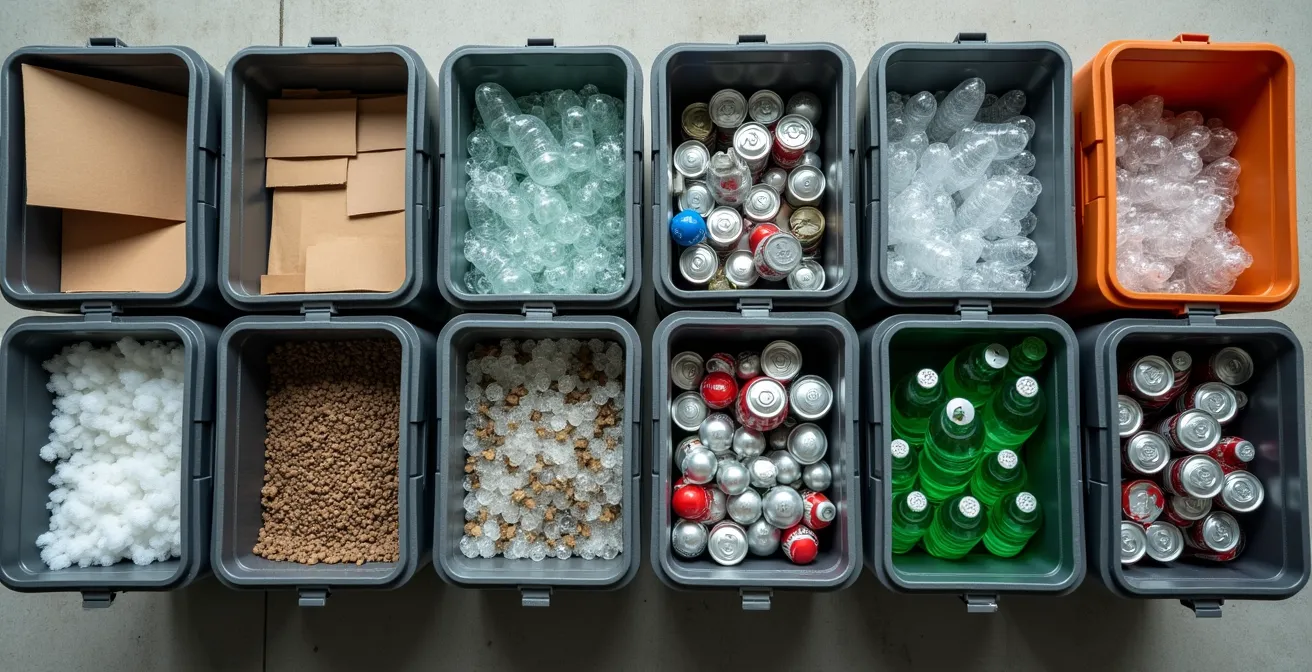
Understanding the “why” behind these rules is what separates passive recycling from active lifecycle management. It’s not arbitrary; it’s based on the physical and economic realities of the system you’re participating in. Keeping your recyclables loose and clean is the most effective way to ensure your efforts aren’t wasted.
What to do with broken electronics: Finding e-waste drop-offs near you
In a modern household, electronic waste—or e-waste—is one of the fastest-growing and most hazardous waste streams. Old phones, broken laptops, and defunct kitchen gadgets contain valuable materials like gold and copper, but also toxic substances like lead and mercury. Tossing them in the trash is an environmental disaster, yet the proper disposal method is often unclear. Globally, the problem is staggering; only 22.3% of e-waste was recycled globally in 2022, while its generation is growing five times faster than our ability to recycle it.
Before you even think about recycling, however, there is a critical first step: data security. Your old devices are a treasure trove of personal information. Simply deleting files or performing a basic reset is not enough. A proper pre-recycling protocol is essential to protect your privacy. This involves backing up all necessary data, performing a full factory reset to wipe the device, and, for ultimate security, physically removing or destroying hard drives on computers.
Once your device is secure, explore your options. Many major retailers like Apple and Best Buy have trade-in programs that may offer cash value for your old electronics, extending their life through refurbishment. For items that are truly at the end of their life, find a certified recycler. Look for organizations certified by standards like R2 or e-Stewards. These certifications guarantee that the recycler adheres to strict environmental standards and secure data destruction protocols, preventing your e-waste from being illegally shipped overseas or dumped in a landfill.
Your Action Plan: Pre-Recycling Security Protocol for Electronics
- Back Up Data: Save all important files, photos, and documents to an external hard drive or a secure cloud service.
- Perform a Factory Reset: Follow the manufacturer’s specific instructions to wipe all personal data from the device.
- Remove/Destroy Drives: For computers, physically remove the hard drive. If it contains sensitive information, consider physically destroying it.
- Check for Trade-Ins: Investigate programs from manufacturers or retailers (like Apple or Best Buy) that offer store credit or cash for old devices.
- Find a Certified Recycler: Search for local R2 or e-Stewards certified recyclers to ensure responsible and secure disposal.
- Harvest Parts (Optional): For DIY enthusiasts, consider salvaging valuable components like RAM, fans, or power supplies for future projects before recycling the rest.
Where to find undervalued vintage rugs before dealers buy them?
Extending the life of existing items is a core principle of the circular economy, and nowhere is this more rewarding than in the secondhand market for quality goods. A vintage, hand-knotted rug can last for generations, unlike a cheap, machine-made alternative that quickly ends up in a landfill. The challenge is finding these treasures before professional dealers, who know exactly what to look for, snap them up. The secret is to monitor the sources where items first appear: estate sales and local auction houses.
Professional vintage hunters consistently report finding items at 50% below market value by diligently monitoring platforms like estatesales.net and attending pre-sale viewings at local auction houses. These are the front lines where a family’s possessions are liquidated, often without a full appraisal of every item. This is your opportunity to find an undervalued gem. The key is to be prepared and able to assess quality quickly.
You don’t need to be an expert to spot a quality hand-knotted rug. A few simple checks can reveal its authenticity in seconds. First, flip a corner over to inspect the back; a hand-knotted rug will show the pattern almost as clearly as the front, with visible individual knots. A machine-made rug’s back will be uniform and rigid. Second, check the fringe. On a genuine piece, the fringe is part of the rug’s foundational structure, not sewn on as a decorative afterthought. Finally, a hand-knotted rug is flexible and can be easily folded, whereas a machine-made one is stiff. When you find a potential bargain, always factor in the cost of professional cleaning ($200-$500) to determine the true final price.
Investing in quality secondhand items like this is a powerful upstream decision. The Circular Economy Foundation notes that extending the life of furniture by just five years can reduce its environmental impact by nearly 50%. It’s a choice that saves money, resources, and brings a unique piece of history into your home.
Key takeaways
- The “recyclable” label on plastic is not a guarantee; only plastics #1 (PET) and #2 (HDPE) have viable recycling markets.
- Making smart “upstream” choices, like opting for products held together by screws instead of glue, has a greater circular impact than recycling.
- Extending a product’s life is the most effective circular strategy; keeping a phone for 3 years instead of 2 can cut its lifetime emissions in half.
The upgrade mistake: Why keeping your phone for 3 years cuts emissions in half
The relentless cycle of tech upgrades is one of the biggest drivers of waste and carbon emissions in a modern household. We’re conditioned to want the latest model, but the most significant environmental impact of your smartphone occurs long before you unbox it. This is its “invisible” footprint, also known as embodied carbon—the emissions generated during the mining of raw materials, manufacturing, and shipping.
According to the World Economic Forum’s circular economy initiative, a staggering 80-90% of a phone’s lifetime carbon emissions occur during mining and manufacturing. This means the single most powerful action you can take to reduce its impact is simply to use it for longer. Extending your phone’s life from the typical two years to three or four years effectively spreads that massive initial carbon investment over a longer period, dramatically reducing its annual footprint. Keeping it for just one extra year can cut its impact by a third.
The decision to upgrade is often driven by a slowing battery or a cracked screen, but these are highly repairable issues. As a Lifecycle Manager, weighing the cost-benefit of repair versus replacement is a critical calculation. A battery replacement, for example, costs a fraction of a new phone but can add another two to three years of life to your device, saving significant money and carbon emissions. Even simple software optimization, like clearing out old files and apps, can improve performance and extend its usability.
The table below breaks down the clear financial and environmental benefits of choosing repair over replacement. It reframes minor annoyances not as a reason to upgrade, but as an opportunity to make a smart, circular choice.
| Action | Cost | Phone Lifespan Extension | Carbon Savings |
|---|---|---|---|
| New Phone Purchase | $800-1200 | 0 years (replacement) | -70kg CO2 (new emissions) |
| Battery Replacement | $50-90 | +2-3 years | 35kg CO2 saved |
| Screen Repair | $100-200 | +1-2 years | 20kg CO2 saved |
| Software Optimization | $0 | +6-12 months | 10kg CO2 saved |
How to reduce your “invisible” digital carbon footprint?
In a truly circular household, the concept of waste extends beyond physical objects. Every email you store, every photo saved to the cloud, and every unused subscription service contributes to an “invisible” digital carbon footprint. Data centers that power the internet consume enormous amounts of energy, and your stored data is a part of that demand. A digital declutter is not just for mental clarity; it’s a tangible environmental action.
The energy cost of storing data is immense. Every file, no matter how old, requires a server to be powered, cooled, and maintained 24/7. Think of your inbox as a digital attic filled with thousands of old newsletters, promotional emails, and attachments you haven’t looked at in years. Deleting them reduces the load on these servers. A systematic approach is most effective. Use your email client’s search commands to find and delete large batches of old or oversized emails.
This principle applies to all your digital habits. Unsubscribing from newsletters you no longer read stops future server demand. For cloud storage, the same logic holds: it’s an energy-intensive service. For files you access frequently, it’s more efficient to download a local copy and delete them from the cloud. This reduces the constant energy required to keep them accessible online. Becoming a digital Lifecycle Manager means being intentional about what data you create and keep.
Here are a few powerful search commands to start your digital declutter:
- Gmail Search: ‘older_than:2y’ – Finds all emails older than two years for mass deletion.
- Gmail Search: ‘has:attachment larger:10M’ – Locates emails with large attachments that are hogging server space.
- Outlook Search: ‘received:<2022 hasattachments:yes’ – A similar search for Outlook users to find old emails with attachments.
By regularly cleaning out your digital life, you complete the final loop of a holistic circular economy at home. You take responsibility not just for the physical items you can see and touch, but for the invisible data streams you control.
Frequently asked questions about How to Build a Real Circular Economy in Your Home (Beyond the Recycling Bin)
Can I recycle a greasy pizza box?
The oily bottom contaminates paper recycling, but you can tear off and recycle the clean top half of the box.
Should I leave caps on plastic bottles?
No, caps are often different plastic types. Remove them to prevent contamination of PET recycling streams.
Why can’t I put recyclables in plastic bags?
Plastic bags jam sorting machinery at MRFs and are automatically treated as trash for safety reasons. Incorrect items can end up contaminating good recyclables and can potentially damage the equipment.