
The comfort of a daily-use sofa bed isn’t in its style, but in its hidden engineering specifications.
- Prioritize mattress foam density of at least 2.5 PCF (pounds per cubic foot) to prevent sagging and ensure spinal support.
- Analyze the opening mechanism’s quality—look for welded steel frames and protective wheels over basic plastic parts.
Recommendation: Stop shopping for a “sofa” and start investing in a piece of sleep equipment. Demand the technical data sheet before you buy.
For anyone living in a studio or micro-apartment, the convertible sofa represents both a brilliant solution and a potential trap. It promises the ultimate two-in-one: a stylish seating area by day and a comfortable bed by night. Yet, the reality is often a compromise that fails at both. Many shoppers focus on the aesthetics—the color, the fabric, the style—only to find themselves with a sagging, squeaking source of back pain within a year.
The common advice to “choose a comfortable mattress” or “find a sturdy frame” is frustratingly vague. It ignores the fundamental truth: a sofa bed designed for nightly sleep is not furniture; it’s a piece of high-performance ergonomic equipment. Its long-term value isn’t determined by its looks, but by hidden technical specifications that manufacturers rarely advertise on the showroom floor.
But what if the key to finding the perfect sleeper sofa wasn’t about subjective comfort, but about objective engineering? This guide shifts the perspective. We will move beyond marketing claims and decode the critical components that define a durable, pain-free convertible sofa. We will analyze the science behind mattress sagging, dissect the mechanics of opening systems, evaluate upholstery for true longevity, and finally, place this crucial furniture piece within a larger strategy for total space optimization.
This article provides a complete roadmap for making a smart, long-term investment in your comfort and your space. Explore the sections below to learn how to identify quality, avoid common pitfalls, and transform your small apartment into a perfectly optimized, dual-function home.
Summary: Your Guide to a Better Convertible Sofa
- Why Cheap Sofa Beds Sag After 6 Months and Ruin Your Sleep?
- How to Open a Sofa Bed in 10 Seconds Without Scratching the Floor?
- Click-Clack or Pull-Out: Which Mechanism Lasts Longer for Daily Use?
- The Upholstery Mistake That Makes Convertible Sofas Look Old Fast
- Where to Store the Duvet: Solutions for Sofa Beds Without Storage Boxes
- Smart Watch vs Oura Ring: Which Actually Tracks REM Stages?
- What to Put Under the Stairs: Turning Dead Space into a Wardrobe
- How to Build a Mezzanine in a Small Loft Without Breaking Building Codes?
Why Cheap Sofa Beds Sag After 6 Months and Ruin Your Sleep?
The number one failure point of a budget sofa bed is mattress sagging. This isn’t bad luck; it’s bad physics. The culprit is low-density foam. Manufacturers use it because it’s cheap and feels soft in the showroom, but it lacks the cellular structure to withstand the nightly compression of a human body. The key metric they don’t want you to know is foam density, measured in pounds per cubic foot (PCF).
For a surface you sleep on every night, a minimum density of 2.5 PCF is non-negotiable. Anything less, especially common 1.5 PCF foam, is designed for occasional sitting, not consistent sleep support. Industry durability benchmarks show that low-density polyurethane foam can experience a 27% compression loss after just 18 months of regular use. This loss creates the dreaded “hammock effect,” where your hips sink lower than your shoulders and legs, forcing your spine out of alignment and leading directly to morning back pain.
Furthermore, consumer data confirms this rapid degradation. One analysis revealed that 22% of all polyurethane foam mattresses showed visible signs of sagging within 3 to 5 years, a number that accelerates dramatically with the dual-use strain of a sofa bed. A high-quality mattress will also be labeled “High Resilience” (HR) and have a high support factor (the ratio of its firmness at 65% compression versus 25% compression), ensuring it pushes back against you to provide support, rather than simply collapsing.
How to Open a Sofa Bed in 10 Seconds Without Scratching the Floor?
A sofa bed for daily use is an active piece of machinery. Its opening mechanism will be operated twice a day, every day—that’s over 700 transformations a year. The quality of this mechanism defines not only its lifespan but also your daily convenience and the integrity of your floors. Cheap mechanisms use flimsy parts, require significant muscle to operate, and often deploy hard plastic feet that scratch wood or laminate flooring.
A premium mechanism is an elegant piece of engineering. Look for features like gas-piston assists, which counterbalance the mattress’s weight, allowing for a smooth, near-effortless opening. The gold standard for floor protection is recessed wheels made of soft rubber. These wheels are hidden within the frame when the sofa is closed and only engage with the floor during the final stage of opening, lifting the structure slightly so it glides out rather than drags.
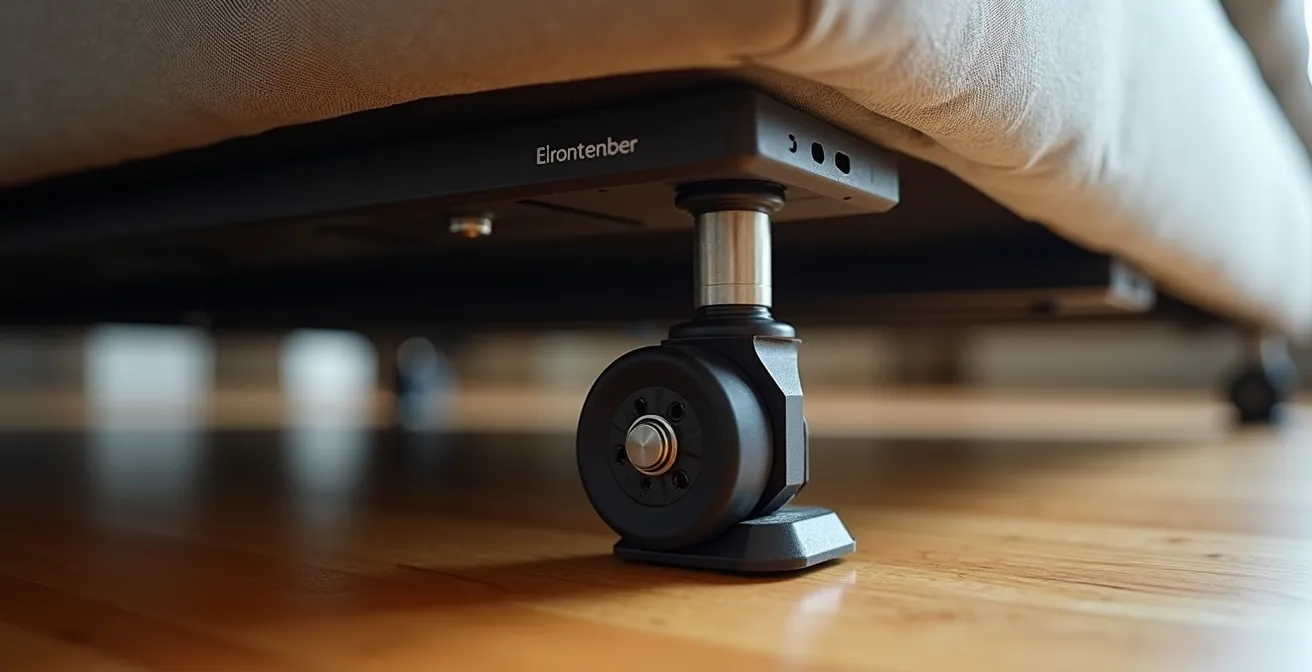
As the diagram above illustrates, the engineering is in the details. These components are designed for thousands of cycles without failure or damage. They transform the daily chore of making your bed into a quick, satisfying, and silent process. The difference between a quality mechanism and a cheap one is the difference between a 10-second glide and a 2-minute struggle that ends with a new scratch on your floor.
The following table breaks down the common systems and their real-world performance for daily use, highlighting why investing in a superior mechanism is critical for both convenience and preserving your home.
| Protection System | Floor Safety | Ease of Movement | Durability |
|---|---|---|---|
| Rubber Caster Cups | Excellent – No scratches | Static – Manual lifting required | 5+ years |
| Recessed Wheels | Excellent – Engage only when opening | Very Easy – Glides smoothly | 10+ years |
| Standard Plastic Wheels | Poor – Can scratch hardwood | Easy – But noisy | 2-3 years |
| Felt Pads | Good – Soft on floors | Moderate – Some resistance | 1-2 years (need replacement) |
Click-Clack or Pull-Out: Which Mechanism Lasts Longer for Daily Use?
The debate between “click-clack” and “pull-out” mechanisms is often misleading. The question isn’t which type is better, but how well-built that type is. For daily use, the longevity of the mechanism is paramount, and this is almost always tied to the quality of a pull-out system designed for permanent sleeping.
Click-clack mechanisms, where the sofa back clicks down to become flat, are mechanically simple. However, their frames and hinges are often a weak point, designed for occasional guest use. The stress is concentrated on a few pivot points, and the mattress is inseparable from the seating cushions, meaning wear and tear from sitting directly impacts your sleeping surface. In contrast, a high-quality pull-out mechanism unfolds a separate, dedicated mattress from within the sofa’s frame. This separation is crucial for durability.
As the design experts at FLOVED note, there’s a clear distinction in the market. In their European Furniture Guide, they state:
The high quality and high-quality features of a sofa bed or a permanent sleeper set it apart from an ordinary sofa bed that is only intended for occasional use
– FLOVED Design Team, FLOVED European Furniture Guide
Top-tier pull-out systems feature welded steel frames, not screwed-together components. They often incorporate features from the hospitality industry, which demands extreme durability. For example, some premium models use double-sided mattresses that can be flipped and rotated to drastically extend their lifespan. This feature is so effective that in the commercial sector, double-sided polyurethane foam mattresses accounted for 42% of total unit sales in 2024, a testament to their long-term value. When you buy a daily sleeper, you are buying a bed that happens to fold into a sofa, not the other way around.
The Upholstery Mistake That Makes Convertible Sofas Look Old Fast
A sofa bed used daily endures twice the wear of normal furniture. It’s a sofa surface by day and a bed frame by night. The upholstery isn’t just a decorative choice; it’s a high-performance material that must resist abrasion, stretching, and stains from two different contexts. The most common mistake is choosing a fabric based on color or initial softness while ignoring its technical durability ratings.
Look for fabrics engineered for high-traffic environments. This includes tightly woven “performance” velvets, which resist crushing, or high-quality synthetic blends. For example, some innovative brands use fabrics made of 90% recycled polyester and 10% nylon, a composition that offers the softness of a textile with the resilience of sportswear. These materials are often treated to be water-resistant and have high anti-pilling ratings, preventing the formation of small, unsightly bobbles of fiber that make a sofa look worn out.
Another critical feature is the ability to clean the fabric easily. In a small space where you eat, work, and sleep, spills are inevitable. The best sofa beds for daily use feature removable, machine-washable covers. This simple feature can be the difference between a sofa that looks fresh for years and one that’s permanently marked by a single coffee spill. Finally, inspect the seams. Look for double-stitching or flat-felled seams, especially at stress points like corners and cushion edges, which indicate superior construction.
Your Action Plan: Fabric Durability Checklist
- Choose tightly woven performance velvets or high-quality polyester/acrylic blends.
- Verify there is a water-resistant treatment for easy cleaning of minor spills.
- Look for fabrics with an explicit anti-pilling certification or high abrasion rating.
- Check for removable and, ideally, machine-washable covers for deep cleaning.
- Ensure double-stitched or flat-felled seams are used at all major stress points.
Where to Store the Duvet: Solutions for Sofa Beds Without Storage Boxes
The sleekest, most comfortable sofa beds often sacrifice one key feature: a built-in storage compartment for bedding. While models with a storage chaise are practical, they are often bulky and may not fit in a true micro-apartment. So, where do the duvet, pillows, and sheets go every morning? The answer lies in thinking vertically and embracing multi-functional furniture.
Don’t let bedding clutter consume your precious floor space. The most effective strategy is to utilize your walls. A stylish set of wall-mounted shelves or a shallow cabinet installed above eye level can become a designated “linen closet.” Using decorative woven baskets or minimalist fabric boxes on these shelves keeps the bedding contained, dust-free, and aesthetically pleasing. It turns a practical necessity into a design element.
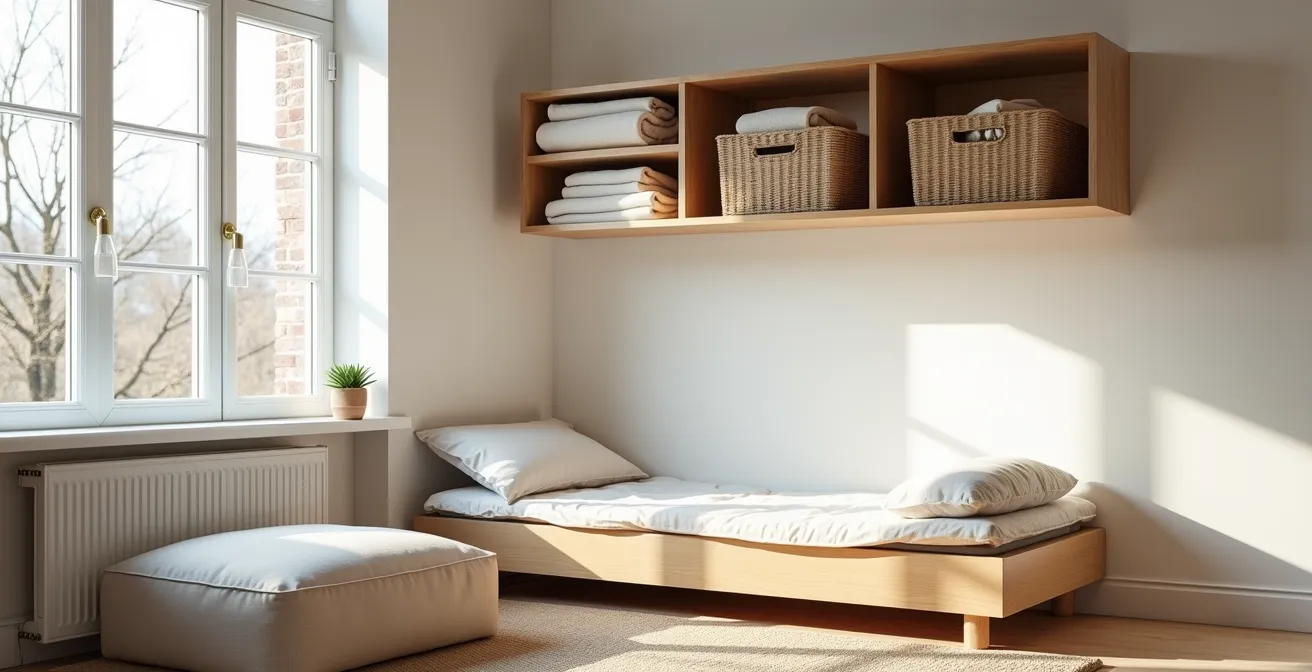
Beyond the walls, look for other storage opportunities hidden in plain sight. A hollow ottoman or a storage coffee table is a perfect dual-purpose item. It provides a surface or extra seating while secretly housing your entire bedding set. For maximum space-saving, vacuum storage bags can reduce the volume of a thick duvet by up to 75%, allowing it to be stored in a much smaller drawer or container. The key is to have a dedicated, easy-to-access spot for everything, making the morning conversion from bedroom to living room a quick and seamless routine.
Smart Watch vs Oura Ring: Which Actually Tracks REM Stages?
After investing in a high-quality sofa bed designed for orthopedic support, how can you be sure it’s actually improving your sleep? Subjective feelings of being “more rested” are a good start, but objective data provides concrete proof. This is where modern sleep trackers, whether a smartwatch or a device like the Oura Ring, become invaluable tools for validating your investment.
These devices go beyond simply logging sleep duration. They use a combination of heart rate sensors, accelerometers, and temperature sensors to estimate your sleep stages, including the crucial REM (Rapid Eye Movement) and Deep Sleep phases. While no consumer device is as accurate as a clinical polysomnography test, they are excellent at tracking trends. By tracking your sleep for a week on your old surface and then comparing it to a week on your new, high-density foam sofa bed, you can see the data for yourself.
You might notice a decrease in “time to fall asleep” (sleep latency), a reduction in restlessness or “wake-ups” during the night, and, most importantly, an increase in the percentage of time spent in restorative REM and Deep Sleep. This data-driven feedback loop is powerful. It moves your purchase from the realm of hope to the realm of a quantifiable health improvement. In fact, studies on guest comfort in hotels that upgraded their mattresses showed a measurable 19% improvement in sleep satisfaction, a metric directly tied to these sleep quality indicators. Both smartwatches and rings can effectively track these trends, with the primary difference being form factor and comfort during sleep.
What to Put Under the Stairs: Turning Dead Space into a Wardrobe
Optimizing a micro-apartment is a game of inches. Once you’ve solved the sleep-and-seating dilemma with the right sofa bed, the next frontier is conquering “dead space.” The most common offender is the awkward, triangular void under a staircase in a loft or duplex studio. Instead of letting it gather dust, this space can be transformed into a highly efficient storage hub, perfectly complementing your new, clutter-free lifestyle.
Custom-built pull-out drawers are the most elegant solution. Designed to match the angle of the stairs, these deep drawers can act as a full-sized wardrobe, housing clothes, shoes, and even the vacuum-packed duvet we discussed earlier. To ensure longevity and protect your belongings, it’s crucial to install ventilated drawer systems to prevent moisture buildup and to consider adding cedar lining for natural freshness. Labeling each drawer makes the morning routine effortless.
While under-stair solutions are ideal, they are just one piece of a broader storage strategy. A truly optimized small space uses a variety of methods to keep floors clear. The table below compares different storage types, illustrating how a combination of approaches can create a comprehensive system.
| Storage Type | Space Efficiency | Accessibility | Cost Range |
|---|---|---|---|
| Under-stair drawers | Excellent – Uses dead space | Easy – Pull-out access | $300-800 |
| Wall-mounted cabinets | Very Good – No floor space | Moderate – Need step stool | $150-400 |
| Hollow furniture | Good – Dual purpose | Very Easy – At hand level | $200-600 |
| Ceiling storage | Excellent – Zero footprint | Difficult – Ladder required | $100-300 |
To maximize this specific space, follow a clear plan:
- Measure the exact dimensions of your under-stair space, including the angle.
- Install ventilated drawer systems or shelving to ensure air circulation.
- Add cedar lining or blocks for natural moth deterrence and freshness.
- Label each drawer or bin for quick identification of contents.
- Designate one oversized, deep drawer specifically for bulky items like the duvet and pillows.
Key Takeaways
- Sofa bed longevity depends on a mattress foam density of at least 2.5 PCF to prevent sagging and back pain.
- A quality opening mechanism with a welded steel frame and recessed rubber wheels is crucial for daily, effortless use without floor damage.
- Choose performance fabrics with high abrasion ratings and removable covers, treating the upholstery as a technical component, not just a style choice.
How to Build a Mezzanine in a Small Loft Without Breaking Building Codes?
For the ultimate micro-apartment optimization, we move from optimizing furniture to optimizing the very volume of the space: building a mezzanine. This is the “Phase Two” of small-space living, a project made possible by the “Phase One” investment in a compact, efficient, and high-quality convertible sofa. A mezzanine can nearly double your usable living area, creating a dedicated sleep loft and freeing the entire ground floor to be a pure living, dining, and working space.
However, this is a structural project governed by strict building codes regarding ceiling height, load-bearing capacity, and staircase safety. It’s not a DIY weekend project. You must consult a structural engineer or architect to ensure your plan is safe and legal. They will assess the building’s existing structure and design a mezzanine that meets local requirements for things like minimum headroom (both above and below the mezzanine) and railing height.
This is where your initial smart choices pay off. As one case study on long-term value noted, “Investing in a high-quality sofa bed is a smart choice for long-term value and convenience… These durable sofa beds feature robust mechanisms and are crafted for daily use, ensuring lasting reliability.” By starting with a premium sleeper, you ensure your ground floor remains fully functional and comfortable during the planning and construction of the mezzanine. The sofa bed becomes the flexible core of the home, adapting as the space evolves. The IKEA Design Team perfectly captures this philosophy:
A sleeper sofa can not only transform itself, but also the room it’s in. Shifting your living room to bedroom in a few simple steps is a superb hack for space-efficiency and flexibility
– IKEA Design Team, IKEA Sleeper Sofa Collection Guide
The journey to a perfectly optimized micro-loft is a phased one. It begins not with a hammer, but with a smart furniture choice that provides immediate comfort and future flexibility.
Armed with this ergonomic knowledge, you can now analyze any sofa bed not for its showroom appeal, but for its engineering performance. Start your search by demanding the technical specifications from retailers—your back, your floors, and your future self will thank you.
Frequently Asked Questions About Daily-Use Sofa Beds
Can I use vacuum storage bags for daily duvet storage?
Yes, vacuum bags can reduce duvet volume by 50-75%, making them ideal for small spaces. For daily use, it’s best to choose high-quality bags with reinforced seams and a durable valve system to withstand repeated compression and decompression.
What’s the best height for wall-mounted bedding storage?
As a general rule, install shelving or cabinets for bedding between 6 and 7 feet (approximately 1.8 to 2.1 meters) high. This maximizes the usable vertical space in your room without interfering with headroom, while keeping the items accessible with a small, foldable step stool.
How can I prevent a musty smell in stored bedding?
To prevent musty odors, ensure your bedding is completely dry before storing it. Use breathable storage containers like canvas bags or woven baskets rather than airtight plastic bins for long-term freshness. Adding natural moisture absorbers like silica gel packets or cedar blocks can also help maintain a fresh, clean scent.