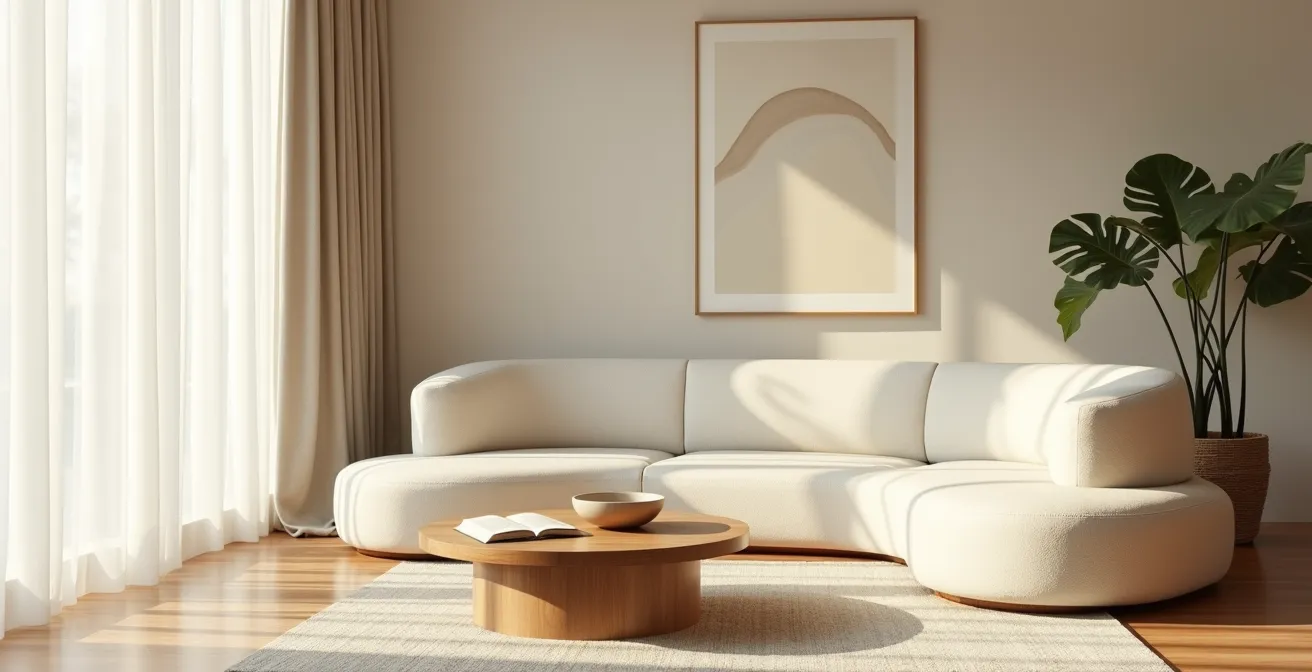
A truly calming home isn’t about having less, but about scientifically reducing your brain’s cognitive load.
- Visual clutter directly elevates cortisol, the body’s primary stress hormone, creating a state of chronic, low-level anxiety.
- Curved furniture and soft textures are neurologically processed as safer and more welcoming than sharp, angular designs.
Recommendation: Begin by redesigning one small corner of your home not just for how it looks, but for how it makes your brain *feel*.
Does your home feel more like a second office than a sanctuary? For many busy professionals, the line between work and rest has blurred, and the home environment, instead of offering refuge, often adds to the feeling of being overwhelmed. You’ve likely heard the usual advice: “Just declutter!” or “Paint everything white.” While well-intentioned, these tips only scratch the surface of a much deeper connection between our surroundings and our mental state.
The constant visual noise of a disorganized space, the subtle stress from poor lighting, or even the shape of your furniture can actively contribute to mental fatigue. This isn’t just a feeling; it’s a neurological reality. The visual chaos demands constant, subconscious processing from your brain, draining your cognitive resources and leaving you feeling depleted before you’ve even started your day.
But what if the key wasn’t just aesthetic, but scientific? This guide moves beyond simple minimalism to explore neuro-architecture—the science of how our spaces impact our brains. We will uncover how to transform your home from a source of cognitive overload into an environment engineered for calm and focus. This isn’t about creating a sterile, empty box; it’s about making intentional design choices that work with your brain’s natural tendencies, not against them.
We’ll explore how to choose calming colors scientifically, why furniture shape matters for psychological flow, how to create coziness without clutter, and even how elements like thermal comfort and plant life contribute to your mental peace. By the end, you’ll have a blueprint for a home that is not only beautiful and minimalist but also a powerful tool for reducing anxiety.
This article provides a structured path to understanding and implementing these principles in your own home. Explore the sections below to build your sanctuary, one scientifically-backed step at a time.
Summary: A Blueprint for a Calmer, Minimalist Home
- Why a Cluttered Coffee Table Is Secretly Spiking Your Stress Levels?
- How to Choose “Greige” Paints That Don’t Look Cold or Sterling?
- Curved Furniture or Sharp Angles: Which Layout Promotes Better Flow?
- The Sterile Trap: How to Be Modern Without Losing Coziness?
- Where to Hide the Mess: Designing “Drop Zones” That Are Invisible
- How to Meditate for 2 Minutes at Your Desk Without Anyone Knowing?
- Why “Water Once a Week” Is a Lie That Kills Your Ferns?
- How to Stop Drafts and Improve Thermal Comfort in an Old House?
Why a Cluttered Coffee Table Is Secretly Spiking Your Stress Levels?
A cluttered coffee table, or any messy surface, spikes your stress because your brain perceives every object as a potential task, a decision to be made, or a piece of information to process. This creates a constant, low-level state of cognitive overload. Your mind is unable to fully rest because it’s subconsciously cataloging the pile of mail, the remote controls, and the stack of magazines. Each item is a micro-interruption, a tiny drain on your mental energy that accumulates throughout the day.
This isn’t just a subjective feeling; it’s a measurable physiological response. Groundbreaking research from UCLA’s Center on Everyday Lives of Families revealed a direct link between clutter and stress. The study found that women living in cluttered homes showed consistently elevated levels of cortisol, the body’s primary stress hormone. This chronic elevation can lead to a host of negative health effects, including increased anxiety and difficulty concentrating.
Furthermore, clutter forces your brain into a state of continuous partial attention. You can’t fully engage with a book, a conversation, or even a moment of quiet thought because your visual field is saturated with unfinished business. Researchers at the University of Minnesota found that people in a clean, organized workspace were twice as likely to make healthier choices and be more generous. A tidy environment doesn’t just look better; it frees up precious cognitive resources, allowing for better decision-making and a more profound sense of calm.
How to Choose “Greige” Paints That Don’t Look Cold or Sterling?
“Greige”—a sophisticated blend of grey and beige—is a minimalist’s dream, but choosing the wrong shade can turn a potential sanctuary into a cold, uninviting space. The secret to success lies in understanding and controlling its undertones. A greige can lean cool (with green, blue, or violet undertones) or warm (with yellow, red, or orange undertones). A cool-toned greige in a north-facing room with little natural light will feel sterile, while a warm-toned greige will create a cozy, enveloping atmosphere.
To avoid the sterile trap, you must test colors within the actual context of your space. The same paint color can look dramatically different depending on the light it receives throughout the day. A swatch that looks perfectly warm and inviting under the yellow-hued lights of a hardware store may appear harsh and grey in the cool blue light of a morning sun. Ignoring light temperature is the most common mistake in color selection.
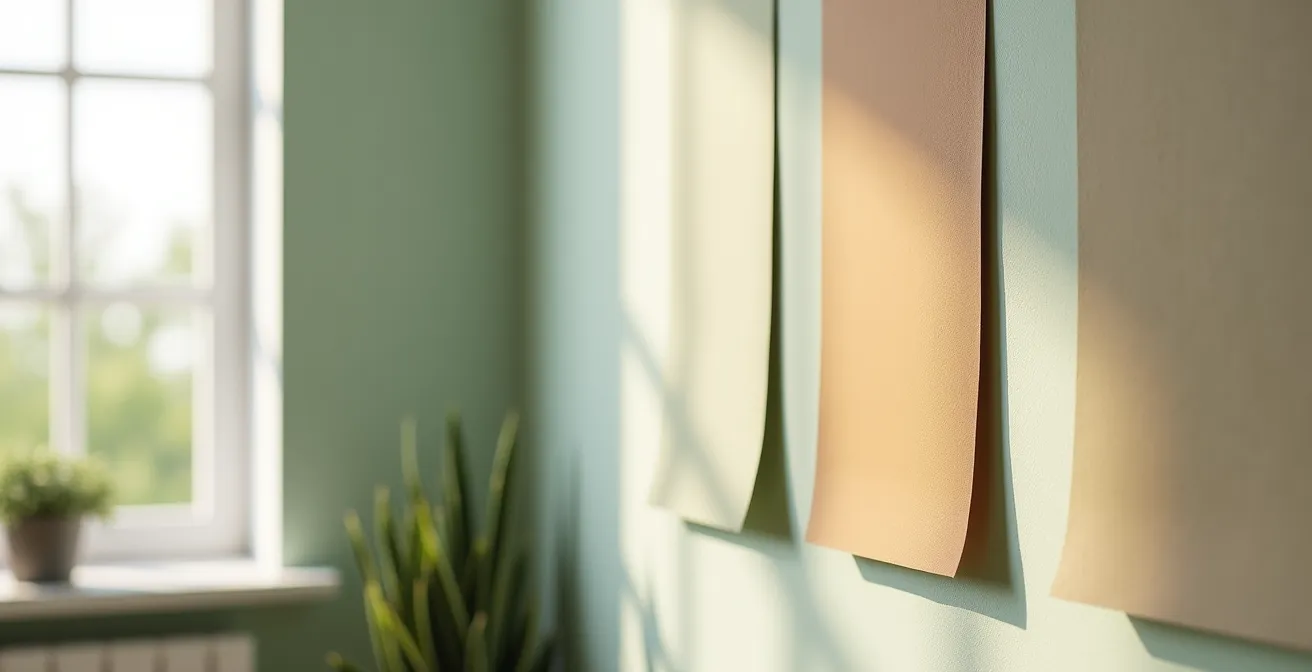
As the illustration demonstrates, observing how light interacts with the undertones is critical. A scientific approach to testing is the only way to guarantee the color you choose is the color you will live with. Don’t rely on tiny paint chips; paint large sample boards and move them around the room at different times of the day to see how they perform.
Action Plan: The Three-Light Temperature Test
- Test in morning light (cool, ~6500K) to see if unwanted cool undertones become too prominent.
- Check at midday (neutral, ~5000K) to evaluate the paint’s true base color without heavy color casting.
- Evaluate in the evening with your artificial lights on (warm, ~2700K) to ensure it retains its warmth and doesn’t look muddy.
- Paint samples on at least two different walls (e.g., one that gets direct light and one that doesn’t) to account for varying exposures.
- Pair your final test swatches with fabric and wood samples from your furniture to ensure a harmonious palette.
Curved Furniture or Sharp Angles: Which Layout Promotes Better Flow?
From a neuroaesthetic perspective, our brains are hardwired to perceive sharp angles and pointed objects as potential threats on a primal level. This can trigger a subtle, subconscious state of alertness or anxiety. In contrast, curved lines and rounded forms are processed as soft, safe, and welcoming. This is why a room filled with curved furniture inherently promotes a better sense of psychological flow and relaxation.
As Jaye Anna Mize, a leader in the field of design neuroscience, explains in Home Accents Today:
“When it comes to inclusivity (taking into account the needs of the neurodivergent, for example), it’s been discovered that curves, rather than hard angles, can be comforting… the gentler, softer approach of curves tends to make people feel more comfortable”
– Jaye Anna Mize, Home Accents Today – The Neuroscience Behind Interior Design
This preference is backed by data. A growing body of neuroaesthetics research demonstrates that spaces incorporating curved lines, balanced negative space, and natural materials are shown to lower cortisol levels. A round coffee table, a sofa with soft, sloping arms, or an arched doorway can literally calm your nervous system more effectively than their sharp-cornered counterparts.
This doesn’t mean you must eliminate all straight lines. The goal is balance. Angular forms are excellent for defining zones and directing focus, making them suitable for work areas. However, in spaces designed for rest and social connection, prioritizing curves creates an environment of effortless comfort. The following table breaks down the neurological impact.
| Furniture Type | Neurological Response | Best Use Case |
|---|---|---|
| Sharp Angles | Activates alertness, can trigger subtle stress response | Work zones, focus areas |
| Curved Forms | Reduces cortisol, promotes relaxation | Social spaces, relaxation areas |
| Mixed Approach | Balanced stimulation and calm | Multi-functional living spaces |
The Sterile Trap: How to Be Modern Without Losing Coziness?
A common pitfall of minimalist design is the “sterile trap,” where a commitment to reducing clutter results in a space that feels cold, empty, and devoid of personality. This happens when minimalism is interpreted only as a visual subtraction. True coziness, however, is a multi-sensory experience. To be modern without losing that essential feeling of warmth, you must engage the other senses: touch, sound, and even smell.
The key is to introduce textural variety and sensory layers. A room can be visually simple but feel rich and complex. Imagine a space with clean lines, but the sofa is upholstered in a soft wool bouclé, the floor has a plush rug underfoot, and a linen throw is draped over a chair. These textures invite touch and create a sense of physical comfort that a purely visual minimalism lacks. This sensory input signals safety and comfort to our brains.

Lighting and acoustics are also critical. A single, harsh overhead light creates a flat, unwelcoming environment. Layering light with at least three sources—ambient (overall illumination), task (for reading), and accent (to highlight art or texture)—creates depth and mood. Similarly, hard surfaces everywhere can create an echo chamber that feels unsettling. Soft materials like felt panels, curtains, and rugs absorb sound, creating an acoustic softness that is deeply calming.
- Install felt acoustic panels in neutral tones to absorb sound without adding visual clutter.
- Layer lighting with 3 sources: a soft ambient light below 2700K, a focused task light, and a subtle accent light.
- Choose one signature, natural scent for the entire home, like cedarwood or sandalwood, to create a consistent olfactory identity.
- Incorporate a rich variety of natural textures: wool, linen, raw wood, and stone to stimulate the sense of touch.
- Use dimmers on all light sources to control the mood and adapt the space’s energy throughout the day.
Where to Hide the Mess: Designing “Drop Zones” That Are Invisible
Even the most dedicated minimalist has to contend with the daily influx of keys, mail, wallets, and phones. Without a designated system, these items inevitably create clutter on the first available surface, usually the kitchen counter or dining table, sabotaging your calm environment. The solution is to design an intentional “drop zone”—a specific, contained area right at the entrance of your home designed to catch this daily detritus.
The power of a drop zone is rooted in the psychology of transitions. Your arrival home is a critical moment for down-regulating from the stress of the outside world. As research on home environments has found, people experience lower stress levels if they enter a clutter-free space. An effective drop zone acts as a buffer, preventing the chaos of the day from spilling into your sanctuary.
However, a drop zone must not become a new source of visual clutter. The goal is to make it invisible or aesthetically pleasing. This means moving beyond a simple bowl on a table. An “invisible” drop zone integrates storage into furniture or architectural elements. A floating console with a drawer, a stylish cabinet, or even a beautiful closed basket allows you to immediately put items out of sight. This “one-touch” system is crucial: you handle each item once by placing it in its designated spot, freeing your mind from the burden of seeing it.
- Install a slim, wall-mounted floating console with a drawer near the entrance for keys and wallets.
- Place a beautiful lidded basket or a decorative box on a bench to conceal unsorted mail, with a label inside that says “To Process.”
- Create a dedicated charging station inside a cabinet drawer to hide the visual clutter of devices and cables.
- Add sleek, modern hooks to the inside of a coat closet door for frequently used bags and scarves.
- Schedule a weekly 15-minute “drop zone reset” in your calendar to sort, file, and clear out the accumulated items.
How to Meditate for 2 Minutes at Your Desk Without Anyone Knowing?
Reducing anxiety isn’t just about controlling your physical space; it’s about creating pockets of mental quiet within your day. The workplace, often a source of high stress and overstimulation, is precisely where these micro-breaks are most needed. You don’t need a special room or a long session; a two-minute, discreet meditation at your desk can be enough to reset your nervous system. The key is to use subtle anchors for your attention that are invisible to those around you.
Your immediate visual field plays a significant role in this. Even small adjustments can help create a calmer micro-environment. As neuroaesthetics research shows that specific colors can reduce anxiety, with a particular focus on the calming effects of blues and greens. Placing one small, simple object in these hues—like a small succulent or even changing your desktop background to a serene landscape—can provide a soft, non-demanding focal point for your eyes.
The goal of a desk meditation is not to achieve a deep trance but to briefly disconnect from the relentless flow of input. It’s about shifting from external chaos to internal awareness, even for just 120 seconds. This practice of “mental minimalism” trains your brain to find calm amidst the noise, a skill that is invaluable for any busy professional. The following techniques can be performed without anyone noticing you are doing anything other than taking a brief pause from your work.
- Place a smooth stone or a small wooden sphere in your desk drawer. During a stressful moment, you can reach in and use it as a tactile anchor, focusing on its temperature and texture.
- Position one small, simple succulent at your eye level to serve as a soft, natural focal point.
- Practice the 4-7-8 breathing technique: inhale for 4 seconds, hold for 7, and exhale for 8, all while appearing to simply read a document on your screen.
- Set a subtle 2-minute timer to vibrate on your phone or smartwatch, creating a clear boundary for your meditation without an audible alarm.
- Use a keyboard shortcut to instantly minimize all open windows, giving your eyes and brain a momentary blank slate to rest upon.
Why “Water Once a Week” Is a Lie That Kills Your Ferns?
The generic advice to “water your plants once a week” is a lie that turns a potential source of calm into another source of failure and anxiety. This one-size-fits-all rule ignores the fundamental needs of the plant, especially sensitive ones like ferns. It fails because it’s based on an arbitrary human schedule, not the plant’s actual environment—light, humidity, soil type, and season all dictate a plant’s thirst. A dying plant in a minimalist home becomes another piece of visual clutter, a symbol of something you’ve failed to care for.
The true benefit of having plants in a calming interior, a practice known as biophilic design, comes not just from their presence, but from the mindful interaction with them. As The Spaces magazine notes, studies confirm that “interaction with indoor greenery can reduce physiological and psychological stress.” When you learn to care for a plant properly—by checking the soil’s moisture with your finger, observing the leaves, and responding to its real needs—you engage in a mindful, grounding practice. It forces you to slow down and connect with a natural rhythm.
The positive impact of biophilia is profound. Studies on hospital interior spaces found that the inclusion of natural elements like green plants significantly reduced patient stress and increased pain tolerance. To truly benefit, you must abandon the rigid, false rule. Instead, learn the language of your fern. They typically prefer consistently moist (but not soggy) soil. This might mean watering a small amount every few days, not a large soak once a week. The goal is to create a stable, nurturing environment, and the act of creating it is, in itself, a stress-reducing therapy.
Key Takeaways
- Your brain perceives visual clutter as unfinished tasks, which directly increases the stress hormone cortisol.
- Curved shapes, soft textures, and layered lighting are neurologically interpreted as “safe,” promoting relaxation.
- True minimalism is multi-sensory; engaging touch and sound is essential to avoid a sterile environment.
How to Stop Drafts and Improve Thermal Comfort in an Old House?
In the pursuit of a calm interior, thermal comfort is a silent but powerful factor. An unpredictable cold draft is a subtle, persistent physical stressor. It puts your body on a low-level alert, preventing you from fully relaxing. In an older house, where drafts are common, achieving a sense of “thermal security”—a stable, predictable temperature—is a crucial and often overlooked aspect of neuro-architecture. You cannot feel truly at peace if your body is subconsciously fighting off cold spots.
The challenge in a minimalist design is to address these drafts without adding visual clutter, such as bulky plastic window coverings or unsightly foam tape. The solution lies in choosing materials that are both functional and aesthetically aligned with your modern decor. The goal is to integrate draft-proofing so seamlessly that it enhances the design rather than detracts from it.
For example, instead of a garish novelty draft snake, choose one made of a heavy, neutral-colored wool or linen that adds a touch of cozy texture to the base of a door. Modern thermal curtains, available in beautiful, simple weaves, can block a significant amount of cold air while adding a layer of acoustic softness to the room. For windows where you want to maintain a clean line, nearly invisible transparent insulation films can be applied directly to the glass. These solutions prove that practical comfort and minimalist aesthetics can coexist beautifully.
The following comparison, based on findings from design sources like HGTV, outlines solutions that balance effectiveness with design integrity. As shown in the analysis of design-focused anxiety reduction techniques, the right choice depends on balancing visual impact with performance.
| Solution | Aesthetic Impact | Effectiveness |
|---|---|---|
| Wool Draft Snakes | Adds texture, neutral colors blend with minimalist decor | Reduces drafts by 60-70% |
| Transparent Window Films | Invisible, maintains clean lines | Improves insulation by 40% |
| Thermal Curtains | Can enhance design if chosen in complementary neutrals | Blocks 85% of cold air |
Ready to transform your space into a true sanctuary? Begin by identifying the single biggest source of visual or physical stress in your main living area and apply one of the targeted solutions from this guide today.