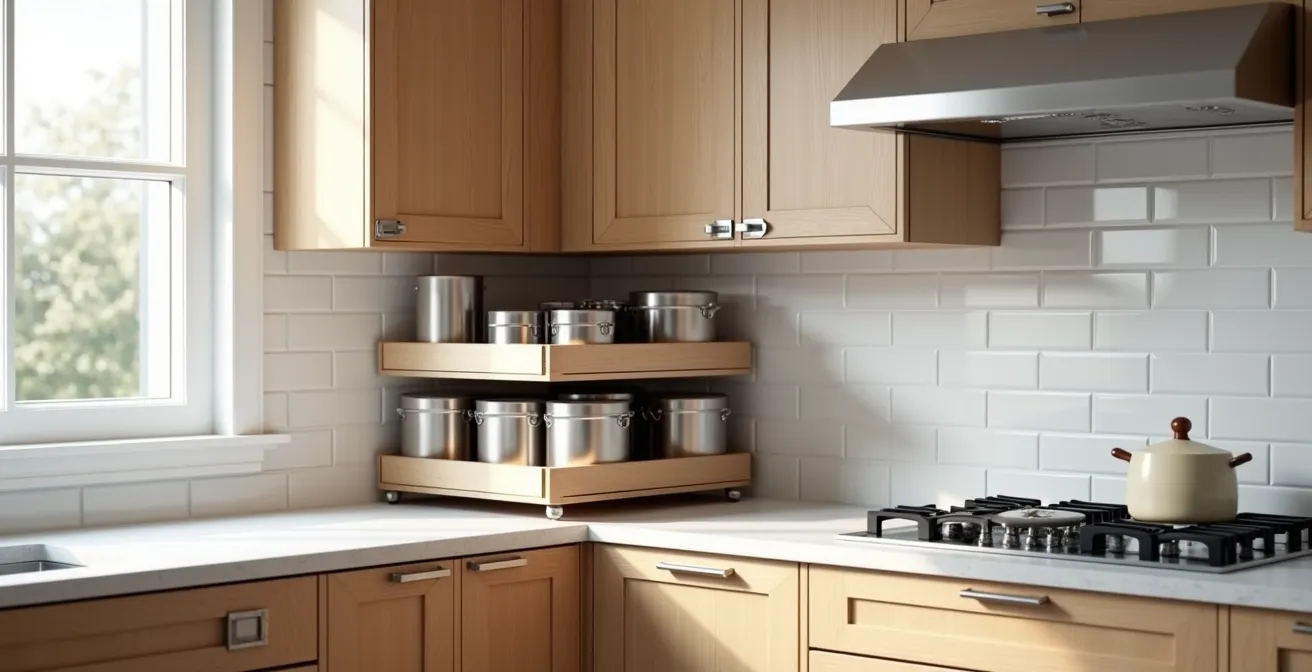
The true value of custom corner cabinets isn’t just filling a gap; it’s engineered precision that doubles functional storage and outlasts stock options by decades.
- Focus on mechanism quality (like Blum or Hettich) over simple aesthetics for long-term reliability.
- Choose materials like marine-grade plywood for their superior moisture resistance and structural integrity.
Recommendation: Audit any potential cabinet by its joinery and hardware, not its price tag. A well-built corner is an investment, not an expense.
Every kitchen has one: the awkward, cavernous corner cabinet. It’s the graveyard for forgotten wedding gifts and appliances you swear you’ll use one day. Homeowners often see it as a lost cause, a black hole of wasted potential. The common advice is to throw in a spinning shelf or simply accept the dead space as an unfortunate quirk of kitchen geometry. These solutions, however, are mere bandages on a design flaw.
The standard approach focuses on accessories, treating the corner as a problem to be mitigated. But a true craftsman sees it differently. The secret isn’t what you put *in* the corner, but how the cabinet itself is conceived, built, and integrated into the kitchen as a whole. It’s a question of engineering, material science, and an obsession with millimeters. The difference between a cheap fix and a bespoke solution is the difference between fighting with your space and making it work flawlessly for you.
This guide abandons the superficial fixes. Instead, we will adopt a joiner’s mindset, focusing on the structural and mechanical principles that transform a frustrating corner into the most efficient storage space in your kitchen. We will explore why the right materials and joinery are non-negotiable, how to select mechanisms built for a lifetime of use, and how to spot the subtle design errors that betray a lack of true craftsmanship. This is about reclaiming every inch of your kitchen with precision-built utility.
To navigate this detailed approach, the following sections break down the essential considerations for designing custom corner cabinetry that is both beautiful and exceptionally functional. This structure will guide you from understanding true cost versus value to mastering the finer points of material selection and installation.
Contents : A Joiner’s Blueprint for Perfect Kitchen Corners
- Why Custom Cabinets Cost 40% More Than Stock but Double Your Storage?
- How to Use “Magic Corners” to Access Dead Space in Deep Cabinets?
- MDF vs Plywood: Which Cabinet Material Survives a Water Leak?
- The “Filler Strip” Error That Makes Custom Kitchens Look Cheap
- How to Extend Cabinets to the Ceiling Without Creating a Claustrophobic Feel?
- Glue or Screws: Which Product Design Feature signals a Longer Lifespan?
- Why Personal Photos on Walls Drive Down Your Offer Price?
- How to Eat Organic on a Budget Without Doubling Your Grocery Bill?
Why Custom Cabinets Cost 40% More Than Stock but Double Your Storage?
The initial sticker shock of custom cabinetry can be daunting. It’s not just about paying for a different size; you are investing in a fundamentally different product. Stock cabinets are mass-produced to average dimensions, using materials and joinery optimized for low cost, not longevity. The result is often wasted space in the form of wide filler strips and inefficient internal layouts. A custom solution, by contrast, is built to the exact millimeter of your space. There are no “standard” sizes, only your sizes.
This precision allows for the complete elimination of dead space. Where a stock layout might leave a 10cm gap, a custom cabinet extends fully, translating to significant gains in usable volume. Furthermore, the cost reflects superior materials, robust hardware, and skilled labor. A joiner builds a cabinet box with structural integrity, designed to support heavy loads and withstand decades of use. This focus on quality is not just an aesthetic choice; it’s a financial one. Well-executed custom work delivers a tangible return on investment of 60% to 80% during a home sale.
Ultimately, the 40% premium isn’t for the cabinet itself, but for the perfect fit and the doubled utility. You are paying to transform a non-functional void into a highly efficient, fully accessible storage unit. It’s an investment in solving a problem permanently, rather than just covering it up with a flimsy, off-the-shelf compromise.
How to Use “Magic Corners” to Access Dead Space in Deep Cabinets?
The term “Magic Corner” refers to a range of pull-out mechanisms designed to make the entire contents of a blind corner cabinet accessible. Unlike a simple Lazy Susan that only utilizes the central space, these systems use a series of articulated shelves that slide out of the cabinet opening, bringing the items from the deep, “dead” zone directly to you. This is true engineering, designed to conquer the geometry of the corner.
The key to selecting the right mechanism is not its appearance, but its functional load capacity and smoothness of operation. A quality system, often from German or Austrian manufacturers like Hettich or Blum, will feature robust ball-bearing slides and soft-close dampers. This ensures that even when fully loaded with heavy pots or appliances, the movement is silent and effortless. The integrated lighting seen in premium models further enhances usability, ensuring no item is ever lost in the shadows.
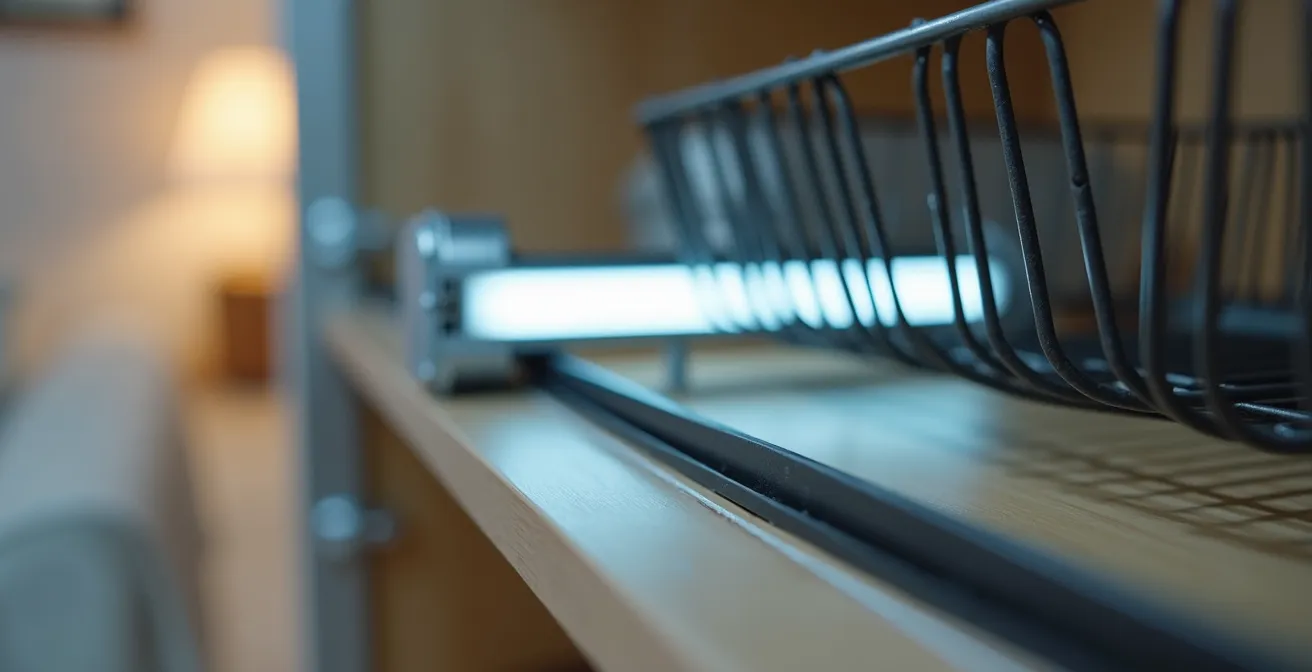
Choosing the right model depends entirely on your specific storage needs. A generic recommendation is useless; the choice must be purpose-driven.
- For The Avid Baker: You need to store a heavy stand mixer and large bowls. Choose robust mechanisms with a 20kg+ weight capacity per shelf, like the Hettich Magic Corner.
- For Small Appliance Collectors: Your collection of blenders, juicers, and food processors needs organization. Select compartmentalized systems with multiple tiers to keep everything visible and accessible.
- For The Down-Sizer: Accessibility is paramount. Install drawer-style pull-outs at a comfortable height to completely eliminate the need for bending and reaching into a deep cabinet.
- For Heavy Cookware: Cast iron skillets and Dutch ovens demand the most durable hardware. Opt for a system with a top-tier weight rating, such as the Blum Space Corner which can support up to 65kg.
MDF vs Plywood: Which Cabinet Material Survives a Water Leak?
The choice of material for cabinet carcasses is one of the most critical decisions in custom kitchen design, yet it’s often overlooked. While Medium-Density Fiberboard (MDF) offers a smooth, stable surface perfect for painted finishes, its core weakness is its reaction to moisture. Made of compressed wood fibers and resin, MDF acts like a sponge when exposed to water. A minor leak from a sink or dishwasher can cause it to swell, warp, and disintegrate, rendering the cabinet structurally useless.
Plywood, on the other hand, is constructed from thin layers of wood veneer (plies) glued together with alternating grain directions. This cross-graining gives it superior structural strength and, most importantly, far greater resistance to moisture. While not entirely waterproof, plywood will withstand exposure to water for much longer than MDF without swelling or losing its integrity. For a high-risk area like a kitchen sink base or corner unit, using marine-grade plywood provides the ultimate peace of mind. It’s a choice for longevity, ensuring that a small plumbing issue doesn’t turn into a catastrophic cabinet failure. While the initial cost is higher, the durability justifies the investment, especially when aiming for the maximum lifespan. Indeed, according to professionals, newly installed kitchen cabinets will last around 50 years if built with quality materials.
The following table from a recent analysis provides a clear breakdown of how these common materials stack up against each other in terms of cost, durability, and lifespan.
| Material | Cost Range | Moisture Resistance | Lifespan |
|---|---|---|---|
| Plywood | $8,000-$12,000 | Excellent | 25-30 years |
| MDF | $6,000-$9,000 | Fair | 15-20 years |
| Particleboard | $4,000-$6,000 | Poor (swells when wet) | 10-15 years |
The “Filler Strip” Error That Makes Custom Kitchens Look Cheap
A filler strip is a piece of wood used to close a gap between a cabinet and a wall, or between two cabinets. In stock cabinetry, they are an unavoidable necessity, a clumsy patch to account for imprecise fits and standard sizing. In the world of custom joinery, however, an obvious, wide filler strip is a cardinal sin. It signals a failure in measurement and design, an admission that the cabinetry was not truly built for the space. It breaks the clean, continuous lines that define high-end kitchen design.
A true custom solution anticipates these junctions and designs them out from the start. Instead of adding a separate strip, a skilled joiner will build the cabinet with an extended stile—the vertical frame piece of the cabinet itself is made wider to perfectly meet the wall. The “filler” becomes an integral, seamless part of the cabinet structure. This requires precise on-site measurement and meticulous planning, but the result is a flawless, architectural look that screams quality.

Eliminating filler strips is not just about aesthetics; it’s about reclaiming every last millimeter of space and demonstrating a higher level of craftsmanship. There are several elegant solutions to achieve this:
- Use an extended stile on the cabinet frame itself, making the spacer an integral part of the cabinet structure.
- Design adjacent cabinets with handle-less or “J-pull” profiles to eliminate any issues of handles colliding at the corner.
- Install a decorative corner post that transforms the functional spacer into an intentional, handsome design element.
- Consider an accent filler in a contrasting material, like brushed metal in a wood kitchen, to create a deliberate and striking vertical line.
How to Extend Cabinets to the Ceiling Without Creating a Claustrophobic Feel?
Extending kitchen cabinets to the full height of the ceiling is a powerful design move. It maximizes vertical storage, eliminates the dust-collecting gap above the cabinets, and creates a clean, architectural line that can make a room feel taller and more stately. However, if executed poorly, a solid wall of cabinetry can feel heavy, monolithic, and overbearing, particularly in a smaller kitchen. The key is to create visual relief without sacrificing storage.
The most effective strategy is to treat the upper-most section of cabinetry differently from the lower sections. This creates a visual break and reduces the perceived mass of the units. One classic technique is to use glass-fronted doors for the top-tier cabinets. This not only showcases decorative items but also adds a sense of depth and reflectivity. Integrating subtle interior lighting within these glass cabinets can further enhance the effect, turning them into a design feature rather than just storage.
Another approach involves color and finish. A two-tone strategy, where the upper-most cabinets are finished in a lighter color than the base cabinets—or even a color that matches the ceiling—can make them visually recede. This tricks the eye into seeing them as part of the ceiling plane, not the cabinet wall. Finally, varying the depth of the cabinets can also help. By making the top-tier cabinets slightly shallower than the main wall cabinets, you create subtle shadow lines and prevent the imposing, flat-wall effect.
Glue or Screws: Which Product Design Feature signals a Longer Lifespan?
When inspecting the quality of a cabinet, homeowners often look at the finish or the hardware. A joiner, however, looks at the joints. The method used to assemble the cabinet box is the single most telling indicator of its structural integrity and expected lifespan. The debate isn’t simply “glue or screws”; it’s about the type of joinery those fasteners are supporting. The lowest grade of construction uses simple butt joints, where two pieces of wood are butted together and held with screws. This method is fast and cheap, but it offers very little mechanical strength and will loosen over time.
Superior craftsmanship relies on interlocking joinery. A dado joint, where a channel is cut in one piece of wood to receive another, creates a secure, mechanical lock that vastly increases the surface area for glue. This type of joint is inherently stronger and more stable than a butt joint. Even better is the dovetail joint, traditionally used for drawer boxes. Its interlocking pins and tails create an incredibly strong mechanical bond that is nearly impossible to pull apart. While screws may be used to clamp these joints while the glue sets, the strength comes from the precision of the woodwork itself.
High-quality custom cabinets with premium materials and tailored design can last 40+ years, and this longevity is directly tied to the quality of the joinery. When you see clean, tight-fitting dado or dovetail joints, you are looking at a product built with intent and skill, designed not just to be assembled, but to endure.
Inspector’s Checklist: Corner Cabinet Quality Assessment
- Pull the mechanism out: Check if the movement is smooth and silent. This indicates high-quality ball-bearing slides rather than cheap plastic rollers.
- Examine the joints: Look for the clean lines of dado or dovetail joints in the drawer boxes and cabinet carcass, a clear sign of quality over basic screwed butt joints.
- Assess the mechanism: Verify the brand names on the hardware. Seeing established names like Blum, Hettich, or Grass is a strong indicator of quality and reliability.
- Check the weight rating: Ask for the specifications. Quality mechanisms should support a minimum of 20kg (approx. 45 lbs) per shelf; premium ones can handle up to 65kg (140 lbs).
- Test the closing: A quality unit will feature a soft-close mechanism that engages smoothly in the last few centimeters of travel, preventing slamming and reducing wear.
Why Personal Photos on Walls Drive Down Your Offer Price?
When a potential buyer walks into a home, they are trying to do one thing: imagine themselves living there. Every element in the house either helps or hinders this mental projection. While family photos and personal memorabilia make a house a home for you, they act as a constant reminder to a buyer that they are a guest in someone else’s space. This creates a psychological barrier, preventing them from mentally “moving in” and connecting with the property on an emotional level.
This same principle applies, in a more subtle way, to the functional aspects of your home, like the kitchen. A well-designed kitchen with smart, efficient storage solutions invites a buyer to imagine their own life unfolding there. They can see where their pots will go, how they’ll organize their pantry, and how the space will work for them. It presents a vision of potential and possibility.
Conversely, a kitchen with obviously dysfunctional elements, like a chaotic and inaccessible corner cabinet, does the opposite. It doesn’t just waste space; it actively broadcasts the home’s limitations. It forces a potential buyer to think about the problems they would have to solve, the compromises they would have to make, and the money they would have to spend. Just as personal photos prevent an emotional connection, a poorly designed corner prevents a practical one. It breaks the illusion of a perfect, move-in-ready home and can directly impact a buyer’s perceived value of the property.
Key Takeaways
- Mechanism quality is paramount: A corner cabinet is only as good as its hardware. Prioritize smooth, high-capacity mechanisms from reputable brands.
- Plywood is the superior choice: For longevity and moisture resistance, especially near sinks, plywood offers far greater structural integrity than MDF or particleboard.
- Seamless integration is a sign of true craft: The absence of wide, obvious filler strips indicates a genuinely custom, precision-fit installation.
How to Eat Organic on a Budget Without Doubling Your Grocery Bill?
Successfully eating organic on a budget hinges on one core principle: minimize waste. This means buying in bulk when items are on sale and having a robust system for storing everything from root vegetables to grains and canned goods to maximize their shelf life. This is where your kitchen’s forgotten corners cease to be a problem and become a strategic asset. A well-designed corner cabinet can become the central hub of your food storage system, turning a dead zone into a highly organized, budget-saving pantry.
For bulk dry goods like flour, rice, and beans, a corner unit with a simple carousel or “Lazy Susan” mechanism is highly effective. These rotating shelves bring everything from the back to the front with a simple push, ensuring you can practice the “First In, First Out” (FIFO) method to use up older items before they expire. Carousel units, which rotate on a central pivot, are excellent for storing heavy-duty pots and pans but are equally adept at handling heavy bags of flour or large containers of grains.
For fresh produce, a custom corner solution can be designed to create the ideal storage environment. It’s about more than just shelves; it’s about creating specific zones for specific needs. By integrating smart storage features, you can dramatically extend the life of your organic produce, ensuring your investment doesn’t end up in the compost bin.
- Install slatted, ventilated drawers in a lower corner cabinet for onions, garlic, and potatoes to prevent moisture buildup and sprouting.
- Create a dark, solid-fronted section for storing winter squash or pumpkins, which helps extend their shelf life for months.
- Implement a multi-tier Lazy Susan specifically for your canned goods to easily see and rotate your stock.
- Add pull-out wire baskets for other root vegetables, ensuring proper air circulation all around them.
To transform your kitchen’s most challenging space, the next step is to consult a craftsman who thinks in terms of joinery, not just assembly. Assess your specific storage needs, from heavy appliances to delicate produce, and then seek out a solution built to last a lifetime.