
The belief that eight hours of sleep automatically guarantees mental clarity is a myth. For professionals and students battling brain fog, the true bottleneck isn’t sleep duration, but poor sleep architecture. This guide bypasses generic advice to reveal how you can actively engineer your REM sleep—the critical phase for memory consolidation—by strategically manipulating core body temperature, light exposure, and neural-calming techniques to finally wake up feeling sharp and restored.
You follow the rules. You get your eight hours, you avoid late-night coffee, and yet, you wake up feeling like your brain is running on low power. The memories from yesterday’s meeting are fuzzy, and learning new information feels like walking through mud. This frustrating experience is common for high-achievers, and it points to a misunderstanding of what sleep is for. It’s not just about turning off your brain; it’s about running critical software updates. While most sleep advice focuses on duration, it misses the most important factor for cognitive performance: sleep quality, and specifically, the architecture of your sleep stages.
About 20-25% of your night should be spent in Rapid Eye Movement (REM) sleep. This is not just “dream sleep”; it’s a vital neurological process where your brain consolidates memories, prunes irrelevant neural connections, and enhances learning. Feeling forgetful despite a full night in bed is a classic sign of REM deprivation. The issue isn’t that you aren’t sleeping enough, but that you are unknowingly sabotaging this crucial cycle with common habits related to light, temperature, and even your evening wind-down routine.
But what if you could stop accidentally disrupting your sleep and start actively engineering it? The key is to move beyond basic sleep hygiene and treat your sleep environment as a control panel for your biology. This isn’t about trying harder to sleep; it’s about providing your brain with the precise, non-negotiable signals it needs to initiate and sustain deep, restorative REM. This guide will provide a neuroscientist’s approach to sleep optimization, focusing on actionable protocols that leverage the mechanisms of your own brain.
We will deconstruct the most common REM saboteurs and provide a clear roadmap to enhance your sleep architecture. By understanding the ‘why’ behind each strategy, you can transform your sleep from a passive state of rest into an active tool for peak mental performance.
Summary: A Neuroscientist’s Guide to Unlocking REM Sleep
- Why One Glass of Wine Before Bed Kills Your REM Cycle?
- How to Set Your Bedroom Temperature to Promote Deep Dreaming?
- Smart Watch vs Oura Ring: Which Actually Tracks REM Stages?
- The Blue Light Mistake: Why Screens Delay Your REM Onset
- When to Wake Up: Using Sleep Cycle Alarms to Avoid Grogginess
- Why 6000K Light Bulbs in the Evening Are Ruining Your Melatonin Production?
- Why Eastbound Flights Are Harder on Your Body Than Westbound?
- How to Use Somatic Exercises for Instant Anxiety Relief?
Why One Glass of Wine Before Bed Kills Your REM Cycle?
That evening glass of wine might feel like a shortcut to relaxation, but from a neurological perspective, it’s a sledgehammer to your sleep architecture. Alcohol is a sedative, but sedation is not sleep. It acts as a potent suppressor of REM sleep, particularly in the first half of the night. As the liver metabolizes the alcohol, the body experiences a “rebound effect,” causing fragmented sleep and a surge of wakefulness in the early morning hours, precisely when you should be getting your longest, most restorative REM cycles. This fragmentation is why you can sleep for eight hours after drinking and still wake up feeling cognitively sluggish and unrefreshed.
The mechanism involves the disruption of neurotransmitters. Alcohol initially enhances the effect of GABA, the brain’s primary inhibitory neurotransmitter, which causes drowsiness. However, your brain quickly adapts, downregulating GABA receptors and upregulating glutamate, an excitatory neurotransmitter. This neurochemical seesaw leads to a shallow and unstable sleep state. Instead of seamlessly cycling through light, deep, and REM sleep, your brain is caught in a battle between sedation and arousal, with REM sleep being the primary casualty. Even a single drink can be enough to significantly derail this delicate process.
Fortunately, you can signal relaxation to your brain without resorting to chemicals that disrupt its essential work. The goal is to support the body’s natural wind-down process, not to force it with a depressant. Consider these neuro-smart alternatives:
- Chamomile Tea: Contains apigenin, a compound that binds to specific receptors in the brain to decrease anxiety and initiate sleep without suppressing REM.
- L-theanine Supplements: This amino acid, found in green tea, promotes the generation of alpha brain waves, which are associated with a state of “wakeful relaxation.” Taking 100-200mg about 30-60 minutes before bed can ease the transition to sleep.
- Progressive Muscle Relaxation: A 5-minute practice of tensing and then releasing muscle groups sends powerful feedback to the nervous system, triggering a relaxation response without any chemical interference.
Choosing one of these alternatives protects your cognitive recovery overnight, ensuring the hard work your brain does during REM sleep—like memory consolidation and emotional regulation—happens without interference.
How to Set Your Bedroom Temperature to Promote Deep Dreaming?
Your body’s internal clock doesn’t just respond to light; it’s also profoundly influenced by temperature. A key biological signal for initiating and maintaining sleep is a drop in your core body temperature. If your bedroom is too warm, you prevent this crucial temperature drop, forcing your body to struggle with thermoregulation instead of progressing into deep and REM sleep. The ideal ambient temperature for sleep is surprisingly cool, generally within a specific cool range to facilitate this process. This allows your body to effortlessly shed heat, a primary trigger for the transition into sleep.
To enter deep sleep, your core body temperature needs to drop by about 2 to 3 degrees Fahrenheit. This drop is a powerful circadian anchor. A cool room doesn’t just feel more comfortable; it actively helps your body’s thermoregulatory system achieve this state faster. When the room is cool, the blood vessels in your skin dilate, releasing heat into the environment and lowering your core temperature. This process is most efficient in a room set between 60-67°F (15.5-19.5°C). A warmer environment hinders this heat dissipation, leading to more frequent awakenings and a marked reduction in both deep and REM sleep.
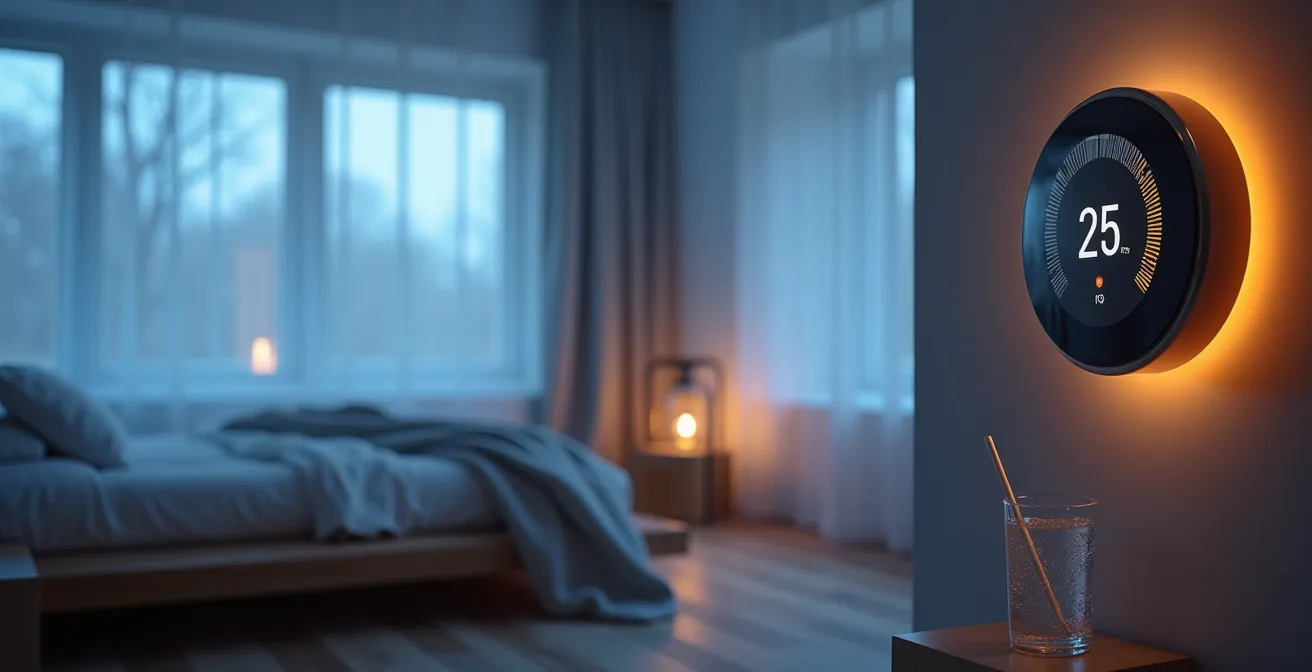
As the visualization suggests, temperature is not just a matter of comfort but a functional lever for sleep quality. One of the most effective ways to leverage this mechanism is through a pre-sleep protocol that accelerates the cooling process. This is where a strategic warm bath can be counterintuitively effective.
The 90-Minute Warm Bath Protocol
Research demonstrates that taking a warm bath 90 minutes before bedtime increases peripheral blood flow to your hands and feet. When you get out of the bath, this enhanced circulation dramatically accelerates heat loss from your core. This leads to a rapid 2-3°F drop in core body temperature precisely as you’re getting into bed. This sharp decline acts as a powerful biological “time for sleep” signal, significantly improving sleep onset and boosting the quality of REM sleep in the latter half of the night.
By actively managing your thermal environment, you’re not just creating a comfortable room; you’re providing a clear, unambiguous signal to your brain to begin its nightly work of restoration and memory consolidation.
Smart Watch vs Oura Ring: Which Actually Tracks REM Stages?
If you can’t measure it, you can’t improve it. This is where sleep trackers become a valuable tool, but their accuracy varies wildly. Understanding how these devices work is crucial to interpreting their data and avoiding misguided conclusions. Most smartwatches rely solely on photoplethysmography (PPG) and an accelerometer, measuring heart rate, heart rate variability (HRV), and movement. While useful, this method is an indirect and often imprecise proxy for sleep stages. REM sleep, for instance, has a heart rate and breathing pattern that can sometimes resemble light sleep, leading to frequent misclassification.
More advanced devices like the Oura Ring or dedicated EEG headbands incorporate additional data streams for a more accurate picture. The Oura Ring adds a sensitive temperature sensor to track the nightly fluctuations in your skin temperature, providing another crucial data point for its algorithm. EEG (electroencephalogram) headbands go a step further by directly measuring brainwave activity, which is the “gold standard” for differentiating sleep stages. While no consumer wearable can match the precision of a clinical polysomnography (PSG) test, some are significantly better than others at estimating your sleep architecture.
This paragraph introduces the following table, which compares the accuracy of different sleep trackers against the clinical gold standard. According to a comparative analysis published in Science Advances, multi-sensor devices offer a clear advantage.
| Device Type | REM Detection Method | Accuracy vs PSG | Key Advantage |
|---|---|---|---|
| Smartwatches (PPG) | Heart rate variability only | 65-75% | Convenient all-day wear |
| Oura Ring | PPG + temperature + accelerometer | 79-85% | Multi-sensor validation |
| EEG Headbands | Direct brainwave measurement | 85-93% | Clinical-grade accuracy |
| Polysomnography | Full EEG + EMG + EOG | 100% (Gold Standard) | Complete sleep architecture |
While chasing a perfect score is tempting, it’s important to use these tools correctly. As leading sleep researchers highlighted in the Science Advances study, the primary benefit of these devices isn’t in their nightly absolute accuracy, but in their ability to track relative changes over time.
The real value is in tracking the relative change in REM sleep percentage over weeks as you experiment with new habits
– Sleep researchers, Science Advances REM Sleep Study
The goal is not to fixate on a single night’s data but to establish a baseline and then observe how your REM sleep percentage trends upward as you implement the protocols for light, temperature, and stress management. It’s about building a balanced sleep architecture, not just maximizing one stage.
The Blue Light Mistake: Why Screens Delay Your REM Onset
The single most powerful environmental signal for regulating your 24-hour sleep-wake cycle is light. For millennia, the bright, blue-rich spectrum of sunlight set our internal clocks. The dim, warm light of fire in the evening signaled the brain to begin producing melatonin, the hormone that facilitates sleep. Today, we have inverted this natural order. We spend our days in dimly lit offices and our evenings staring into screens that blast our eyes with light at a wavelength and intensity that mimics midday sun, creating a profound state of circadian confusion.
The problem is specifically with short-wavelength blue light (around the 450-480nm range). Specialized photoreceptors in your retina, called intrinsically photosensitive retinal ganglion cells (ipRGCs), are highly sensitive to this spectrum. When they detect this light, they send a strong “daytime” signal directly to your brain’s master clock, the suprachiasmatic nucleus (SCN). This signal forcefully suppresses the release of melatonin from the pineal gland. Evening exposure to screens can delay your natural melatonin surge by several hours, which in turn delays the onset of your entire sleep cycle, pushing your REM stages later into the night and often truncating them before you wake up.
As this visual implies, not all light is created equal, and managing your “light diet” is fundamental to protecting your REM sleep. Simply enabling a “night mode” is a good first step, but often insufficient. A more robust, tiered strategy is necessary to create a truly sleep-permissive environment in the evening.
Your Action Plan: A Tiered Blue Light Protection Strategy
- Device Settings: Enable the built-in “night mode” or “night shift” on all your digital devices (phones, tablets, computers) to automatically shift to warmer colors after sunset. This is your baseline defense.
- Software Filters: Install applications like f.lux on your computers. These are more aggressive than built-in settings, dynamically removing blue wavelengths based on the time of day and your location.
- Protective Eyewear: For the 1-2 hours before bed, wear certified blue-light blocking glasses. Look for lenses that specifically block light in the 450nm wavelength range for maximum effectiveness. This protects you from all sources, including overhead lighting and TVs.
- Environmental Control: Create a “light diet” for your home. Use bright, full-spectrum lights during the day to send a strong wake-up signal. In the evening, switch to dim, warm-toned lighting (under 3000K) to mimic the natural transition to night.
- Final Hour Blackout: The ultimate step is to avoid all screens for the last 60 minutes before bed. Use this time for non-stimulating activities like reading a physical book (under dim, warm light), light stretching, or journaling.
By implementing this strategy, you stop sending your brain conflicting signals and instead create a clear, coherent message that it’s time to prepare for a night of deep, restorative, REM-rich sleep.
When to Wake Up: Using Sleep Cycle Alarms to Avoid Grogginess
The groggy, disoriented state you feel some mornings, known as sleep inertia, isn’t random. It’s a direct result of being woken at the wrong point in your sleep cycle. Your brain cycles through stages of light, deep, and REM sleep roughly every 90 minutes. Being jolted awake by a standard alarm during a deep or REM sleep stage is like pulling the plug on a computer during a software update. It leaves your brain in an intermediate state, struggling to come fully online, a feeling that can last from 15 minutes to over an hour.
The solution is not to sleep longer, but to wake up smarter. By timing your awakening to coincide with a light sleep phase, you can wake up feeling refreshed and alert. This is where sleep cycle alarms come in. These apps or devices monitor your movement or heart rate to estimate your current sleep stage. You set a “wake-up window” (e.g., 7:00-7:30 AM), and the alarm will sound at the point within that window when you are in your lightest phase of sleep, making the transition to wakefulness smooth and immediate.
This isn’t just a subjective feeling of being more alert; it has a measurable cognitive impact. According to NIH research on sleep inertia, being awakened from deep sleep causes significant grogginess, but using alarms that target light sleep phases can reduce this effect by up to 70%. Participants in these studies report not only feeling better upon waking but also demonstrate improved cognitive performance and alertness throughout the morning. You can personalize this approach by understanding your own unique rhythm.
To implement this, you need to think in terms of cycles, not just hours:
- Find Your Cycle: Use a sleep tracking app for a couple of weeks to determine your personal sleep cycle length, which is typically between 80 and 100 minutes.
- Plan in Cycles: Set your bedtime to allow for a specific number of full cycles. Aiming for five cycles (7.5 hours) or six cycles (9 hours) is a common strategy.
- Use a Smart Alarm: Utilize a smart alarm app with a 20-30 minute wake-up window. This gives the app enough flexibility to find the optimal moment to wake you.
- Consider a Sunrise Alarm: For an even more natural awakening, a sunrise simulator alarm clock gradually increases the light in your room over 30 minutes before your desired wake time. This light gently suppresses melatonin, easing you out of sleep without a jarring sound.
By respecting your brain’s natural rhythms, you can eliminate that dreaded morning fog and start your day with your cognitive faculties fully engaged from the moment you open your eyes.
Why 6000K Light Bulbs in the Evening Are Ruining Your Melatonin Production?
Your fight against disruptive blue light doesn’t stop at your phone screen; it extends to the very lights you use to illuminate your home. Most standard LED and fluorescent bulbs, especially those labeled “daylight” or “cool white,” emit a strong spike in the blue spectrum of light. The temperature of light is measured in Kelvin (K), and many modern bulbs are 5000K to 6500K, designed to mimic the bright, alerting light of the midday sun. While this is excellent for focus and productivity during the day, having these lights on in the evening is the equivalent of shining a miniature sun into your eyes, telling your brain it’s still noon.
This high-Kelvin light is a potent suppressor of melatonin. Even at low brightness levels, the strong blue-light component is enough to trick your brain’s master clock into delaying sleep preparation. This creates a mismatch between the actual time and your internal, biological time, which can significantly reduce the amount and quality of your REM sleep later in the night. The solution is to create a “light diet” that changes throughout the day, just as natural light does.
This means using different types of bulbs in different rooms or, even better, using smart bulbs that can change their color temperature. You should be using bright, high-Kelvin light in the morning and afternoon, and transitioning to dim, low-Kelvin (warm/amber) light in the evening. As renowned sleep expert Dr. Matthew Walker often explains, the intensity and color of light are critical. During a discussion on the Huberman Lab Podcast, he emphasized how even seemingly dim screens can have a powerful effect.
Even a dim phone screen can emit thousands of LUX at 6500K+, enough to significantly delay melatonin surge
– Dr. Matthew Walker, Huberman Lab Podcast on Sleep
To make this actionable, use the following guide to audit and optimize your home lighting environment for better sleep.
| Light Temperature | Kelvin Range | Best Time of Day | Effect on Melatonin |
|---|---|---|---|
| Blue Sky Daylight | 5000-6500K | Morning to 3 PM | Strongly suppresses (good for daytime) |
| Warm White | 2700-3000K | 3 PM to sunset | Mild suppression |
| Amber/Candlelight | 1800-2000K | 1 hour before bed | Minimal impact |
| Red Light | <1800K | Night/sleep time | No suppression |
Replacing a few key light bulbs is one of the highest-leverage, lowest-effort changes you can make to protect your nightly REM sleep and, by extension, your memory and learning capacity.
Why Eastbound Flights Are Harder on Your Body Than Westbound?
Anyone who travels frequently knows that jet lag from an eastbound flight feels significantly more brutal than from a westbound one. This isn’t just a feeling; it’s a biological reality rooted in the natural timing of our internal clocks. The phenomenon is explained by a fascinating detail of our circadian biology: for most people, the innate, free-running circadian rhythm is not exactly 24 hours long. It’s slightly longer.
On average, research reveals our internal clock naturally runs on approximately a 24.2-hour cycle. This means our bodies have a natural tendency to want to drift later each day. When you fly westbound, you are traveling in the direction your body naturally wants to go—you are extending your day. This makes it relatively easy to adapt; you just stay up a bit later and wake up a bit later, which aligns with your body’s intrinsic drift. It’s like floating downstream.
Flying eastbound, however, is the opposite. You are shortening your day, forcing your body to go to sleep and wake up several hours *earlier* than it wants to. This is a direct fight against your natural biological tendency. It’s like trying to paddle upstream. This forces a more abrupt and difficult reset of your entire circadian system, leading to more severe symptoms of jet lag, including insomnia, daytime fatigue, and, crucially, a highly disrupted sleep architecture with suppressed REM sleep for several nights until you adapt.
You can mitigate this by proactively preparing your body *before* you travel. Don’t wait until you land to start adapting. A pre-flight protocol can significantly reduce the impact of eastbound jet lag:
- Pre-Shift Your Clock: For three days before your flight, shift your bedtime and wake-up time 30-45 minutes earlier each day. This begins the adjustment process gradually.
- Manage Caffeine: On the day of travel, avoid all caffeine after the morning hours. Caffeine can mask tiredness and interfere with your ability to sleep at the new, earlier time.
- Strategic Melatonin: On the plane, consider taking a very low dose (0.5mg) of melatonin timed for the early evening of your destination. This helps signal your brain that nighttime is arriving earlier than it expects.
- Anchor with Light: Upon arrival, seek out bright morning light immediately. This is the most powerful signal (a “zeitgeber”) to anchor your circadian rhythm to the new time zone.
- Maintain a Strict Schedule: For the first three nights, go to bed and wake up at your new target times, even if you don’t feel tired or you wake up in the middle of the night. This forces adaptation.
By being proactive instead of reactive, you can minimize the circadian disruption and protect the quality of your sleep, even when crossing multiple time zones against your body’s natural current.
Key takeaways
- REM sleep is not automatic; it’s a sensitive neurological process that is easily disrupted by modern habits related to alcohol, light, and temperature.
- Optimizing REM involves actively engineering your environment to provide clear, consistent signals to your brain, such as a cool room and dim, warm lighting in the evening.
- The feeling of “grogginess” is often caused by waking during a deep or REM sleep phase, a problem that can be solved by using sleep cycle alarms to wake you during light sleep.
How to Use Somatic Exercises for Instant Anxiety Relief?
You can have the perfect sleep environment—a cool, dark room and no screens—and still lie awake, your mind racing. For many professionals and students, the biggest saboteur of REM sleep isn’t external, but internal: stress. High levels of daytime stress and anxiety lead to elevated evening levels of cortisol, the body’s primary stress hormone. As Yale School of Medicine researchers note, cortisol is a powerful antagonist to sleep and is known to directly suppress REM.
To get restorative REM sleep, your body needs to transition from the “fight-or-flight” sympathetic nervous system to the “rest-and-digest” parasympathetic nervous system. When you’re stressed, your sympathetic system remains active, making it difficult to fall asleep and fragmenting the sleep you do get. Somatic exercises are a powerful tool to consciously induce this shift. These are body-focused practices that use physical sensation and breath to down-regulate the nervous system, providing immediate anxiety relief and preparing the brain for sleep.
Practices like Non-Sleep Deep Rest (NSDR) or Yoga Nidra are prime examples. They involve systematically bringing your attention to different parts of your body, which helps to break the loop of racing thoughts and ground you in the present moment. This isn’t just a relaxation technique; it has a measurable impact on your neurochemistry and subsequent sleep quality.
The NSDR Protocol for Cortisol Reduction
Stanford research on NSDR practices has shown that a 20-minute session of guided body scanning during the day can reduce evening cortisol levels by a remarkable 23%. This hormonal shift translates directly into better sleep: participants who practiced NSDR daily for eight weeks experienced an average of 18% more REM sleep and showed significant improvements in emotional memory processing and reduced anxiety scores. The practice teaches your nervous system how to switch itself off, a skill that pays dividends when your head hits the pillow.
You don’t need a long session to feel the benefits. A simple 5-minute routine before bed can be enough to release physical tension and quiet the mind.
- Feet and Legs: Lying in bed, start with your feet. Tense all the muscles for five seconds, then fully release and feel the wave of relaxation. Move up to your calves and thighs, tensing and releasing with a deep exhale.
- Core and Chest: Gently engage your core and chest muscles, hold, and then release completely while breathing into your belly.
- Arms and Shoulders: Squeeze your hands into fists and pull your shoulders up toward your ears. Hold the tension, then let it all drop with a sigh.
- Face and Jaw: Scrunch all your facial muscles toward your nose, then soften completely, letting your jaw hang slightly open. Notice the feeling of release.
This simple act of tensing and releasing re-establishes the mind-body connection, short-circuits the anxiety loop, and sends a powerful signal to your brain that it is safe to power down and enter a night of deep, restorative, REM-rich sleep.