In summary:
- Maintaining health on the road is not about willpower but about managing your body’s physiological response to travel stress (cortisol, blood sugar, dehydration).
- Prioritize protein and fiber in TSA-compliant snacks to stabilize energy levels and avoid the crash from high-glycemic airport food.
- Use “environmental triggers” to make short hotel room workouts happen, as they are more realistic than relying on the hotel gym.
- Systematically manage hydration and adjust eating schedules (fasting windows) to combat travel fatigue and accelerate jet lag recovery.
The cycle is painfully familiar for any frequent flyer: you start the week with good intentions, but after a 6 a.m. flight, a day of back-to-back meetings, and a client dinner, you find yourself exhausted and reaching for whatever is convenient. You feel lethargic, your suits feel a little tighter, and your productivity dips. The common advice—”pack snacks,” “drink water”—feels inadequate for the relentless demands of business travel.
These platitudes fail because they don’t address the root cause. The challenge isn’t a lack of discipline; it’s a physiological battle against a hostile environment. Travel actively works against your health by spiking stress hormones like cortisol, disrupting your internal clock, and surrounding you with low-nutrient, high-sugar foods. Your body is in a constant state of flux, making it nearly impossible to thrive on willpower alone.
But what if the solution wasn’t to try harder, but to be smarter? The key to maintaining peak health isn’t about generic healthy choices; it’s about implementing a precise, strategic protocol to manage your body’s response to the unique stressors of travel. This is about shifting from defensive eating to offensive physiological management. By controlling your blood sugar, mastering hydration, and aligning your meals with your time zone, you can reclaim your energy and performance, no matter your itinerary.
This guide will walk you through that exact protocol. We’ll deconstruct the common pitfalls of travel and provide disciplined, actionable strategies to turn your travel days into a foundation for, not a detriment to, your health.
Contents: A Strategic Guide to Health on the Road
- Why Airport Food Spikes Your Blood Sugar and Crashes Your Energy?
- How to Pack Protein Snacks That Pass TSA Security?
- Hotel Gym vs Room Workout: Which Is More Likely to Happen?
- The Dehydration Mistake That Makes Travel Fatigue Chronic
- When to Eat: Adjusting Your Fasting Window Across Time Zones
- Why You Should Buy Organic Strawberries but Can Skip Organic Avocados?
- How to Swim for Cardio Without Hurting Your Neck?
- How to Eliminate Jet Lag on Eastbound International Flights?
Why Airport Food Spikes Your Blood Sugar and Crashes Your Energy?
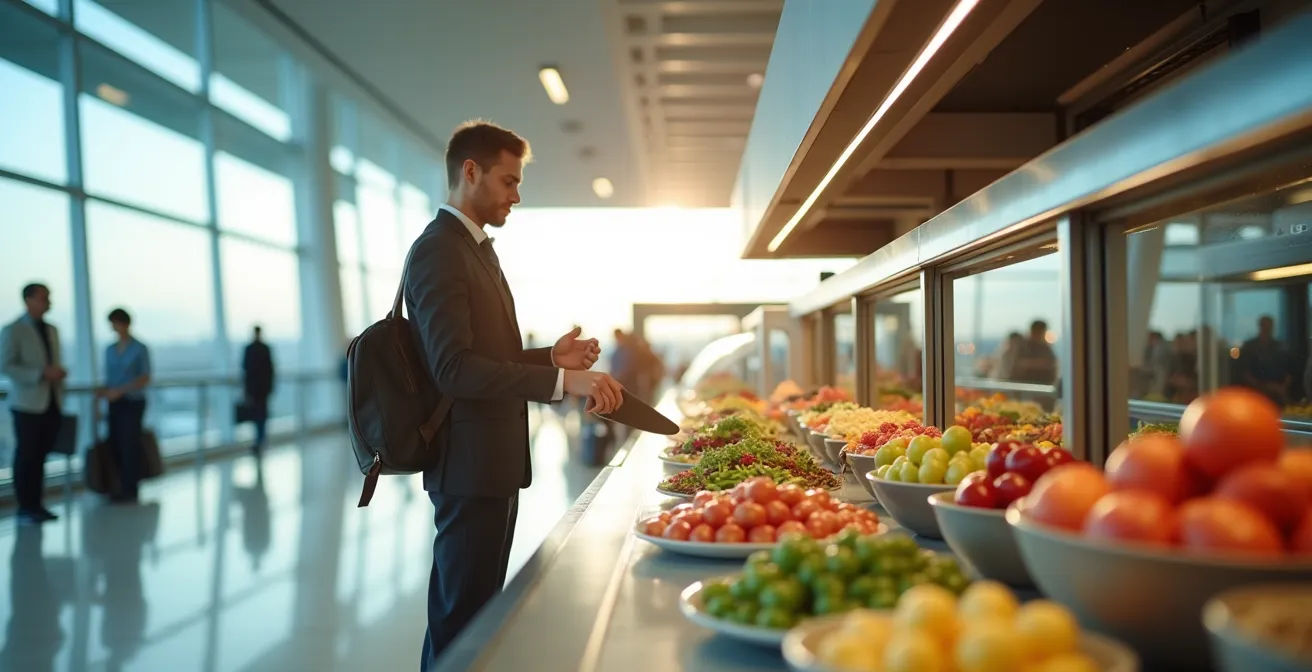
The feeling of post-airport-meal lethargy isn’t just in your head; it’s a predictable physiological reaction. Airport food is overwhelmingly dominated by refined carbohydrates and hidden sugars—pastries, sandwiches on white bread, oversized sodas, and “healthy” yogurt parfaits loaded with granola and sweetened fruit. These foods cause a rapid spike in your blood glucose. Your body responds with a surge of insulin to clear the sugar from your bloodstream, leading to the inevitable energy “crash” an hour or two later, leaving you foggy and craving more sugar.
This cycle is exacerbated by the inherent stress of travel. Rushing to the gate, dealing with delays, and crossing time zones all increase cortisol, your primary stress hormone. This is a critical factor that most travelers overlook. Elevated cortisol makes your cells more resistant to insulin’s effects. In fact, research shows that stress-induced cortisol can reduce insulin sensitivity by up to 20%. This means your body has to work even harder to manage the same amount of sugar, leading to a more pronounced energy crash and promoting fat storage, particularly around the abdomen.
The strategic countermeasure is not to starve yourself but to prioritize protein and fiber. These nutrients slow down the absorption of carbohydrates, promoting a gradual, sustained release of energy instead of a sharp spike and fall. Instead of that croissant at the gate, think of an apple with a handful of almonds. This simple switch bypasses the insulin rollercoaster, keeping your energy stable and your mind clear for the meetings ahead. The goal is to manage your blood sugar proactively, not reactively.
Understanding this mechanism is the first step in taking back control of your travel diet. It reframes the food court not as a source of temptation, but as a strategic environment to be navigated with precision.
How to Pack Protein Snacks That Pass TSA Security?
The most effective way to avoid the airport’s metabolic traps is to arrive prepared. Packing your own protein-rich snacks is a non-negotiable for the disciplined executive. Protein is key for satiety and stable blood sugar, preventing the desperate, poor food choices that travel often encourages. However, navigating TSA regulations, especially with powders and semi-liquids, requires a clear strategy.

For protein and energy powders, be mindful of the rules. Since 2018, the TSA requires separate screening for powders exceeding the 12 oz (350 mL) threshold in carry-on bags. To avoid delays, the best practice is to pack powders in smaller containers or, even better, use single-serving “stick packs.” These are not only convenient but are also less likely to trigger additional security checks. Keeping them in their original, sealed packaging can also streamline the process.
Beyond powders, your options for solid protein are plentiful and effective. Consider these TSA-friendly powerhouses:
- Beef or turkey jerky: Look for low-sodium, nitrate-free options. They are lightweight, durable, and packed with protein.
- Individual nut butter packets: Paired with an apple or a few whole-grain crackers, these provide a balanced mix of protein, healthy fats, and fiber.
- Roasted chickpeas or edamame: A crunchy, savory, and high-fiber alternative to chips.
- Hard-boiled eggs: A classic for a reason. They are a perfect, portable source of high-quality protein.
- Dried fruit: Items like dried apricots are a good source of fiber and nutrients, but should be consumed in moderation due to sugar content.
By dedicating ten minutes before your trip to pack these items, you build a buffer of metabolic resilience that protects you from the worst of airport fare and keeps your performance on track.
Hotel Gym vs Room Workout: Which Is More Likely to Happen?
The intention to use the hotel gym is a common one among business travelers. The reality, however, is often different. After a long day of meetings, the activation energy required to change, find the gym, and navigate an unfamiliar space can be overwhelming. While some disciplined travelers succeed—surveys show about 41% of business travelers in the Americas manage to exercise—for many, the gym remains an unused amenity. The more pragmatic and reliable approach is to weaponize your hotel room for short, effective workouts.
The key to consistency is not motivation, but the removal of friction. A 15-minute bodyweight routine performed in your room is infinitely more valuable than a 60-minute gym session that never happens. To make this a reality, you must employ environmental triggers—simple cues in your surroundings that prompt a desired behavior. Instead of relying on willpower, you architect your environment to make exercise the path of least resistance. This is a core principle of sustainable habit formation.
Action Plan: Environmental Trigger Strategy for Hotel Room Exercise
- Lay out workout clothes: The moment you arrive, place your workout gear on the bed. It becomes a physical obstacle you must address.
- Pack for accessibility: Keep your workout gear in an easily accessible part of your luggage, not buried at the bottom.
- Schedule it first: Plan your exercise for the first thing in the morning, before emails and work obligations derail your day.
- Have a pre-set routine: Create a 15-minute, no-equipment bodyweight routine in advance. Knowing exactly what to do eliminates decision fatigue.
- Set “movement snack” alarms: Use your phone to set multiple alarms labeled “movement snack” to prompt quick stretching sessions throughout the day.
By shifting the focus from an ideal workout to a guaranteed one, you ensure that movement remains a consistent part of your travel routine, safeguarding your energy and mental clarity.
The Dehydration Mistake That Makes Travel Fatigue Chronic
Travel fatigue is often misattributed solely to jet lag or long hours. A more immediate and insidious culprit is dehydration. The air in an airplane cabin is exceptionally dry, with humidity levels often below 20%—drier than the Sahara desert. This environment actively pulls moisture from your body through your breath and skin, accelerating dehydration. Compounding this is the tendency to avoid drinking water to minimize trips to the lavatory and the diuretic effects of caffeine and alcohol, common staples of business travel.

The consequences extend far beyond simple thirst. Your brain is approximately 75% water, and its function is highly sensitive to hydration status. As the European Hydration Institute found that even a 2% loss of body water can reduce concentration, impair cognitive function, and diminish short-term memory. That feeling of brain fog and exhaustion after a flight is a direct symptom of your brain cells lacking adequate water. Chronic, low-grade dehydration from frequent travel leads to sustained fatigue, headaches, and decreased productivity.
The protocol for optimal hydration is simple but requires discipline. Start hydrating 24 hours *before* your flight. Onboard, aim to drink at least 8 ounces (240 mL) of water for every hour of flight time. To enhance water absorption and replenish what’s lost, add electrolytes to your water. A pinch of high-quality sea salt and a squeeze of lemon in your water bottle can make a significant difference. Alternatively, pack sugar-free electrolyte powder packets. This strategy transforms water from a simple liquid into a functional tool for physiological management, directly combating the core cause of travel fatigue.
Making hydration a non-negotiable priority is one of the highest-return investments you can make for maintaining your energy and cognitive performance on the road.
When to Eat: Adjusting Your Fasting Window Across Time Zones
For the frequent traveler, *when* you eat can be just as important as *what* you eat. Your body’s internal clock, or circadian rhythm, governs everything from sleep-wake cycles to metabolism and hormone release. Crossing time zones throws this delicate system into chaos, a state commonly known as jet lag. A powerful tool to reset this clock and manage your metabolism is the strategic use of your eating window, often in the form of intermittent fasting.
Fasting gives your digestive system a rest and can enhance insulin sensitivity, making your body more efficient at using energy when you do eat. As a traveler, this practice becomes a lever to either anchor your body to your home time zone or accelerate its adaptation to a new one. The stress of travel itself can wreak havoc on metabolic health. As author and diabetes expert Adam Brown notes in his guide on travel:
I’m more likely to be sleep deprived and stressed while traveling, which drive insulin resistance, sugar/carb cravings, and worse food choices. If I fall into such choices when I’m not even hungry, high blood sugars are almost guaranteed.
– Adam Brown, DiaTribe – Tackling Travel with Diabetes
This highlights the vicious cycle where travel stress leads to poor choices. A structured eating window provides the discipline to break this cycle. The strategy, however, depends entirely on the duration of your trip. For short trips, anchoring to home is best; for longer ones, immediate adaptation is key. This approach, adapted from expert travel advice, provides a clear framework for decision-making.
| Trip Duration | Strategy | Key Benefits | Implementation |
|---|---|---|---|
| Under 72 hours | Anchor to home time zone | Minimizes circadian disruption | Maintain regular meal times based on home clock |
| Over 72 hours | Immediate adaptation | Accelerates jet lag recovery | Fast during flight, eat protein-heavy meal upon arrival |
| Weekend trips | Anchor to home | Easier transition back to work | Keep consistent eating window |
| Extended business travel | Gradual shift | Balanced adjustment | Shift meal times by 1-2 hours daily |
This level of strategic eating moves you beyond simple calorie counting and into the realm of true circadian management, a critical skill for any global professional.
Why You Should Buy Organic Strawberries but Can Skip Organic Avocados?
The debate between conventional and organic produce can be confusing, especially when you’re on the road with a limited budget and options. The guiding principle for a traveler should be strategic allocation: spend your “organic budget” where it matters most and prioritize resilience and practicality for everything else. The concept behind the “Dirty Dozen” (produce with high pesticide residue) and “Clean Fifteen” (produce with low residue) is a useful framework here. Strawberries consistently top the Dirty Dozen list, while avocados, with their thick, protective skin, are always on the Clean Fifteen list.
For a business traveler, this translates into a simple, effective purchasing strategy. When you’re at a hotel breakfast buffet or a local grocery store, you can confidently choose conventionally grown, thick-skinned fruits. These items are not only safer from a pesticide perspective but are also more durable for travel. A banana, an orange, or an avocado can be tossed in your briefcase and consumed later in the day, providing a healthy, whole-food snack that prevents you from turning to the vending machine.
This allows you to save your resources for items where an organic choice provides a more significant benefit. For example, if you consume coffee daily, choosing an organic brand might be a better investment. Similarly, if you are packing protein powder or other daily supplements, prioritizing high-quality, organic versions ensures you are minimizing your overall exposure to contaminants. The strategy is to focus on the cumulative dose: reduce pesticide load on the items you consume most frequently or that are known to be most contaminated.
By understanding this principle, you can make quick, confident, and healthy decisions in any food environment, freeing up mental energy for the business at hand.
How to Swim for Cardio Without Hurting Your Neck?
For the business traveler, the hotel pool can be an oasis—a low-impact environment perfect for cardiovascular exercise that also helps decompress a spine tight from airplane seats and long meetings. However, many adults swim with their head out of the water, especially during freestyle, which puts significant strain on the cervical spine and neck muscles. This can exacerbate the “tech neck” already common among executives, turning a healthy activity into a source of pain.
The solution is to adopt a neck-safe swimming technique. The goal is to keep your spine, from your head to your tailbone, in a neutral, elongated line as much as possible. This means using goggles and keeping your face in the water, looking at the bottom of the pool. For freestyle, this involves rotating your entire body to breathe, rather than just twisting your neck. If you already have neck tension, it’s often more effective to focus on other strokes that are inherently easier on the neck.
A short, 15-minute hotel pool session can be a powerful tool for both physical and mental recovery. Here is a simple, neck-safe routine you can implement:
- Warm-up (5 minutes): Start with 5 minutes of kickboard work. Holding the board with your arms extended, focus on kicking from your hips. This warms up your legs and gently decompresses the spine without any neck strain.
- Main Set (8 minutes): Perform 5 minutes of a smooth backstroke, focusing on long, powerful arm pulls and consistent body rotation. Then, add 3 minutes of breaststroke, keeping your head in a comfortable position and focusing on the glide phase.
- Cool-down (2 minutes): Finish with 2 minutes of gentle water walking or treading water to bring your heart rate down.
This kind of smart, targeted movement fits seamlessly into a busy travel schedule, providing maximum benefit with minimal risk of injury, ensuring you feel refreshed and ready for the next day.
Key takeaways
- Travel fatigue is often caused by a combination of dehydration, blood sugar instability, and circadian disruption, not just a lack of sleep.
- Proactive physiological management—through strategic hydration, protein-focused snacking, and timed eating—is more effective than relying on willpower.
- Short, consistent workouts in your hotel room using environmental triggers are more realistic and beneficial than ambitious but often-skipped gym sessions.
How to Eliminate Jet Lag on Eastbound International Flights?
Eastbound international flights, where you “lose” time, are notoriously the most difficult for adjusting to jet lag. Your body’s internal clock is more resistant to shifting forward than backward. Eliminating jet lag entirely is a bold claim, but you can drastically accelerate your adaptation and mitigate its worst effects—brain fog, insomnia, and digestive issues—with a disciplined, multi-faceted protocol that begins before you even leave for the airport.
First, as discussed earlier, the immediate adaptation strategy for your eating window is crucial. For a long-haul eastbound flight, this means fasting during the flight and having your first meal upon arrival, timed to the local meal schedule. This meal should be high in protein, which promotes alertness and helps reset your body clock. Second, manage light exposure with military precision. Light is the most powerful signal for your circadian rhythm. During an eastbound flight, you should wear sunglasses and an eye mask to avoid light, tricking your body into thinking it’s still nighttime. Upon arrival, if it’s daytime, expose yourself to as much bright, natural sunlight as possible.
Finally, your activity and hydration upon arrival are critical. A short, moderate-intensity workout (like the swimming routine or a bodyweight circuit) can help reset your internal clock. And, of course, aggressive hydration with electrolytes is non-negotiable to combat the fatiguing effects of dehydration. This is not just about feeling better; it’s about performing at your peak. As the International Labour Organization found that proper nutrition can boost productivity by up to 20%, and managing jet lag is a cornerstone of maintaining that nutritional foundation abroad.
By implementing this comprehensive strategy, you transform from a victim of jet lag into a proactive manager of your own physiology, ensuring you arrive at your destination ready to perform.
Frequently Asked Questions on Healthy Travel
Can I bring liquid electrolytes through TSA security?
Yes, travelers with documented medical conditions like diabetes can bring liquids in quantities over 3.4 ounces through security. This exemption allows for liquid medicines, fast-acting sugar sources like juice for hypoglycemia, or gel packs needed to keep insulin cool. While general electrolyte drinks may not always qualify, it highlights that exceptions exist for medical necessity.
How does altitude affect blood sugar during flights?
The high altitude of a flight cabin can be a physiological stressor, potentially increasing stress hormones. This hormonal shift can decrease the efficiency of carbohydrate metabolism and, in some individuals, lead to temporary insulin resistance. This can result in higher-than-normal blood sugar levels, even with your usual diet.
Should I adjust my meal timing before or after landing?
The best strategy depends on your trip’s duration. For short trips lasting less than 72 hours, it’s often best to maintain your home time zone’s eating schedule to minimize disruption. For longer trips, you can ease the transition by beginning to shift your meal times by 1-2 hours daily in the days leading up to your departure, aligning them more closely with your destination’s time zone.