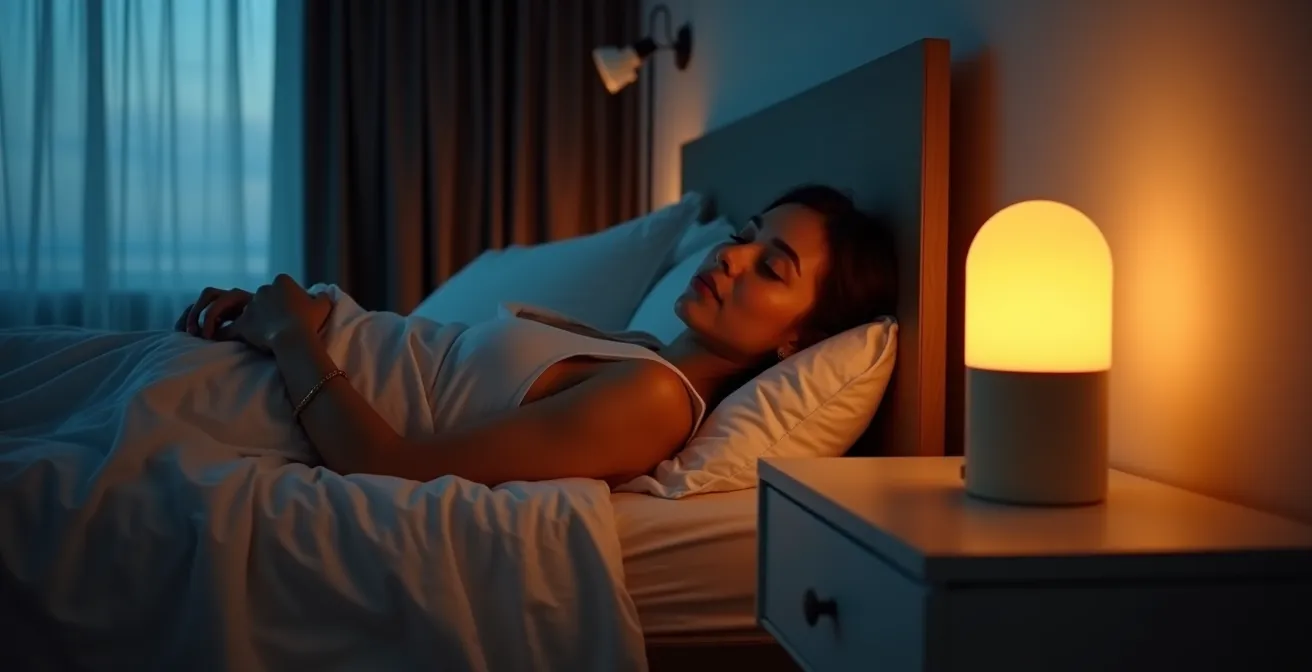
In summary:
- Your body treats light as a signal. Cool, bright light in the morning sets your internal clock, while dim, warm light in the evening allows for melatonin production.
- Light quality (CRI and flicker) is just as important as color. Cheap LEDs can cause subconscious eye fatigue and headaches.
- A personalized “light diet” involves adjusting color temperature (Kelvin) and intensity (lux) throughout the day to match your natural circadian rhythm.
- Strategic positioning of task lighting eliminates glare and shadows, reducing eye strain and improving focus.
- You can balance your lighting needs with those of indoor plants by creating zoned lighting and using timers.
If you’re struggling with eye strain after a day at the computer or find yourself staring at the ceiling at night, the solution might be hanging right over your head. We often blame screens for our sleep woes, and while they are a factor, the entire lighting ecosystem of our home plays a far more significant role. The generic advice to “use warm bulbs” or “dim the lights” barely scratches the surface of a powerful biological mechanism.
The truth is, your body doesn’t just see light; it interprets it as a potent signal that governs your sleep-wake cycle, hormone production, and energy levels. The wrong light at the wrong time is like eating junk food before bed—it disrupts your system. This isn’t just about avoiding blue light; it’s about actively cultivating a healthy “light diet.”
But what if the true key to restorative sleep and vibrant energy wasn’t just avoiding bad light, but proactively designing a personalized, therapeutic light environment? Instead of treating light as a utility, we can learn to use it as a nutrient. This article will provide a scientific yet practical framework for doing just that.
We will deconstruct the science of circadian signaling, explore the technical aspects of light quality that are often overlooked, and provide actionable schedules to turn your home into a sanctuary for wellness. You’ll learn not just what to do, but why you’re doing it, empowering you to take control of your light environment for good.
This guide will walk you through the essential principles of circadian-friendly lighting, from the science of melatonin to the practicalities of choosing the right technology and even keeping your houseplants happy. Explore the sections below to build your personalized light diet.
Summary: Your Guide to a Healthy Light Diet
- Why 6000K Light Bulbs in the Evening Are Ruining Your Melatonin Production?
- How to Position Task Lighting to Eliminate Shadows on Your Workspace?
- Wi-Fi or Bluetooth Bulbs: Which Smart System Is More Reliable?
- The Cheap LED Mistake That Causes Subconscious Eye Fatigue
- When to Dim the Lights: A Schedule for Winding Down Before Bed
- The Blue Light Mistake: Why Screens Delay Your REM Onset
- Where to Find “Eco Mode” on Your Devices to Save Passive Energy?
- How to Keep Indoor Plants Alive in Low-Light Apartments?
Why 6000K Light Bulbs in the Evening Are Ruining Your Melatonin Production?
The concept of “circadian rhythm” is more than a buzzword; it’s a 24-hour internal clock controlled by a master group of cells in your brain. Its most powerful regulating signal is light. During the day, bright, cool-toned light (like natural daylight) signals your body to be alert and awake. In the evening, the absence of this light triggers the production of melatonin, the hormone that prepares you for sleep. The problem is, modern lighting often sends the wrong signals at the wrong times.
A 6000K light bulb emits a cold, bluish-white light similar to midday sun. While excellent for a workshop or office during the day, using it in your living room or bedroom in the evening is a recipe for disaster. This high-Kelvin light is rich in the blue wavelengths that are most effective at inhibiting melatonin production. Your brain essentially receives a “daytime” signal, delaying the onset of sleepiness and disrupting the quality of your rest. Research confirms the potent effect of light color; one Harvard study found that blue light suppressed melatonin for about twice as long as green light and could shift circadian rhythms by as much as three hours.
This doesn’t mean you need to live in darkness after sunset. The key is to manage the color temperature and intensity of your evening light. Switching to bulbs in the 2200K to 2700K range (a warm, amber, or reddish hue) significantly reduces this disruptive signal. Furthermore, even dim light can interfere with your circadian clock. Research shows that as little as eight lux—roughly twice the brightness of a standard night light—can have a measurable effect. Practicing good “luminic hygiene” means using the dimmest, warmest light necessary for your activities in the hours before bed.
How to Position Task Lighting to Eliminate Shadows on Your Workspace?
While managing ambient light is crucial for your circadian rhythm, targeted task lighting is essential for visual comfort and productivity. Poorly positioned lighting on a workspace is a primary cause of eye strain, headaches, and fatigue. The two most common errors are direct overhead lighting that creates harsh shadows from your hands and body, and lighting from behind your monitor that causes veiling glare on your screen.
The solution lies in a design principle called task-ambient layering. Your room should have soft, diffuse ambient light, and you should add a dedicated, adjustable task lamp for your specific work area. The ideal placement for this lamp is at a 45-degree angle to the side of your primary workspace, positioned on the side opposite your writing hand. For example, if you are right-handed, your task light should be on your left. This angle illuminates your task without creating shadows from your hand or reflecting glare into your eyes.
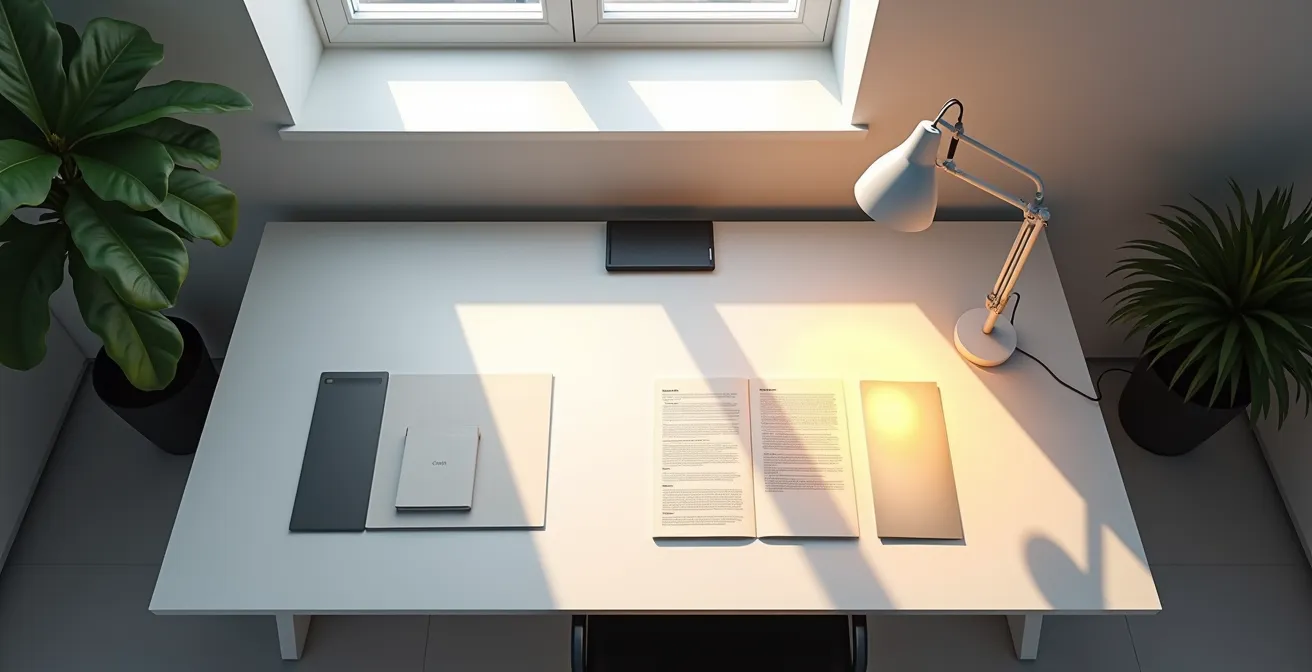
As this setup demonstrates, the goal is to create a “light sandwich” where your work is evenly illuminated from an angle, eliminating distracting shadows and reducing the contrast between your task area and the surrounding environment. This not only boosts comfort but also enhances focus by drawing your attention to the work at hand.
The intensity of the light, measured in lux, also matters. For detailed tasks, a brighter light is needed, but for general computer use, a softer light is sufficient. The key is control and adjustability.
This table outlines the ergonomic impact of different lighting positions. As it shows, positioning light opposite your writing hand at a side angle provides the best balance of shadow control and low eye strain.
| Positioning Method | Shadow Control | Eye Strain Impact | Recommended Lux |
|---|---|---|---|
| 45-degree side angle | Minimal shadows | Low strain | 500-750 lux |
| Direct overhead | Creates hand shadows | Moderate strain | 300-500 lux |
| Behind monitor | No task shadows | High glare risk | 200-300 lux |
| Opposite writing hand | Eliminates writing shadows | Low strain | 750-1000 lux |
Wi-Fi or Bluetooth Bulbs: Which Smart System Is More Reliable?
Implementing a “light diet” is made infinitely easier with smart lighting. The ability to automate color changes, dimming schedules, and create different “scenes” is the cornerstone of a modern circadian-friendly home. However, when choosing a system, a critical question arises: which technology is more reliable? The main contenders are Wi-Fi, Bluetooth, and mesh networks like Zigbee or Thread.
Wi-Fi bulbs are simple to set up as they connect directly to your home’s router. However, their reliability depends entirely on your Wi-Fi network’s strength and stability. If your router is overloaded with dozens of devices or has a weak signal in certain rooms, your lights may become unresponsive or slow. They also rely on a cloud server for many functions, meaning if your internet goes down, you might lose control.
Bluetooth bulbs connect directly to your phone or a nearby hub. This is great for single-room control but can be unreliable for whole-home systems, as Bluetooth has a limited range. You often can’t control a light from the other side of the house unless you have multiple hubs or a mesh system.
Zigbee and Thread are low-power mesh networks designed specifically for smart home devices. Instead of each bulb connecting to a central router, they connect to each other, creating a robust and self-healing network. This local control is generally faster and far more reliable, as it doesn’t depend on your Wi-Fi or the internet for basic commands. A dedicated hub (like a Philips Hue Bridge or an Amazon Echo with Zigbee) translates commands from your network to the light bulbs.
Case Study: Smart Bulb Connectivity Performance
To determine the most dependable system, real-world testing is crucial. In one comprehensive analysis of smart bulb performance, it was found that Zigbee bulbs had the quickest and most reliable response. They were followed by select Wi-Fi bulbs that prioritized local control. Matter-over-Thread bulbs were generally quick, but some brands still showed occasional timeouts, highlighting that the underlying technology (the mesh network) is often a better predictor of reliability than the marketing label.
For a robust, whole-home circadian lighting system, a hub-based mesh network like Zigbee or Thread is typically the most reliable choice. It provides fast, local control that remains functional even when your internet is down, ensuring your “light diet” schedule runs without a hitch.
The Cheap LED Mistake That Causes Subconscious Eye Fatigue
When upgrading to LED lighting, it’s tempting to grab the cheapest multi-pack off the shelf. However, this is often a false economy. Low-quality LEDs can introduce two hidden problems that contribute to subconscious eye fatigue, headaches, and an overall sense of unease: invisible flicker and poor spectral quality.
LED flicker is a rapid, often imperceptible pulsation in light output caused by cheap driver electronics. While you may not consciously see it, your brain and eyes are still processing these rapid changes, leading to strain. You can often detect this flicker by viewing the light through your smartphone’s slow-motion camera mode; if you see dark bands moving across the screen, the bulb has significant flicker.
The second, more subtle issue is poor spectral quality, measured by the Color Rendering Index (CRI). CRI is a scale from 0 to 100 that indicates how accurately a light source reveals the true colors of objects. Natural daylight has a CRI of 100. Cheap LEDs often have a low CRI (below 80), which means they are missing significant portions of the light spectrum. Their light might appear “white,” but it’s a spiky, incomplete white. This can make colors look dull or washed out and forces your brain to work harder to interpret visual information, contributing to fatigue. For spaces where color accuracy matters, or simply for better visual comfort, a CRI of 90 or above is highly recommended.
Investing in high-quality LED bulbs with high CRI and no-flicker drivers is a critical part of a healthy light diet. It ensures the light in your home is not only the right color and intensity but also stable and full-spectrum, creating a more comfortable and less strenuous visual environment.
Your Checklist for a Quality LED Bulb
- Flicker Test: Use your smartphone’s slow-motion camera. Look for visible banding or strobing effects on the screen as you film the bulb.
- Check the CRI: Look for a Color Rendering Index rating on the packaging. An CRI above 90 is needed for accurate color reproduction, while a score above 80 is suitable for most general situations. Avoid anything below 80.
- Verify Dimming Quality: If the bulb is dimmable, ensure the flicker percentage remains low across all brightness levels, not just at 100%.
- Inspect Diffusion: A quality bulb should have a good diffuser (the plastic dome) to spread light evenly and prevent harsh, concentrated glare points from the individual LED chips.
- Prioritize Smooth Spectrum: While harder to verify without lab equipment, brands that advertise “full-spectrum” or high-CRI light typically have a smoother spectral distribution, which is easier on the eyes.
When to Dim the Lights: A Schedule for Winding Down Before Bed
Knowing you should dim your lights before bed is one thing; knowing exactly when and by how much is another. Creating a specific, automated schedule for your “luminic hygiene” is one of the most effective interventions for improving sleep onset and quality. The ideal schedule is not one-size-fits-all but should be tailored to your personal chronotype—whether you are a natural “early bird” or a “night owl.”
The goal is to gradually decrease both the intensity (brightness) and the color temperature (Kelvin) of your lighting in the 2-3 hours leading up to your desired bedtime. This mimics the natural progression of a sunset and sends a powerful, consistent signal to your brain to begin producing melatonin. Implementing such a schedule has been shown to have profound effects. For example, research on night shift workers reveals 50% fewer lapses in vigilance after just four nights of a circadian-informed lighting schedule, demonstrating how quickly the body responds to the right light signals.
Dr. Samer Hattar, a leading researcher at the National Institute of Mental Health, offers a simple but profound rule for evening light:
Just try to dim the light as much as you can. I call it the minimum amount of light you require to see comfortably. Use red light that is very dim if you want to keep the room for sleeping. Red light that is very dim has very small effect on circadian clock. Below 10 lux of red light literally doesn’t affect sleep at all.
– Dr. Samer Hattar, Huberman Lab Podcast
The following table provides a sample evening light schedule that you can adapt to your chronotype. Using smart bulbs, you can automate these transitions so your environment effortlessly guides you toward sleep.
| Chronotype | 8 PM Light | 9 PM Light | 10 PM Light | Bedtime |
|---|---|---|---|---|
| Early Bird (Lark) | 3000K/50% | 2700K/30% | 2200K/10% | 10:30 PM |
| In-Between | 4000K/70% | 3000K/50% | 2700K/30% | 11:30 PM |
| Night Owl | 4000K/80% | 3500K/60% | 3000K/40% | 12:30 AM |
The Blue Light Mistake: Why Screens Delay Your REM Onset
The most infamous source of disruptive blue light is, without a doubt, the glowing screen of our phones, tablets, and laptops. What makes screens particularly problematic is not just the light they emit, but their proximity to our eyes. A light source held close to the face delivers a much more intense signal to the photoreceptors in the retina than ambient room lighting.
This intense, close-range exposure directly suppresses melatonin, delaying the entire sleep process. The consequences are not trivial; compelling studies of college students show a 55% decrease in melatonin and a delay in sleep onset of about 1.5 hours after just two hours of evening tablet use. This delay pushes your entire sleep architecture back, often cutting into the crucial deep and REM sleep stages that occur later in the night, leaving you feeling groggy and unrefreshed in the morning.
While the best advice is to avoid screens for two to three hours before bed, this is not always practical. Therefore, mitigation strategies are key. Many devices now have a “night shift” or “eye comfort” mode that automatically warms the color temperature of the screen after sunset. While helpful, these modes primarily address color, not intensity. Simply dimming the screen brightness is an equally important step.
More advanced techniques can further reduce the screen’s stimulating effects. Enabling grayscale mode makes the content far less engaging and removes the blue light component entirely. Physically, holding your device at least arm’s length away can significantly reduce the intensity of the light reaching your eyes. If evening screen use is unavoidable, a combination of these software and behavioral adjustments can make a substantial difference in protecting your sleep.
Where to Find “Eco Mode” on Your Devices to Save Passive Energy?
While the primary focus of a circadian lighting system is wellness, a significant and welcome co-benefit is energy efficiency. The same principles that promote healthy sleep—dimming lights in the evening and using only what’s necessary—also drastically reduce electricity consumption. The idea of an “Eco Mode” for your home lighting is built directly into a well-designed circadian plan.
Modern LED technology is already incredibly efficient. For instance, well-designed LED troffer replacements demonstrate 40% more light output while using up to 60% less energy than their fluorescent predecessors. However, the real savings come from intelligent control. A smart lighting system that automatically dims to 30% brightness in the evening isn’t just good for your melatonin; it’s using 70% less energy than it would at full power.
This creates a powerful synergy between health and sustainability. The financial cost of poor lighting is not just on the electricity bill; it also impacts productivity and well-being. This connection reveals that investing in better lighting is not an expense but a high-return investment.
Case Study: The Economic Cost of Poor Lighting
Fatigue in the workplace is a massive hidden cost for the economy. A study published in the Journal of Occupational and Environmental Medicine found that 40% of U.S. workers experience fatigue, leading to an estimated productivity loss of $136 billion annually. In many of these cases, the fatigue can be directly linked to poor office lighting that causes eye strain or disrupts circadian rhythms. This demonstrates that implementing high-quality, human-centric lighting is also a powerful energy and productivity strategy, serving dual purposes of employee wellness and operational efficiency.
By automating your lighting to follow a natural rhythm, you are essentially putting your home into a perpetual “Eco Mode.” You use bright, energy-intensive light only when your body needs it and conserve power during the evening and night. This makes a circadian lighting system one of the rare home upgrades that pays dividends for your health, your wallet, and the environment simultaneously.
Key takeaways
- Light is a biological signal: Treat your lighting like a “diet” with specific timings, colors (Kelvin), and intensities (lux).
- Quality over quantity: Invest in high-CRI, flicker-free LEDs to avoid subconscious eye strain and headaches.
- Automation is key: Use a reliable smart system (like Zigbee) to create personalized evening wind-down schedules based on your chronotype.
How to Keep Indoor Plants Alive in Low-Light Apartments?
A common challenge in creating a human-centric lighting environment is the conflicting needs of our indoor plants. While we need dim, warm, reddish light (2200K-3000K) in the evening to promote sleep, plants require bright, full-spectrum, cool-toned light (5000K+) for photosynthesis. Running a powerful grow light in your living room at 8 PM is great for your ficus but terrible for your melatonin. Reconciling these needs seems impossible, but it can be done with a strategy of zoning and timing.
The first step is to create distinct “plant zones.” Instead of trying to illuminate an entire room with a grow light, consolidate your plants into one or two areas. Use directional grow lights with hoods or barn doors to focus the light directly onto the plants, minimizing “light spill” into your living spaces. This contains the bright, blue-rich light where it’s needed and protects your evening ambiance.
Second, timing is everything. Plants, like humans, have a circadian rhythm. They photosynthesize during the day and “rest” at night. There is no benefit to running grow lights after sunset. Set your grow lights on a timer to run only during daytime hours, for example, from 7 AM to 5 PM. This provides plants with the energy they need while ensuring your home can transition to a human-friendly, warm-dim environment in the evening.
Finally, choose your plants wisely. For areas outside your dedicated plant zones, opt for low-light tolerant species like snake plants, ZZ plants, or pothos. These species can thrive in the lower ambient light levels that are more comfortable for humans. The table below clearly outlines the conflicting needs and compromise solutions.
| Time Period | Plants Need | Humans Need | Compromise Solution |
|---|---|---|---|
| Morning (6-9am) | 5000K+ bright | 4000-5000K bright | Shared bright cool light |
| Daytime (9am-5pm) | 5000K+ bright | 4000K moderate | Zoned lighting approach |
| Evening (5-9pm) | None needed | 3000K dim | Turn off grow lights |
| Night (9pm+) | Complete darkness | 2200K very dim | Both benefit from darkness |
By embracing the concept of a “light diet,” you can transform your home’s lighting from a passive utility into an active tool for wellness. Start by making one small change today—swap out an evening bulb for a warmer hue or set a timer on your screens—and begin the journey to better sleep and more vibrant energy.