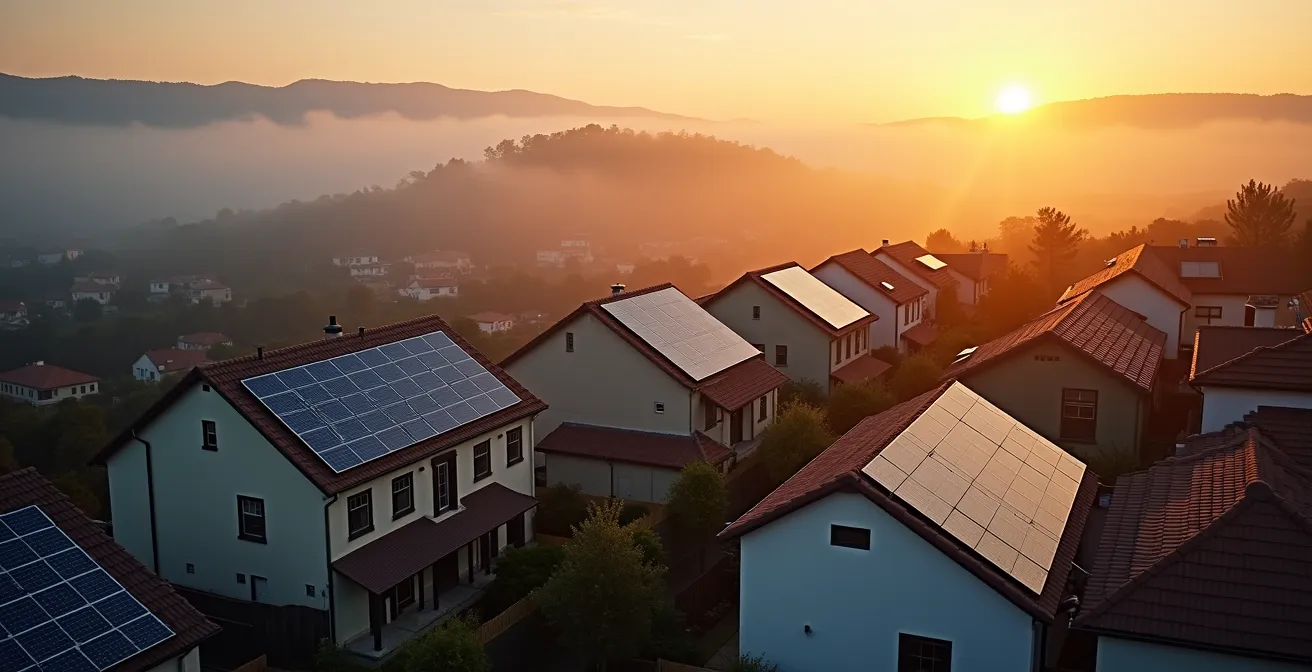
The most profitable roof for solar panels isn’t necessarily the sunniest; it’s the one whose power generation curve creates the most value against your specific utility’s rate structure.
- East- and west-facing roofs can outperform south-facing ones when time-of-use electricity rates are highest in the afternoon.
- Winter installations often provide access to 10-20% discounts on previous-year panel models that are nearly identical in performance.
Recommendation: Before requesting quotes, perform a financial analysis of your utility bill and roof geometry to establish a baseline ROI. This turns you from a passive buyer into an informed investor.
For most homeowners, the decision to install solar panels is framed as a simple question of savings and environmental benefit. The common wisdom suggests that if you have a south-facing roof and enough sun, the investment will eventually pay for itself. While not entirely wrong, this view misses the most critical factor: investing in solar is not an environmental decision, but a financial one. It’s an exercise in capital allocation, and like any investment, its success depends on rigorous, data-driven analysis, not just good intentions or sunny weather.
The standard advice often overlooks the complex interplay of variables that truly determine your return on investment (ROI). It’s a world of time-of-use (TOU) rate arbitrage, asset encumbrance from leasing contracts, and strategic timing. The belief that a perfect southern orientation is the only path to profitability is an outdated simplification. Modern technology and evolving utility policies have created opportunities where east- or west-facing systems can be significantly more lucrative.
This guide departs from the generic advice. We will treat your roof as a financial asset and your solar installation as a power-generating business. The goal is not just to reduce your electricity bill but to engineer a system for maximum, predictable ROI. We will deconstruct the myths around orientation, teach you how to analyze the true profit potential hidden in your utility bill, and reveal the contractual traps and market timings that can make or break your investment. By the end, you’ll have a mathematical framework to determine if—and how—solar is truly worth the investment for you.
This article provides a structured, ROI-focused framework for evaluating a solar investment. Each section builds on the last, moving from technical feasibility to financial optimization and long-term strategy.
Summary: A Financial Framework for Solar Panel Investment
- Why South-Facing Roofs Aren’t the Only Ones That Generate Profit?
- How to Read Your Utility Bill to See If Selling Power Back Is Profitable?
- Grid-Tied vs Off-Grid with Battery: Which Setup Survives a Blackout?
- The Leasing Contract Trap That Makes Your House Harder to Sell
- When to Install Panels: Why Winter Quotes Are Often Cheaper
- Supercharger vs CCS: Knowing Which Plugs Your Car Can Accept
- How to Apply Window Film to Mimic Double Glazing for Under $50?
- How to Eat Organic on a Budget Without Doubling Your Grocery Bill?
Why South-Facing Roofs Aren’t the Only Ones That Generate Profit?
The long-standing rule in the northern hemisphere has been that south-facing roofs are the gold standard for solar production. This is based on a simple physical principle: a southern orientation maximizes total daily exposure to the sun, generating the most kilowatt-hours (kWh) overall. However, maximizing kWh production is not the same as maximizing financial return. The real goal is production curve optimization—aligning your energy generation with periods of highest electricity cost or highest household consumption.
Many utilities have shifted to Time-of-Use (TOU) rates, where electricity is significantly more expensive during peak demand hours, typically in the late afternoon and early evening. For a home on a TOU plan, an east-west split orientation can be more profitable than a purely southern one. The east-facing panels generate power in the morning, covering the home’s early needs. The west-facing panels come alive in the afternoon, generating substantial power exactly when utility rates are at their peak. You might sell this expensive power back to the grid for a high credit, or avoid purchasing it, resulting in greater financial savings than a south-facing system that peaks at midday when rates are lower.
This paragraph introduces a complex concept. To better understand this, it is helpful to visualize the generation patterns. The illustration below breaks down how different orientations perform throughout the day.
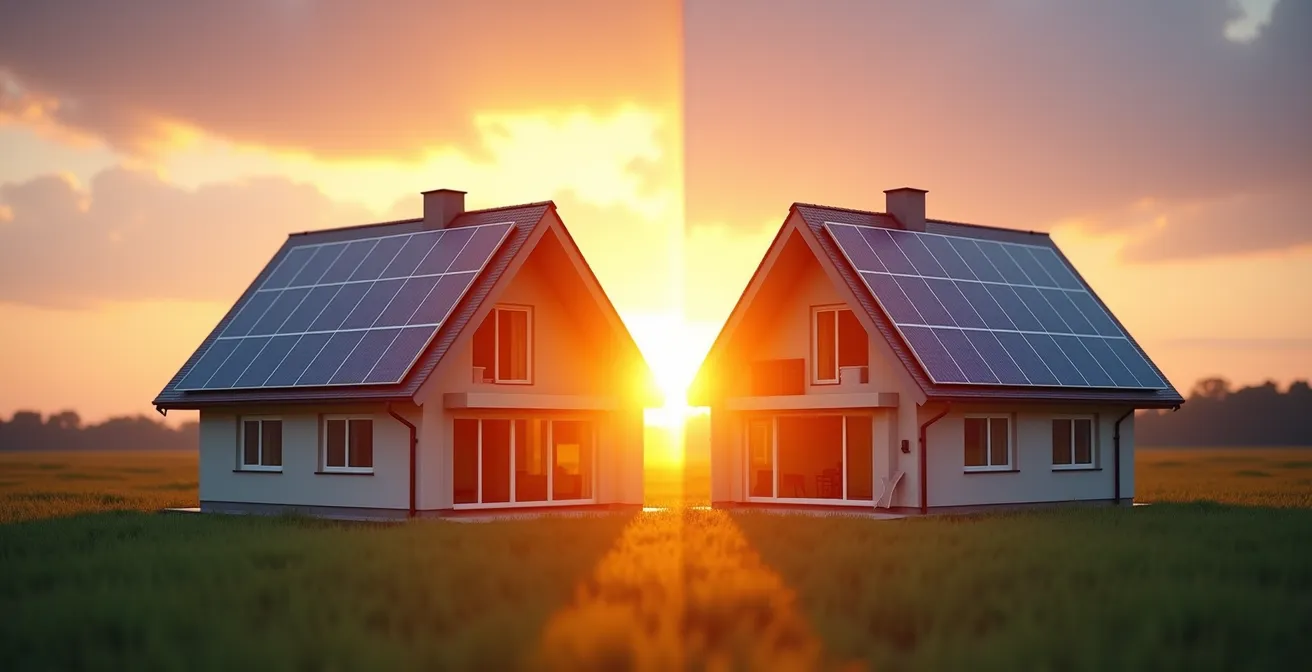
As this visualization shows, modern panel technology further diminishes the dominance of southern exposure. Panels with Passivated Emitter and Rear Cell (PERC) technology offer improved performance in low-light conditions (morning, evening, cloudy days). Furthermore, emerging technologies like bifacial panels, which capture reflected light from the roof surface, can be game-changing. An analysis of these systems shows that bifacial panels can produce up to 30% more energy than traditional monofacial panels in optimal conditions, making orientation even less of a limiting factor.
Action Plan: Your Solar Viability Score Framework
- Identify your roof’s true south orientation using Google Maps (avoid magnetic compasses which can be inaccurate).
- Calculate efficiency loss: West/East facing panels typically generate 85-89% of a south-facing system’s total output, a figure to weigh against rate benefits.
- Factor in Time-of-Use rates: A southwest orientation may be optimal when your utility’s peak rates are 3-4 times higher than off-peak.
- Analyze shading patterns throughout the day and across different seasons to identify any significant output obstructions.
- Account for modern PERC or bifacial technology, which improves low-light performance and can compensate for non-ideal orientations.
Ultimately, the “best” orientation is a financial equation unique to your property, consumption patterns, and local utility rates, not a simple compass direction.
How to Read Your Utility Bill to See If Selling Power Back Is Profitable?
Your utility bill is more than a monthly expense; it is a financial prospectus for your potential solar investment. The profitability of selling power back to the grid hinges entirely on the policy structure detailed in your bill, known as net metering or, increasingly, net billing. Traditional net metering was a simple 1-for-1 credit system: for every kWh you sent to the grid, you received a credit for one kWh to use later. This made the financial calculation straightforward.
However, this model is disappearing. Utilities argue that it shifts grid maintenance costs onto non-solar customers. In California, for instance, a report highlighted an estimated $8.5 billion annual cost shift to non-solar customers by the end of 2024. This has fueled a nationwide move toward less favorable compensation structures. Analyzing your bill requires you to identify two key numbers: the retail rate you pay for electricity (e.g., $0.25/kWh) and the export or “avoided cost” rate you are paid for the electricity you sell (e.g., $0.05/kWh). If these numbers are vastly different, the strategy shifts from exporting as much as possible to maximizing self-consumption.
This changing landscape is the single most important variable in your ROI calculation, making a deep dive into state and utility policies essential.
Case Study: The National Shift Away From Traditional Net Metering
An ongoing analysis by the N.C. Clean Energy Technology Center provides critical insight into this trend. Their 2024 review found that this is a nationwide phenomenon. The key finding from the study reveals a decisive move away from traditional net metering towards “net billing” or “buy-all, sell-all” arrangements. For example, some states are implementing income-graduated fixed charges, fundamentally altering the payback equation. According to the 2024 report on the 50 States of Solar, utilities in multiple states have requested fixed charge increases of 100% or more, directly eroding the savings from solar generation. This proves that a solar investment’s viability is now less about sunshine and more about regulatory foresight.
Therefore, a profitable system under net billing is one paired with a battery, allowing you to store your excess energy instead of selling it for pennies, then using it later to avoid buying expensive grid power.
Grid-Tied vs Off-Grid with Battery: Which Setup Survives a Blackout?
A common misconception is that any home with solar panels will have power during a blackout. This is false for standard grid-tied systems. For safety reasons, these systems automatically shut down when the grid fails to prevent sending electricity back into the lines where crews may be working. True energy independence during an outage requires a battery and, critically, the right type of inverter.
The decision between system types is a calculation of cost versus resilience. An off-grid system offers 100% independence but comes at a significant premium, requiring a large battery bank and generator to handle periods of low sun. It’s often impractical and financially unviable for homes with reliable grid access. The more strategic choice for most is a grid-tied system with battery backup. This hybrid model offers the best of both worlds: it uses the grid as an infinite “battery” for daily overproduction but can “island” itself from the grid during an outage to power essential loads.
The key component is an “islanding” inverter, which disconnects from the grid and creates a stable, self-contained microgrid for your home. The size of the battery determines your level of resilience—from a few hours for critical loads (refrigerator, lights) to full-day operation. The following table breaks down the core financial and functional differences.
| Feature | Standard Grid-Tied | Grid-Tied + Battery | Off-Grid + Battery |
|---|---|---|---|
| Power During Blackout | No | Only with islanding inverter | Yes |
| Initial Cost | Lowest | Medium (+$8-15k) | Highest (+$20-40k) |
| Rate Arbitrage Capability | No | Yes | N/A |
| Maintenance Required | Minimal | Battery monitoring | Extensive |
| Grid Independence | 0% | Partial (4-24 hours) | 100% |
The “Resilience Premium”—the value you place on having power during a blackout—is a key part of the ROI calculation. For some, it’s a convenience; for those who work from home or have medical needs, it’s a financial necessity that can easily justify the cost of a battery.
The Leasing Contract Trap That Makes Your House Harder to Sell
Solar leases and Power Purchase Agreements (PPAs) are marketed as a “no money down” way to get solar. While they lower the barrier to entry, they introduce a significant financial liability that can complicate or even derail the future sale of your home. When you sign a 20- or 25-year lease, you don’t own the system; you are simply renting it. The solar company owns the asset, and the contract is a lien on your property.
This creates what is known in finance as an asset encumbrance. When you decide to sell your house, the new buyer must be willing and able to assume the remainder of the lease. This is a major hurdle. The buyer must qualify for the lease transfer based on their credit, a process that can add weeks or months to a closing. Worse, the lease likely includes an annual “escalator” clause, increasing the payment by 2-3% per year. A lease that seemed affordable in year one may be significantly overpriced compared to utility rates ten years later, making it unattractive to a potential buyer.
Your options are limited: convince the buyer to take on the lease, or buy out the remaining contract yourself, which can cost tens of thousands of dollars and negate years of savings. In contrast, a purchased system is an asset that typically adds to the home’s resale value without complicating the transaction. Before considering a lease, you must understand that you are not just getting solar panels; you are entering into a long-term financial agreement that can have serious consequences for your home’s marketability. The key is to prepare a comprehensive lease transfer package to present to potential buyers, outlining the real-world savings and process.
The perceived convenience of a lease often masks a long-term financial entanglement. A direct purchase, financed with a solar loan if necessary, almost always yields a better financial outcome and preserves your home’s liquidity as an asset.
When to Install Panels: Why Winter Quotes Are Often Cheaper
Most homeowners begin shopping for solar panels in the spring and summer, when the sun is bright and electricity bills for air conditioning are high. This predictable surge in demand gives installation companies pricing power. The savviest investors, however, know that the best time to secure a quote is during the off-season: late fall and winter.
This seasonal advantage is driven by two market forces. First, installation crews are less busy, and companies are eager to keep their teams working. This creates a willingness to negotiate on labor costs and margins to secure projects. Second, and more importantly, is the concept of the “Technology Lag Discount.” Solar panel manufacturers typically announce their newest, most efficient models in the late summer or early fall. This makes the previous year’s models—which are often only marginally less efficient—”old” inventory that distributors and installers need to clear out during the winter months.
This creates a significant opportunity. You can acquire a top-tier system from the previous model year at a substantial discount. This strategic timing can often result in a 10-20% reduction in total system cost without a meaningful sacrifice in performance. This is especially true as modern panels have reached a high level of efficiency, with differences between model years becoming increasingly incremental.
This approach requires foresight, but the financial payoff is substantial, directly accelerating your breakeven point and increasing your total ROI.

By decoupling your purchasing decision from the weather and aligning it with industry inventory cycles, you are operating like a true financial analyst, not just a consumer.
Supercharger vs CCS: Knowing Which Plugs Your Car Can Accept
For homeowners integrating an electric vehicle (EV) into their solar-powered ecosystem, understanding the charging infrastructure is a critical part of the overall ROI calculation. The energy your panels produce is only valuable if you can efficiently transfer it to your car. The EV charging landscape is dominated by two main standards for DC fast charging: the Supercharger network (proprietary to Tesla) and the Combined Charging System (CCS), used by most other automakers.
Historically, these systems were mutually exclusive. A Tesla used a Supercharger, while a Ford Mustang Mach-E or a Porsche Taycan used a CCS station. However, the industry is standardizing. Tesla has begun opening its Supercharger network to non-Tesla vehicles and is adopting the CCS standard (rebranded as NACS) for its new models. For a homeowner, this means two things. First, when installing a Level 2 home charger (which uses a universal J1772 plug), you can be confident it will work for nearly any EV with the correct adapter. Second, when planning for road trips powered by public fast chargers, you must know which plug your car accepts and which networks are compatible. Knowing this prevents “range anxiety” and ensures the energy ecosystem you’ve invested in is fully functional both at home and on the road.
Ultimately, a solar investment is maximized when it powers your entire life, and understanding the final link in the chain—the plug that goes into your car—is a non-negotiable piece of the puzzle.
How to Apply Window Film to Mimic Double Glazing for Under $50?
Before investing thousands in a solar generation system, the most financially astute first step is to reduce your home’s baseline energy consumption. The single biggest source of energy loss in most homes is inefficient windows. While replacing them with double or triple-glazing is effective, it’s also extremely expensive. A far more ROI-positive starting point is applying modern, low-emissivity (Low-E) window film.
This transparent film acts as a selective filter. In the winter, it reflects heat from your furnace back into the room, reducing heating costs. In the summer, it reflects infrared heat from the sun outwards, dramatically lowering the load on your air conditioner. The process is a simple DIY project: you thoroughly clean the window, spray it with a soapy water solution, apply the film, squeegee out the bubbles, and trim the edges. For less than $50 and a weekend afternoon, you can achieve a significant portion of the insulating benefit of new windows.
Reducing your energy demand first has a compounding effect on your solar ROI. A more efficient home requires a smaller, less expensive solar panel system to cover its needs. This not only lowers the upfront capital investment but also accelerates your payback period. It is the most cost-effective “negawatt” (a watt of energy saved) you can find, and it should be the absolute first step in any home energy optimization plan.
Investing in energy efficiency first ensures that every dollar you later spend on solar generation is working as hard as possible, targeting a reduced energy need from the outset.
Key takeaways
- Solar ROI is a financial engineering problem, not just an environmental one; profit is driven by rate structures and timing, not just sunlight.
- The move from net metering to net billing by utilities makes battery storage and self-consumption critical for maximizing financial returns.
- A solar lease is a form of asset encumbrance that can significantly complicate or devalue a home sale; ownership is nearly always the superior financial choice.
How to Eat Organic on a Budget Without Doubling Your Grocery Bill?
At first glance, optimizing a grocery budget seems entirely unrelated to calculating the ROI of a solar panel installation. However, the underlying mindset is identical. Both challenges require a departure from conventional wisdom and an embrace of a data-driven, system-based approach to achieve a superior outcome without simply spending more money.
The common advice for eating organic is to “buy from farmers’ markets” or “only buy what’s on sale”—the equivalent of the “get a south-facing roof” advice for solar. It’s not wrong, but it’s superficial. A truly optimized strategy, much like our solar framework, involves deeper analysis. It means understanding seasonal supply chains (the “winter discount” on last-gen panels), prioritizing which items provide the highest nutritional return for their “organic premium” (the “Dirty Dozen” list), and reducing waste to zero (the “energy efficiency first” principle). It’s about building a system, not just making individual purchasing decisions.
Just as you analyze your utility bill’s TOU rates to find arbitrage opportunities, a savvy organic shopper analyzes unit pricing and plans meals around high-yield ingredients. You’re not just buying food; you’re managing a complex portfolio of assets to maximize a desired outcome—health and wellness—within a fixed budget.
To accurately model your own solar ROI and apply this mindset effectively, the next logical step is to apply this analytical framework to your specific utility bill and property data, transforming abstract concepts into a concrete financial plan.