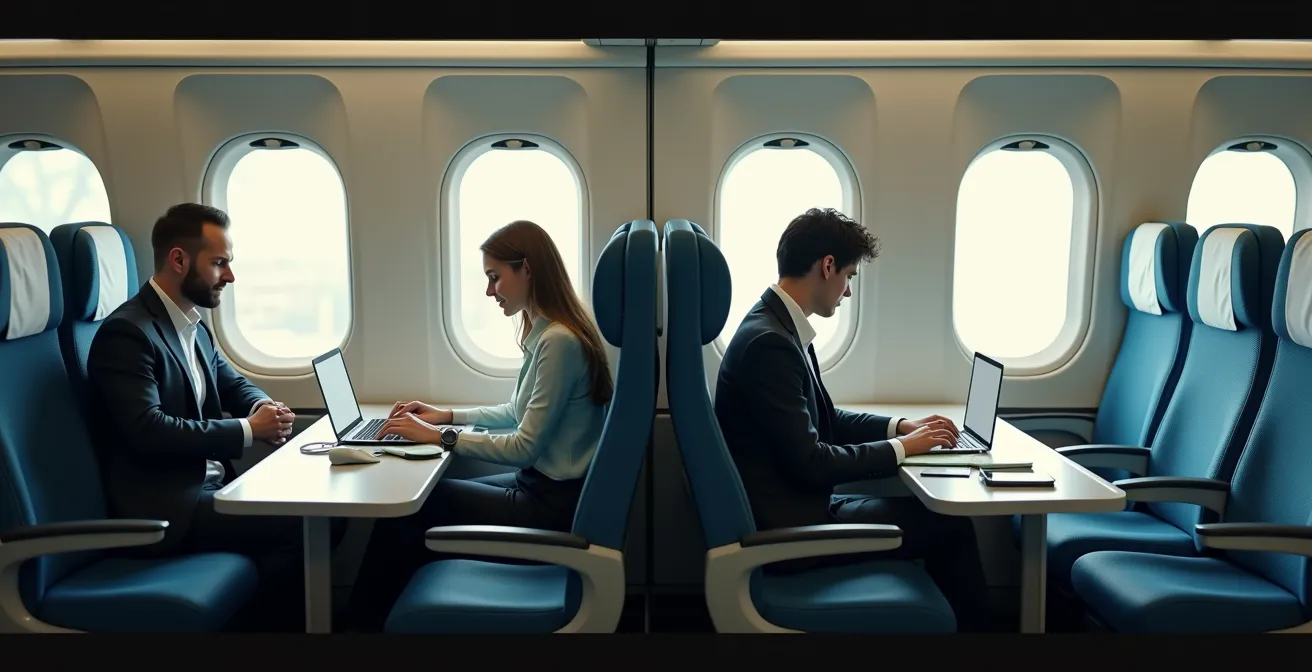
For any business trip under 4-5 hours, high-speed rail consistently outperforms air travel in delivering uninterrupted, productive work time.
- The “door-to-door” time of flying is deceptive, hiding significant “Productivity Delta” losses in security lines, transfers, and non-conducive work environments.
- Train travel provides superior ergonomics and connectivity, directly translating to higher quality work output and fewer errors.
Recommendation: Re-evaluate your travel choices not by flight duration, but by the total potential for billable hours. The train is a mobile office; the plane is a series of productivity interruptions.
As an executive, your time is your most valuable asset. When faced with a 4-hour journey for a critical meeting, the default choice often leans towards the perceived speed of air travel. The logic seems simple: a 60-minute flight beats a 4-hour train ride. This calculation, however, is fundamentally flawed because it ignores the hidden variable of productive uptime. The conventional wisdom focuses on total travel duration, a metric that is misleading for any professional who intends to work while in transit.
The real question isn’t “Which is faster?” but “Which mode of transport functions as a better mobile office?” The journey is not just a necessary evil between point A and point B; it’s a block of time that can either be converted into billable hours or lost to what we can call “Transition Friction”—the unproductive minutes spent in security queues, taxi rides to remote airports, and cramped waiting lounges. This common approach fails to account for the cognitive load of navigating airports and the poor ergonomics of an airplane seat, which actively sabotage deep work.
This analysis moves beyond the simple door-to-door timeline. We will dissect the journey from a productivity consultant’s perspective, quantifying the hidden costs of air travel and revealing the strategic advantages of high-speed rail. It’s time to reframe the choice: stop thinking about travel time and start calculating your Productivity Delta—the real difference in work you can actually accomplish.
This guide will break down every component of the journey, from the quality of your workspace to the impact on your energy levels, providing a clear framework for making the most efficient and profitable travel decision. Explore the detailed analysis below to understand how to turn your next business trip into a productive work session.
Summary: Plane vs. High-Speed Rail: A Productivity Analysis
- Why Legroom and Table Space Are Critical for Laptop Work
- How to Secure Your Data When Using Train Wi-Fi
- First Class or Standard: Is the Quiet Zone Worth the Extra Cost?
- The Airport Trap: How Security Lines Kill Your Billable Hours
- When to Book: Finding Flexible Tickets for Unpredictable Meeting End Times
- Why Walking the Last Mile Is Costing You 2.5 Hours a Week?
- Why Airport Food Spikes Your Blood Sugar and Crashes Your Energy?
- How to Maintain a Healthy Diet While on Regular Business Trips?
Why Legroom and Table Space Are Critical for Laptop Work
The ability to perform deep, focused work during travel is not a luxury; it’s a core component of efficiency. The physical environment directly dictates the quality and quantity of that work. An airplane’s economy seat, with its minimal pitch and a tray table barely large enough for a tablet, is an ergonomic disaster. It forces a hunched posture, constrains typing movements, and creates a sense of being cramped, all of which contribute to physical discomfort and mental distraction. This isn’t just an inconvenience; it’s a direct drain on your cognitive resources and work quality.
In contrast, high-speed trains are designed with the working professional in mind. The standard provision of a full-size table, ample legroom, and access to power outlets creates an environment that mimics a proper workstation. This isn’t merely about comfort. A superior ergonomic setup is proven to enhance productivity and reduce mistakes. For instance, a landmark Cornell University study demonstrated that proper ergonomic setups can reduce errors by up to 60%. This is attributed to decreased physical and mental fatigue, a factor that is magnified during travel.
When you’re finalizing a crucial presentation or reviewing a complex contract, the difference between a cramped airplane seat and a spacious train table is the difference between error-prone skimming and focused, high-value work. The generous space allows you to use a full-sized laptop comfortably, spread out documents, and maintain a healthy posture over several hours. This physical freedom translates directly into a higher state of concentration and, ultimately, a more productive journey.
Choosing your mode of transport is, therefore, an investment in your work environment. Opting for the train is choosing a setting designed for productivity, not just transit.
How to Secure Your Data When Using Train Wi-Fi
While train travel offers superior connectivity, the convenience of public Wi-Fi introduces a critical vulnerability: data security. Connecting to an unsecured or poorly configured network can expose sensitive corporate information, client data, and personal credentials to malicious actors. The linear seating arrangement on many trains also increases the risk of “shoulder surfing,” where a person can visually capture confidential information from your screen. For any business traveler handling proprietary data, treating public Wi–Fi with the same caution as any other public network is non-negotiable.
The threat is not theoretical. A September 2024 cyber attack demonstrated vulnerabilities when 19 major UK stations were affected, highlighting how these central hubs can be targeted. Relying on the default network security is an unacceptable risk. You must take proactive steps to create a secure bubble for your digital workspace. This involves a combination of software solutions and physical awareness to mitigate both digital and visual threats effectively.
The most robust defense is a multi-layered one. A Virtual Private Network (VPN) is the foundational tool, creating an encrypted tunnel that makes your data unreadable to anyone snooping on the network. However, a VPN doesn’t protect you from someone physically looking over your shoulder. For this, a physical privacy screen is an essential, low-cost investment that drastically narrows the viewing angle of your laptop screen. For the most sensitive tasks, bypassing the public network entirely by tethering to your phone’s personal hotspot provides the highest level of security, as you are using a direct, private cellular connection.
Ultimately, a productive journey is also a secure one. By implementing these measures, you can leverage the connectivity of train travel without compromising the integrity of your data.
First Class or Standard: Is the Quiet Zone Worth the Extra Cost?
The difference between a standard and a first-class train ticket is not just about a wider seat; it’s an investment in a controlled, predictable work environment. Standard class can be a lottery of noise and distractions—from loud phone conversations to family holiday excitement. For a business traveler needing to concentrate, this unpredictability can completely negate the benefits of train travel. This is where the designated “Quiet Zone” or a first-class upgrade becomes a strategic decision, not a luxury expense.
The “Quiet Zone” is an explicit agreement among passengers to minimize noise. Mobile phone calls are prohibited, conversations are kept to a whisper, and the overall ambiance is one of library-like focus. This environment is specifically engineered to facilitate deep work, allowing you to enter a state of flow without the constant, low-level interruptions that plague other travel settings. The small premium for a quiet zone seat often delivers an outsized return on investment in terms of uninterrupted billable hours.
This is reflected in executive perceptions of travel. Research from Belgian operator Thalys revealed a stark contrast: 90% of managers surveyed viewed rail travel as productive time, while only 6% said the same about air travel. This staggering difference is largely attributable to the environment. First-class travel amplifies this advantage, often including at-seat service, which eliminates the need to break your concentration to get a coffee or snack, further preserving your productive state.

As this setting illustrates, the upgrade is about purchasing focus. When deciding, calculate the value of two or three hours of guaranteed, uninterrupted work. If that value exceeds the cost of the upgrade, the choice is clear. You are not just buying a better seat; you are buying a more profitable journey.
For any task that requires deep concentration, the quiet zone is not a perk—it’s an essential productivity tool.
The Airport Trap: How Security Lines Kill Your Billable Hours
The single greatest fallacy in the plane vs. train debate is comparing the flight time to the train journey time. A 60-minute flight is never just 60 minutes. A more accurate calculation reveals a significant amount of “dead time”—unproductive, high-stress periods that are an inherent part of air travel. This “Airport Trap” includes the journey to a typically remote airport, the recommended two-hour pre-flight arrival, security screening, and boarding procedures. These are all segments where focused work is virtually impossible.
Consider the sequence: you can’t work in the taxi to the airport. You can’t work while navigating check-in. You certainly can’t work while unpacking your electronics for the security scanner. Even in the departure lounge, the noisy, crowded environment is hostile to concentration. This accumulation of transition friction represents a significant erosion of potential billable hours. A 60-minute flight easily balloons into a 3.5 to 4-hour door-to-door commitment, with perhaps only 30 minutes of semi-productive time once at cruising altitude.
The train, by contrast, minimizes this friction. Stations are centrally located, arrival is recommended 15-20 minutes before departure, and security is swift or non-existent. You can be working at your seat within minutes of arriving at the station. This creates a much larger block of continuous, productive time.
A comparative analysis of popular European business routes makes this productivity delta crystal clear. While the train journey may be longer on paper, the time available for actual work is vastly superior.
| Route | Flight Time | Total Travel Time (inc. transfers) | Train Time | Productive Time Difference |
|---|---|---|---|---|
| London-Paris | 75 min | 3.5 hours | 2.5 hours | +2 hours on train |
| Madrid-Barcelona | 75 min | 3 hours | 2.5 hours | +2 hours on train |
| Amsterdam-Berlin | 80 min | 3.5 hours | 6.5 hours | +4 hours on train |
As this breakdown from Opportunity Green shows, the train consistently delivers more productive hours, even on longer routes. The time saved from the airport process is directly converted into focused work time.
The true measure of efficiency is not the speed of the vehicle, but the duration of uninterrupted productivity it enables.
When to Book: Finding Flexible Tickets for Unpredictable Meeting End Times
Business travel is rarely predictable. Meetings run over, decisions are delayed, and new opportunities arise spontaneously. Being locked into a rigid, non-flexible flight schedule can be incredibly costly, forcing you to either cut a critical meeting short or pay exorbitant last-minute change fees. The structure of air travel pricing is inherently punitive towards flexibility, while high-speed rail networks are often designed to accommodate it.
Airlines typically operate on a model where the cheapest fares are the most restrictive. A flexible or refundable plane ticket can cost 30-50% more, a significant premium for a level of agility that should be standard for business. In contrast, many rail operators offer flexible fares for a much smaller premium (10-20%) or even allow changes for a nominal administrative fee. On high-frequency routes with hourly departures, a flexible ticket effectively allows for spontaneous travel, letting you leave when your meeting is *actually* finished, not when your ticket dictates.
This flexibility is not just a convenience; it is a strategic asset. It allows you to maximize the value of your face-to-face interactions without the looming stress of a fixed departure time. The ability to extend a promising client discussion or join an impromptu team dinner can be the difference between a successful trip and a missed opportunity. Therefore, the choice of ticket type should be an integral part of your travel productivity strategy, not an afterthought.
Your Action Plan for Strategic Booking
- Assess meeting importance: High-stakes client meetings demand maximum flexibility. Opt for fully flexible tickets to remove any time pressure.
- Compare price differentials: Before booking, analyze the cost of a flexible ticket vs. a fixed one. A 15% premium on a train is a smart investment; a 50% premium on a flight may not be.
- Evaluate change frequency: If your schedule changes on more than one-third of your trips, a flexible rail pass or business account could offer a better long-term return on investment.
- Analyze route frequency: For cities with hourly train service (e.g., London-Paris, Boston-NYC), a flexible ticket provides walk-up-and-go convenience, eliminating the need for premium pricing.
- Book based on meeting type: For internal team meetings with fixed agendas, a standard, non-flexible ticket may suffice. For external client negotiations, always choose flexibility.
Choosing the right ticket is about controlling your time, reducing stress, and ensuring your travel logistics support your business objectives, rather than hindering them.
Why Walking the Last Mile Is Costing You 2.5 Hours a Week?
The final phase of any journey—the “last mile” from the terminal to your final destination—is a frequently overlooked productivity killer. Airports, by necessity, are located on the outskirts of major cities, requiring an additional and often unpredictable transfer by taxi, express train, or bus. This final leg adds significant time, cost, and cognitive load to your trip. A 30-minute taxi ride in rush hour traffic is 30 minutes of lost productivity.
In stark contrast, high-speed rail terminals are almost always integrated directly into the city center. Arriving by train means stepping off the platform and being just a short walk or a quick subway ride away from your meeting in the central business district. This eliminates an entire segment of the journey, saving time and removing a major source of travel-related stress and uncertainty. The time saved is immediate and quantifiable.
For example, traveling from central London to Stansted Airport alone takes over an hour before you even begin the check-in process. That is a full hour of unproductive time that simply does not exist when traveling by train from London to Paris, where you arrive directly in the heart of the city at Gare du Nord. Over the course of a year, for a regular traveler, this “last mile” tax can add up to dozens of lost hours.

This visual comparison highlights the core strategic advantage of rail. The seamless integration of the train station into the urban fabric means your productive time ends when you step out of your office, not when you arrive at a remote terminal. This geographical efficiency is a powerful, yet often underestimated, component of the overall productivity equation. You are not just saving time; you are preserving mental energy for the meeting that matters.
When you choose the train, you are buying proximity. You are choosing to arrive at the heart of the action, ready to engage, rather than at the edge of town, facing another transfer.
Why Airport Food Spikes Your Blood Sugar and Crashes Your Energy?
Maintaining peak cognitive performance during a business trip requires managing your energy levels with precision. What you eat has a direct and immediate impact on your focus, clarity, and stamina. Airports present a uniquely challenging nutritional landscape, dominated by fast food, sugary snacks, and processed pastries. These options, high in refined carbohydrates and unhealthy fats, lead to a rapid spike in blood sugar followed by an inevitable energy crash—the last thing you need before a high-stakes meeting.
This “sugar spike and crash” cycle is a physiological saboteur of productivity. The initial rush of glucose provides a short-lived burst of energy, but the subsequent sharp drop leaves you feeling fatigued, irritable, and unable to concentrate. Trying to do complex work in this state is inefficient and prone to error. Furthermore, the low humidity of a pressurized airplane cabin exacerbates dehydration, a primary driver of cognitive decline during travel. Grabbing a coffee and a croissant in the terminal is a recipe for mental fog.
As Nutritional Science Research highlights in its Travel Health Guidelines, this is a serious concern:
The low humidity of a pressurized cabin, combined with the diuretic effects of coffee or soda, leads to dehydration, a primary cause of cognitive decline during travel.
– Nutritional Science Research, Travel Health Guidelines
Train travel offers a far superior solution. Many high-speed rail services provide dedicated dining cars or at-seat service with options for proper, balanced meals. Having access to a grilled chicken salad or a salmon fillet instead of a pre-packaged sandwich allows you to fuel your body and brain for sustained performance. It gives you control over your nutrition, enabling you to avoid the energy roller coaster and arrive at your destination feeling sharp and focused.
Ultimately, managing your nutrition on the go is not about health-consciousness for its own sake; it’s a core strategy for maintaining your professional edge.
Key Takeaways
- The most productive travel choice is not the fastest vehicle, but the one offering the longest stretch of uninterrupted work time.
- Ergonomics and environment are critical; a spacious train table is a productivity tool, while a cramped airplane seat is a liability.
- Hidden time costs like security lines and “last mile” transfers significantly erode the perceived speed advantage of air travel.
How to Maintain a Healthy Diet While on Regular Business Trips?
The analysis is clear: for the business traveler focused on maximizing productivity, high-speed rail is the superior choice for journeys under 4-5 hours. It transforms transit time into a strategic asset, providing a stable, comfortable, and connected environment for deep work. The decision to fly, driven by a flawed focus on flight duration, systematically ignores the significant “Productivity Delta” lost to airport friction, poor ergonomics, and suboptimal working conditions.
Adopting a train-first policy for regional travel is not merely a preference; it’s a strategic business decision. It is an acknowledgment that your time is too valuable to be squandered in security lines and that the quality of your work depends on the quality of your environment. By consciously choosing the mobile office over the series of interruptions, you are making a direct investment in your own efficiency and the success of your business objectives.
The key is to build a sustainable travel system that prioritizes and protects your ability to be productive. This means looking beyond the ticket price and flight time to evaluate the entire journey through the lens of billable hours. It involves choosing flexibility, securing your data, managing your energy through proper nutrition, and leveraging the geographical advantage of city-center arrivals. Each of these elements contributes to a cumulative gain in efficiency and a reduction in travel-related stress.
The next time you plan a business trip, conduct a simple audit. Calculate the total time you will realistically be able to dedicate to focused work on a plane versus a train. The result will provide a clear, data-driven answer that will transform how you travel for business.