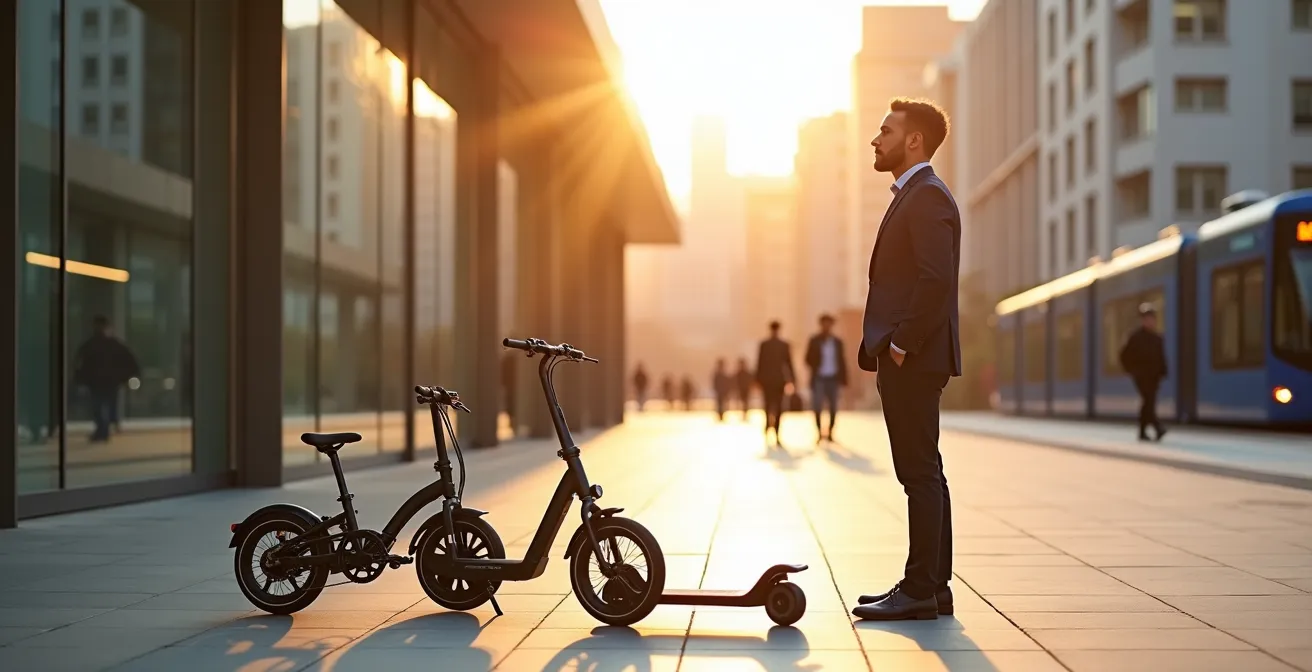
The daily 15-minute walk from the train station to your office is more than an inconvenience; it’s a significant drain on your time and energy. The solution isn’t just buying a scooter, but mastering a system of micro-efficiencies for your entire journey. This guide focuses on practical, sweat-free strategies—from folding your device on a crowded train to timing your office exit—that transform the last mile from a frustrating chore into a streamlined, optimized part of your day.
The train doors slide open. You step onto the platform, joining the river of fellow commuters. But for you, the journey isn’t over. You still face the “last mile”—that 15-minute walk to the office. It seems trivial, but day after day, it adds up. It’s the walk in the summer heat that leaves you flustered before your first meeting, the brisk pace in the cold that feels like a chore, and the cumulative hours lost each week. It’s the final, frustrating hurdle in an already long commute.
Many people’s first instinct is to grab the nearest “solution”: a clunky scooter, a cumbersome bike, or just resigning themselves to the walk. But these often create new problems—the awkward struggle on a crowded train, the fear of theft, or simply trading one hassle for another. The conventional approach looks at the vehicle, but the real issue is the entire process. It ignores the hidden points of friction that steal your time and peace of mind, from navigating station crowds to waiting for a packed elevator at your destination.
But what if the key wasn’t simply choosing a device, but mastering a complete system? This guide adopts a different perspective. We will treat your last mile not as a distance to be covered, but as a process to be optimized. We’ll move beyond the generic “buy an e-scooter” advice and delve into the practical, operational details that make a real difference. We will focus on the strategies that eliminate friction, reclaim lost time, and ensure you arrive at your desk calm, collected, and completely sweat-free.
Throughout this article, we’ll dissect each stage of the last mile journey. We will quantify the true cost of walking, provide etiquette for using micro-mobility on public transport, compare the real-world safety of different devices, and even reveal the timing strategies that let you bypass the dreaded office elevator bottleneck. Get ready to transform your commute.
Summary: How to Reclaim Your Time and Arrive Sweat-Free
- Why Walking the Last Mile Is Costing You 2.5 Hours a Week?
- How to Fold a Scooter on a Crowded Train Without Annoying Everyone?
- Folding Bike vs Electric Skateboard: Which Is Safer for City Streets?
- The Locking Mistake That Gets Your Scooter Stolen in 5 Minutes
- When to Leave: Avoiding the Elevator Bottleneck in High-Rise Offices
- Why a Border Conflict 3,000 Miles Away Doubles Your Gas Price?
- How to Choose Between a Ladder and a Spiral Staircase for Daily Access?
- How to Maintain E-Bike Battery Life During Freezing Winters?
Why Walking the Last Mile Is Costing You 2.5 Hours a Week?
That 15-minute walk from the station to your office feels minor, but the numbers tell a different story. A 15-minute walk each way amounts to 30 minutes per day. Over a standard five-day workweek, you’re spending 2.5 hours just on that final leg of your journey. That’s 10 hours a month, or 120 hours—a full five days—per year. This is a significant time cost, a hidden tax on your productivity and personal life, often overlooked because it’s broken into small, daily chunks.
The cost, however, extends beyond just lost time. Research from Harvard Business School reveals a startling link between commute distance and professional output. The study found that longer commutes actively kill productivity, with top-performing employees suffering the most significant losses. For every 10 kilometers of added commute, companies saw a 5% drop in patents filed and a tangible 7% decline in the quality of work. While your last mile isn’t a 10km trek, it represents a daily point of friction that depletes your cognitive energy before the workday even begins.
This daily walk forces you into a “time vs. effort” compromise. You can walk at a relaxed pace and arrive late, or rush and arrive flustered and sweaty. Neither is optimal. The goal of a last-mile solution is to break this compromise, allowing you to be both punctual and composed. By replacing that 2.5-hour weekly walk with a 30-minute e-scooter ride, you aren’t just getting from A to B faster; you are performing an act of time arbitrage, buying back productive hours and preserving the mental focus you need for high-value work.
Ultimately, reclaiming this time isn’t a luxury; it’s a strategic decision to invest in your own well-being and professional effectiveness.
How to Fold a Scooter on a Crowded Train Without Annoying Everyone?
Owning a folding e-scooter solves the last-mile problem, but it can create a new one: managing it on a crowded train. The key to avoiding dirty looks and frustrated sighs is not brute force, but etiquette and preparation. It’s about treating the folding process as a planned maneuver, not a last-minute panic. The goal is to become invisible, completing the task so efficiently that you don’t disrupt the flow of other passengers boarding or alighting.
The most common mistake is waiting until the train is pulling into the station to start fumbling with latches and hinges. A seasoned commuter anticipates the transition. This means mastering your scooter’s folding mechanism at home until it’s muscle memory. You should be able to fold it in under 15 seconds without looking. The real-world application of this skill is what separates a smooth journey from a stressful one.
To help you perfect this, here is a simple protocol to follow. This isn’t just about folding; it’s about situational awareness and minimizing your footprint in a shared, fast-moving environment. The following steps will help you handle your device with the grace of a pro.
Your Action Plan: The 5-Step Pre-Platform Folding Protocol
- Anticipate Arrival: Check your train schedule or app 2 minutes before reaching your station to begin your preparation.
- Find Your Zone: Move to a clear area on the platform, away from the main boarding zones and yellow lines where people congregate.
- Pre-emptive Fold: Engage the folding mechanism and collapse the scooter *before* the train has fully stopped and the doors open.
- Secure Everything: Once folded, ensure all loose parts, especially the handlebars, are securely locked in place to prevent them from swinging out.
- Strategic Positioning: Hold the folded scooter vertically, close to your body, and position yourself near the doors but out of the direct line of entry or exit.
This illustration captures the ideal moment of efficient preparation, where the commuter is in control and ready before the train even arrives.
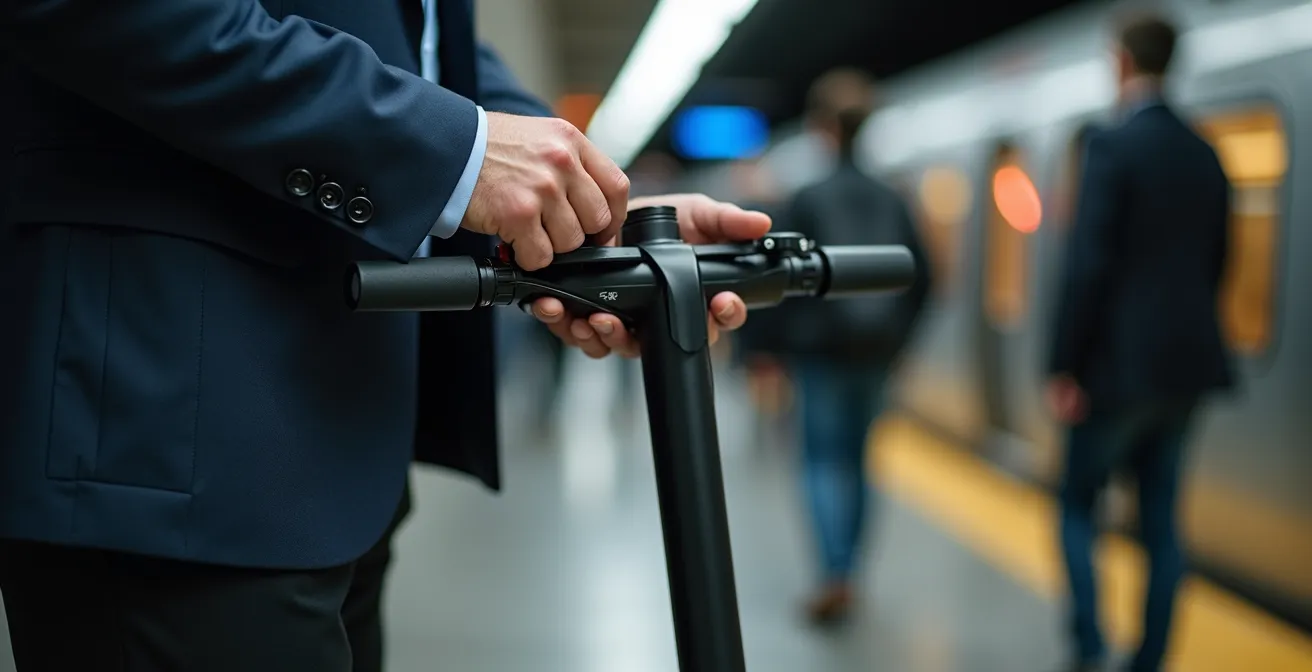
As you can see, the focus is on a quick, decisive action in a designated space. By adopting this protocol, you transform the scooter from a potential nuisance into a seamless part of your multi-modal commute. You show respect for fellow passengers and remove a major source of personal stress.
It’s a small change in routine that has a huge impact on the quality of your daily journey.
Folding Bike vs Electric Skateboard: Which Is Safer for City Streets?
Once you decide to upgrade from walking, the choice of vehicle becomes paramount. Two popular options, the folding bike and the electric skateboard, offer very different experiences, especially concerning safety. While both can solve the last-mile problem, their designs create distinct risk profiles on unpredictable city streets. It’s a classic trade-off between the inherent stability of a bicycle and the extreme portability of a skateboard.
The fundamental difference lies in wheel size and center of gravity. A folding bike, with its 16-20 inch wheels, can roll over potholes, grates, and road imperfections that would instantly stop an electric skateboard’s small 3-4 inch wheels, potentially throwing the rider. Furthermore, the seated position on a bike provides a lower, more stable center of gravity and the familiarity of handlebars for control. An e-skateboard requires constant balance and active rider input, making it more vulnerable to sudden swerves or unexpected obstacles.
This choice is particularly relevant given the nature of urban travel. The National Household Travel Survey found that 35% of U.S. car trips are under 3.5 kilometers, a distance perfectly suited for micro-mobility. As more people adopt these devices, understanding their safety nuances is critical. The following table breaks down the key safety factors to help you make an informed decision based on your route and risk tolerance.
| Safety Factor | Folding Bike | Electric Skateboard |
|---|---|---|
| Wheel Size | 16-20 inches – handles potholes better | 3-4 inches – vulnerable to road imperfections |
| Braking Distance (Wet) | 15-20 feet at 15mph | 25-35 feet at 15mph |
| Visibility to Drivers | Higher profile, more recognizable | Lower profile, easily obscured |
| Center of Gravity | Seated position, stable | Standing, higher risk during swerves |
| Learning Curve | Minimal – intuitive for most | Steep – requires balance skills |
For a commuter prioritizing safety and stability on varied urban terrain, the folding bike is the superior choice. For those whose route is smooth and who value ultimate portability above all else, an electric skateboard might be feasible, but it comes with a significantly steeper learning curve and higher inherent risk.
The Locking Mistake That Gets Your Scooter Stolen in 5 Minutes
Investing in a high-quality last-mile vehicle is pointless if it gets stolen. The single biggest security mistake commuters make is not the quality of their lock, but their locking technique. Many riders will invest in a heavy-duty U-lock, only to secure it through a flimsy or easily removable part of the scooter, like the steering column or a wheel. This is what thieves look for—it’s the equivalent of locking your house but leaving the key under the mat.
Professional thieves can defeat a poorly placed lock in minutes. They can simply unbolt the wheel or handlebars and walk away with the most valuable part of the device: the frame, motor, and battery. The golden rule of scooter security is to always lock the main, non-removable part of the frame to a solid, immovable object. The lock should pass through the deck or a welded part of the chassis that cannot be disassembled with simple tools.
This extreme close-up shows the correct technique: the U-lock is secured through the scooter’s solid frame, making it impossible to separate the lock from the most valuable components.

However, for high-risk urban areas, a single lock is often not enough. A determined thief might still target your wheels or other components. A layered security approach, combining different types of protection, creates multiple obstacles and deterrents. It makes your scooter a much less attractive target than the one next to it with just a single, poorly placed lock. This multi-layer strategy moves beyond simple “security theater” to create a genuinely robust defense.
To protect your investment, adopt the following 3-layer security strategy:
- Layer 1 (The Core): Use a heavy-duty, sold-secure rated U-lock. Pass it through the main, non-removable part of the scooter’s frame and attach it to a solid bike rack or pole. Never lock only the steering column.
- Layer 2 (The Secondary): Add a secondary steel cable lock. Loop this cable through your front wheel and then connect it back to the primary U-lock. This prevents a thief from quickly removing the front wheel.
- Layer 3 (The Deterrent): Install a motion-activated disc brake alarm. This small device attaches to your brake rotor and emits a loud, piercing alarm if the scooter is moved, drawing immediate attention and scaring off most opportunistic thieves.
By combining a strong primary lock, a secondary cable, and an audible alarm, you create a formidable security system that makes your vehicle far too much trouble for the average thief.
When to Leave: Avoiding the Elevator Bottleneck in High-Rise Offices
You’ve successfully navigated the train and your last-mile vehicle, arriving at your building with time to spare. But a final, frustrating bottleneck awaits: the elevator. In any high-rise office, the elevators become a point of major congestion at peak times, especially between 8:45-9:05 AM and 4:55-5:15 PM. Getting stuck in this queue can easily add 5 to 10 minutes to your commute, undoing the time you saved with your scooter or bike.
The average American commute is already a significant time sink. Recent U.S. Census data reveals a 27.2-minute average one-way commute time, and that’s before accounting for these building-specific micro-delays. Solving the last mile is not just about the journey *to* the building, but the journey *to your desk*. Beating the elevator rush requires a strategic approach to your departure and arrival times, a concept we can call “shoulder timing.”
Shoulder timing is about deliberately positioning yourself just outside the peak demand window. Instead of aiming to leave at exactly 5:00 PM along with everyone else, you leave slightly before or slightly after the rush. This small shift can have a disproportionately large impact, allowing you to walk straight into an empty elevator while others are still queuing in the lobby. It’s the final piece of time arbitrage in your daily commute.
Here is a simple but highly effective strategy to implement:
- Leave 5 minutes before the hour (e.g., 4:55 PM). This allows you to get ahead of the mass exodus that happens precisely on the hour or half-hour.
- Or, wait 10 minutes after the hour (e.g., 5:10 PM). By this time, the initial rush has cleared, and the elevators are significantly less crowded.
- Pre-pack your bag and power down your devices 3 minutes before your target departure time. This ensures you can leave your desk the instant your target time arrives.
- Take a final water or coffee break at your desk, not by the water cooler near the elevators, which only adds to the congestion.
- Learn your building’s elevator patterns. Many buildings have express elevators serving only high floors and local elevators serving lower ones. Knowing which to take can save crucial minutes.
By consciously managing your exit time, you can eliminate one of the most frustrating and unnecessary delays in your daily commute, ensuring a smooth journey from start to finish.
Why a Border Conflict 3,000 Miles Away Doubles Your Gas Price?
For commuters who rely on cars, the cost of the journey is directly tied to the volatile global energy market. A geopolitical conflict, a natural disaster, or a policy decision made thousands of miles away can cause gas prices to spike overnight. This financial uncertainty is a major source of stress and makes budgeting for commute costs nearly impossible. The national economic impact is staggering, with studies showing that national congestion costs have reached $269 billion per year, a figure exacerbated by rising fuel prices.
This is where micro-mobility offers a powerful form of economic insulation. By switching to an electric scooter or e-bike for the last mile—or even the entire commute if the distance is short—you effectively disconnect your transportation costs from the unpredictable price of oil. The cost of charging a small battery is negligible and stable compared to filling a gas tank. This shift provides not just cost savings, but more importantly, cost predictability.
This trend is not just a niche movement; it’s a major economic shift. As commuters seek refuge from volatile fuel costs, the adoption of personal electric vehicles is accelerating.
Case Study: Micromobility as Economic Insulation
Research from McKinsey highlights a significant behavioral change driven by cost and convenience. Their analysis shows that by 2025, the total kilometers traveled using micromobility solutions are projected to rise 10% above pre-pandemic levels. This growth is largely attributed to commuters actively seeking alternatives to the financial volatility of gas-powered vehicles. By embracing electric personal vehicles, they are creating a personal hedge against global oil market fluctuations, making their daily commute costs stable and predictable.
Choosing an electric last-mile solution is more than a convenience; it’s a smart financial decision that grants you control and stability in an unstable world.
How to Choose Between a Ladder and a Spiral Staircase for Daily Access?
When selecting a micro-mobility device, commuters face a fundamental trade-off. We can conceptualize this as the choice between a “ladder” and a “spiral staircase.” The ladder—representing an ultra-light, minimalist electric scooter—is incredibly portable and easy to carry, but requires significant focus and effort to use. The spiral staircase—representing a sturdier folding bike—is far more stable and comfortable to ride but is heavier and more cumbersome to transport and store.
There is no single “best” choice; the optimal solution depends entirely on the specific demands of your commute. If your journey involves carrying the device up several flights of stairs or navigating packed train cars, the “ladder” approach of prioritizing ultra-portability (sub-26 lb scooters) is likely the winner. The ability to quickly fold and carry the device with one hand becomes the most critical feature.
Real-World Portability vs. Rideability Test
An extensive test of over 200 different commuter devices found a clear dividing line. Ultra-light scooters weighing under 26 lbs (12kg) excelled in mixed-mode commutes that involved stairs and public transit. However, their small wheels and lack of suspension made for a harsh ride. In contrast, heavier models in the 37-53 lb (17-24kg) range, often equipped with suspension, provided vastly superior ride comfort and stability but severely challenged portability, proving difficult to carry and store in a typical office environment.
Conversely, if your commute has few stairs and your priority is a comfortable, stable ride over potentially uneven city streets, the “spiral staircase” of a folding bike is the more logical choice. The cognitive load is lower, the ride is more relaxed, and its larger wheels provide a greater margin of safety. The following table breaks down this “Portability vs. Rideability” spectrum.
| Factor | ‘Ladder’ (Ultra-light scooter) | ‘Staircase’ (Folding bike) |
|---|---|---|
| Weight | 8-12kg – highly portable | 15-20kg – manageable but heavier |
| Storage Footprint | Wall-mountable, vertical storage | Floor space required |
| Stability | Requires constant focus | More stable and comfortable |
| Cognitive Load | High – constant balance attention | Low – relaxed awareness |
| Deployment Time | 30 seconds to unfold | Instant – always ready |
Ultimately, you must audit your entire route—from your front door to your office desk—and decide which factor, extreme portability or enhanced rideability, is the non-negotiable element for a successful, stress-free commute.
Key takeaways
- Solving the last mile is about optimizing a system, not just buying a device. Focus on eliminating “friction points” like folding, locking, and waiting.
- The choice of vehicle is a trade-off on the “Portability vs. Rideability” spectrum. Audit your full journey (including stairs and train crowds) to find your priority.
- Micro-efficiencies like “shoulder timing” for elevators and pre-platform folding for scooters save significant time and reduce daily stress.
How to Maintain E-Bike Battery Life During Freezing Winters?
For year-round commuters, winter introduces a formidable enemy to any electric vehicle: the cold. Low temperatures can dramatically reduce the performance and lifespan of the lithium-ion batteries that power e-bikes and e-scooters. The chemical reactions inside the battery slow down, leading to a noticeable drop in range and power. In fact, battery performance data shows up to a 30% range loss below 5°C (41°F). This can turn a reliable commute into a stressful race against a dying battery.
Ignoring these effects doesn’t just mean a shorter ride; it can cause permanent damage. Charging a freezing-cold battery or storing it in sub-zero temperatures can lead to the formation of “dendrites” within the battery cells, irreversibly degrading its capacity. Proper winter battery care is therefore not just about performance, but about protecting the most expensive component of your vehicle.
The core principle of winter battery maintenance is temperature management. Your goal is to keep the battery as close to room temperature (around 20-25°C or 68-77°F) as possible, for as long as possible, especially during storage and charging. This requires a proactive approach and a slight change in your daily routine, but it will pay significant dividends in battery longevity and reliable winter performance.
Follow this protocol to ensure your battery weathers the winter safely:
- Always store the battery indoors. Never leave your e-bike or scooter with the battery attached outside or in an unheated garage overnight. Bring the battery inside to a room-temperature environment.
- Insert the battery just before you ride. Keep the battery warm indoors until the last possible moment. This maximizes its starting temperature and initial performance.
- Charge only at room temperature. After a ride in the cold, bring the battery inside and let it warm up for at least an hour before plugging it in to charge.
- Use thermal insulation during rides. A neoprene battery cover acts like a jacket, helping to trap the heat the battery generates during use and shielding it from the cold air, which can preserve range.
- Avoid deep storage in the cold. If you’re storing the bike for a long period over winter, do so with the battery at 40-60% charge, indoors, and away from freezing temperatures to prevent permanent damage.
Start implementing these micro-efficiency strategies today to transform your daily commute from a tolerated chore into a streamlined, stress-free part of your day.