
The key to fixing open-plan noise isn’t just adding soft furnishings; it’s a strategic, multi-layered approach that treats your home as an acoustic system.
- Identify specific acoustic issues like flutter echo and reverberation before applying solutions.
- Combine sound absorption (textiles) with sound diffusion (furniture, dividers) for maximum effectiveness.
- Integrate lighting, ventilation, and zoning to create distinct areas for activity and quiet.
Recommendation: Start by mapping the primary sound paths in your home—from the kitchen to the living area, for instance—and strategically place materials to interrupt them.
The appeal of an open floor plan is undeniable: light-filled spaces, a sense of connection, and effortless flow. Yet, for many families, this architectural dream quickly becomes an acoustic nightmare. The children’s television blares into the kitchen, a conversation at the dining table makes it impossible to read on the sofa, and the clatter of pots and pans reverberates through the entire level. This constant barrage of sound isn’t just annoying; it creates a subtle but pervasive layer of stress and erodes the very sense of togetherness the open plan was meant to foster. When every sound travels, privacy becomes a luxury.
Conventional wisdom suggests simple fixes: throw down a rug, hang some curtains. While these are starting points, they often fall short because they fail to address the root of the problem—the physics of sound in a large, hard-surfaced environment. Without a technical understanding of how sound waves reflect, absorb, and travel, these efforts are often cosmetic at best. In residential settings, echo and reverb problems in large living rooms make it more difficult to converse, forcing people to speak more loudly and exacerbating the problem.
But what if the solution wasn’t just about dampening sound, but about strategically managing it? The true key lies in approaching your space like an acoustic interior designer, viewing sound, light, and even air circulation as interconnected systems. This guide moves beyond the generic advice to provide a practical, technical framework. We will diagnose the specific acoustic issues plaguing your space, deploy materials based on their proven performance, and design intentional “acoustic zones” that restore both peace and privacy to your home.
This article will guide you through the technical principles and practical applications needed to transform your noisy open space into a comfortable, acoustically balanced home. By understanding the ‘why’ behind each solution, you can make targeted, effective changes that truly work.
Summary: A Technical Guide to Open Plan Acoustics
- Why Your Open Living Room Sounds Like a Cafeteria When Guests Arrive?
- How to Use Rugs and Curtains to Dampen Sound Without Looking Cluttered?
- Bookshelves or Screens: Which Divider Creates Better Visual Privacy?
- The Ventilation Mistake That Spreads Kitchen Odors to the Sofa
- Where to Place the Reading Nook in a Busy Open Layout?
- Why You Absorb Your Colleague’s Stress and How to Shield Yourself?
- How to Position Task Lighting to Eliminate Shadows on Your Workspace?
- How to Design a Modern Minimalist Interior That Reduces Anxiety?
Why Your Open Living Room Sounds Like a Cafeteria When Guests Arrive?
The “lively” atmosphere of your open-plan living room during a gathering is a direct result of two acoustic phenomena: reverberation and flutter echo. In a space with large, parallel, hard surfaces—like drywall, hardwood floors, and large windows—sound waves from conversations and activities don’t get absorbed. Instead, they bounce back and forth, arriving at your ears at slightly different times. This creates a long, trailing sound decay known as reverberation, which muddies speech clarity and forces everyone to talk louder to be heard. The problem is quantifiable; a noisy environment can cause a significant 14% drop in cognitive performance as your brain works overtime to filter out the noise.
Flutter echo is a more specific issue, a fast, repetitive ringing or buzzing sound that occurs between two parallel reflective surfaces. When you clap your hands in an empty room and hear a “zzzing,” that’s flutter echo. It adds a harsh, metallic quality to the ambient sound, making the space feel cold and acoustically unpleasant. These hard surfaces act like mirrors for sound, creating a chaotic and fatiguing auditory environment that is the polar opposite of a comfortable family space.
Diagnosing the problem is the first step toward solving it. You don’t need special equipment to identify these issues in your own home. A simple hand clap can reveal a lot about your room’s acoustics. By paying attention to the specific type of echo, you can better target your solutions. The goal is not to create a dead, silent space like a recording studio, but to control the reflections just enough to restore warmth, clarity, and a sense of calm. This is the foundation of acoustic zoning, where you intentionally manage sound to suit the function of each area.
3 Steps to Identify Flutter Echo in Your Space
- Stand in the center of your room and clap your hands sharply—listen for a rapid ‘zzziing’ or metallic ringing sound.
- Move between parallel walls and repeat the clap test, particularly near hard surfaces like windows and bare walls.
- Play music with sharp percussion (snare drums, cymbals) and note any blurring or metallic tail to these sounds.
Understanding these principles is crucial because it shifts the focus from “decorating” to “treating.” Every element you add to the room can either worsen the problem or become part of the solution.
How to Use Rugs and Curtains to Dampen Sound Without Looking Cluttered?
Textiles are the first line of defense against reverberation, but their effectiveness is not a matter of guesswork; it’s a science measured by the Noise Reduction Coefficient (NRC). The NRC is a rating from 0 to 1 that indicates how much sound a material absorbs. A rating of 0 means no absorption (like glass), while a rating of 1 means perfect absorption. To be an effective acoustic tool, a material should have an NRC of 0.35 or higher. This is why a thin cotton throw rug does little to solve a noise problem, while a thick, high-pile wool rug can make a noticeable difference.
The strategy is to layer high-NRC materials strategically. For floors, don’t just add a rug—add a high-density felt or rubber-composite rug pad underneath. This invisible layer can often provide more sound absorption than the rug itself. Aim to cover at least 60% of the hard floor surface in your primary conversation zones, such as the area around your sofa and chairs. For windows, which are major sound reflectors, choose heavy, plush fabrics like velvet or lined linen. To maximize their effect, install curtains on ceiling-mounted tracks that extend 6-12 inches beyond the window frame on each side. This allows the curtain to absorb sound waves that would otherwise reflect off the adjacent wall space.
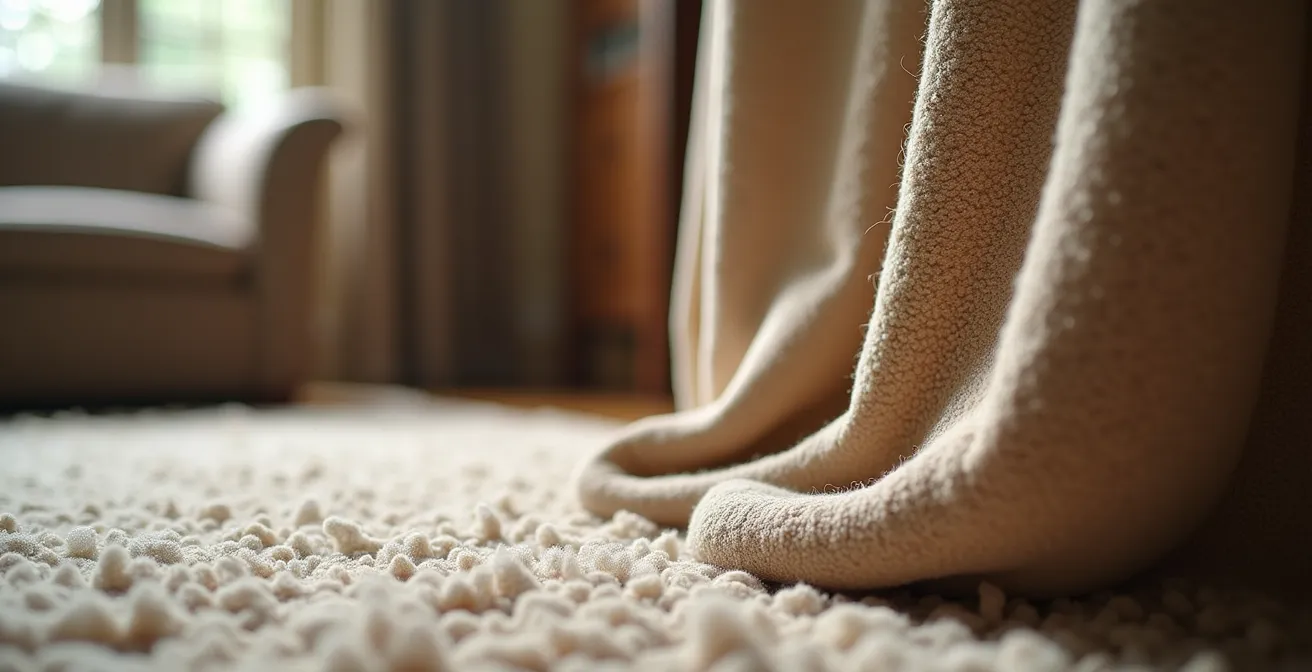
This technical approach avoids a cluttered look because it prioritizes performance over quantity. Instead of adding many small, ineffective items, you are selecting a few high-performance pieces and installing them correctly. For instance, using a double curtain rod allows you to hang both a sheer curtain for light and a heavy acoustic drape for sound control, giving you functional flexibility without visual bulk. It’s about making smart, targeted choices based on material science, not just aesthetics.
This table compares the sound-absorbing properties of common household textiles. As the data from a comprehensive analysis of NRC ratings shows, material choice has a significant impact on acoustic performance.
| Material | NRC Rating | Sound Absorption Level |
|---|---|---|
| Heavy Wool Rugs | 0.35-0.45 | Moderate |
| Velvet Curtains | 0.40-0.50 | Moderate to Good |
| Cotton Drapes | 0.15-0.30 | Low to Moderate |
| Shag Carpets | 0.30-0.40 | Moderate |
| Acoustic Panels | 0.85-1.00 | Excellent |
Ultimately, the goal is to integrate these functional elements so seamlessly that they enhance the design rather than detract from it.
Bookshelves or Screens: Which Divider Creates Better Visual Privacy?
When creating zones in an open plan, dividers serve a dual purpose: they provide visual privacy and manage acoustics. However, not all dividers are created equal. The choice between a solid bookshelf and a lighter screen depends on whether your primary goal is sound absorption or sound diffusion. A large, open-backed screen might create a visual boundary, but it does little to stop sound from passing through it. In contrast, a substantial bookshelf, especially one filled with books of varying sizes and depths, is a far superior acoustic tool.
A bookshelf filled with books acts as an excellent sound diffuser. Rather than simply blocking sound, diffusion scatters sound waves in multiple directions, breaking up strong reflections and preventing flutter echo. The irregular surfaces of the book spines create a complex topography that disperses sound energy, making the room feel acoustically larger and more comfortable. For maximum effect, the bookshelf should be as large and dense as possible. An open-backed étagère with a few decorative objects will be less effective than a solid-backed unit packed with books.
If the goal is purely visual privacy and the footprint must be minimal, a folding screen is a valid option. To enhance its acoustic properties, choose one made of or covered in a heavy, sound-absorbing fabric. A better alternative for a lightweight divider is a hanging panel made of compressed felt or a similar acoustic material. These can be suspended from the ceiling to create a clear visual break without occupying floor space, and they offer moderate sound absorption. The key is to think about the sound path interruption. Will the divider physically block the line-of-sight path sound takes from the source (e.g., the kitchen) to the listener (e.g., the sofa)? A tall, solid bookshelf does this best, creating an “acoustic shadow” behind it.
Ultimately, the most effective divider is one that is both substantial enough to interrupt sound paths and designed to either absorb or diffuse the sound waves that strike it, actively contributing to the room’s acoustic health.
The Ventilation Mistake That Spreads Kitchen Odors to the Sofa
In an open-plan home, air is an invisible conduit for more than just temperature—it transports sound and odors. A common and often overlooked mistake is the placement of HVAC return air vents. If a large return vent is located in the living area, it creates negative air pressure that actively pulls air—along with cooking odors and noise from the kitchen—directly toward it. Your high-powered range hood might be pushing air out, but the home’s main HVAC system can be working against it, spreading the smell of fried onions right to your sofa.
The technical solution is to manage air pressure and flow. First, ensure your kitchen has a powerful and properly sized exhaust fan, ideally rated for at least 300 CFM (Cubic Feet per Minute), to capture odors and moisture at the source. More importantly, consider creating a subtle “air curtain.” This doesn’t require a commercial unit; a quiet, well-placed tower fan or a large air purifier set on a low speed can create a gentle barrier of airflow between the kitchen and living zones. This disrupts the natural path of air and contains kitchen-related sounds and smells within the kitchen area.
For a more advanced solution, especially in a tightly sealed modern home, a makeup air system may be necessary. When a powerful range hood expels a large volume of air, it can create significant negative pressure in the house, causing it to pull air from unwanted places (like the chimney or tiny gaps in windows). A makeup air system is a dedicated vent that actively brings fresh, filtered air into the home to balance this pressure, improving both air quality and the effectiveness of your kitchen ventilation. It’s a prime example of how managing one system (air) directly impacts the comfort of another (smell and sound). In a shared space, every distraction matters, as studies show it takes an average of 20 minutes to regain focus after an interruption.
This holistic view of your home’s systems is fundamental to creating a truly comfortable and functional open-plan environment.
Where to Place the Reading Nook in a Busy Open Layout?
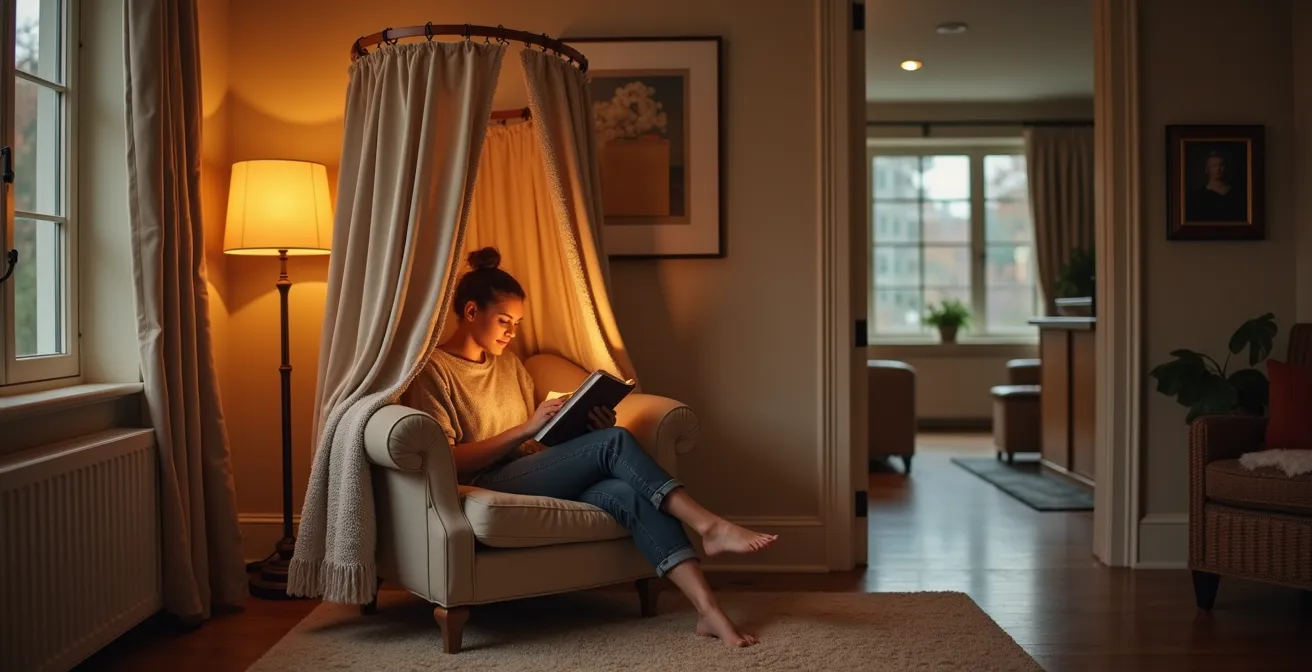
Creating a quiet sanctuary like a reading nook in a bustling open plan requires more than just a comfy chair; it demands the strategic creation of an “acoustic shadow.” An acoustic shadow is an area shielded from direct sound waves by a large physical barrier. The ideal location for a reading nook is in a corner, where two walls naturally help to contain sound and block it from the rest of the space. By placing a large, solid object—like the previously discussed bookshelf—between the nook and the primary noise source (e.g., the kitchen or play area), you can significantly reduce the amount of direct sound entering the quiet zone.
The furniture within the nook is also part of the solution. A high-back wing chair is an excellent choice, as the “wings” act as personal sound barriers, wrapping around your head and shielding your ears from ambient noise. This creates a micro-environment of acoustic privacy. The entire nook should be built on a foundation of sound absorption. Place a thick, textured rug underneath the seating area to absorb floor reflections, and consider adding soft elements like a plush throw blanket, cushions, or even a fabric wall hanging or canopy to absorb more sound.
Finally, complete the multi-sensory design by controlling light and introducing beneficial sound. Use a focused task lamp to create a pool of warm light, visually defining the nook as a separate, intimate space. This visual boundary reinforces the psychological sense of separation. To combat the remaining intrusive background noise, introduce a source of “white noise” or, more accurately, “sound masking.” A small, dedicated white noise machine or even a tabletop fountain can produce a gentle, constant sound that covers up the distracting fluctuations of conversation and activity from elsewhere in the home. This makes speech less intelligible and therefore less likely to pull your focus.
Checklist for your multi-sensory reading nook
- Choose a corner location where two walls meet to naturally terminate sound waves.
- Install a high-back wing chair that creates a physical sound barrier around head level.
- Place a thick, textured rug (minimum 8×10 feet) underneath the seating area.
- Add a focused task light with adjustable brightness to define the space visually.
- Include a small white noise machine or fountain to mask ambient conversation.
This targeted approach allows for peaceful coexistence, enabling one family member to read quietly while others engage in livelier activities nearby.
Why You Absorb Your Colleague’s Stress and How to Shield Yourself?
While the title references a colleague, the principle is universal and highly applicable to a family in an open-plan home: without acoustic privacy, you absorb the stress of those around you. When you can hear every frustrated sigh from someone paying bills, the tense tone of a difficult phone call, or the escalating volume of sibling squabbles, you are involuntarily exposed to their emotional state. This phenomenon, known as emotional contagion, is amplified in environments with no acoustic separation. Indeed, multiple studies confirm people in open-plan offices experience higher stress levels, a finding that translates directly to a shared home environment.
Shielding yourself requires a combination of environmental controls and personal strategies. The first step is to establish “headphone zones” or times. This is a social contract within the family where wearing headphones signals a need for focus and an immunity from interruption. It’s a clear, non-verbal cue that someone is creating their own bubble of acoustic privacy. For those working from home or taking important calls, using a directional microphone is crucial. These microphones are designed to pick up sound directly in front of them while rejecting ambient noise from the sides and rear, minimizing how much of your family’s activity is broadcasted and reducing the need for you to ask for quiet.
For a more passive, whole-room solution, consider implementing a sound masking system. Often mistaken for white noise, sound masking is a specifically engineered, unobtrusive background sound (similar to airflow) tuned to the frequencies of human speech. It doesn’t eliminate noise but reduces its intelligibility. When you can hear that someone is talking but can’t make out the words, the conversation is far less distracting and emotionally engaging. This raises the overall ambient sound floor, making sudden noises less jarring and creating a more consistent, less stressful acoustic backdrop for everyone in the space.
By implementing these technical and social strategies, you can reclaim a degree of cognitive and emotional privacy, even in the most open of layouts.
How to Position Task Lighting to Eliminate Shadows on Your Workspace?
In an open-plan design, lighting is more than just illumination; it’s a powerful tool for visual and acoustic zoning. While the primary function of task lighting is to provide focused, shadow-free light for activities like cooking or reading, the fixtures themselves can be selected and positioned to contribute to your acoustic goals. The key is to move away from a single, central overhead light source, which tends to create harsh shadows and does nothing for sound control, and instead adopt a layered lighting approach.
To eliminate shadows on a workspace (like a kitchen counter or a desk), the light source should come from in front of or to the side of you, not directly from behind or above. For kitchen islands, this means using multiple pendant lights spaced evenly above the work surface. Here, the fixture choice becomes an acoustic opportunity. Instead of hard metal or glass pendants that reflect sound, opt for large fabric drum pendants. These act as mini sound absorbers suspended in the middle of the room, tackling noise exactly where it’s often generated. Position them 30-36 inches above the countertop for optimal light and acoustic benefit.
This principle of using light to define zones extends throughout the space. An adjustable floor lamp with a fabric shade placed next to an armchair not only provides perfect reading light but also creates a visual “wall,” signaling a separate zone. By using multiple light sources at different heights—floor lamps, table lamps, pendants, and recessed lighting—you create a more visually interesting and comfortable environment while also breaking up large, flat ceiling and wall surfaces that contribute to sound reflection. The goal is a holistic design where the materials chosen for lighting fixtures are considered for their acoustic properties, contributing to a quieter, more serene environment.
This multi-functional approach is the essence of smart open-plan design, where every element serves more than one purpose.
Key takeaways
- The core acoustic problems in open plans are reverberation and flutter echo, caused by sound reflecting off hard, parallel surfaces.
- A multi-layered solution is required, combining sound absorption (high-NRC textiles), sound diffusion (irregular surfaces like bookshelves), and sound path interruption.
- Effective zoning involves creating “acoustic shadows” for quiet areas and using lighting and even airflow to define functional spaces.
- Material choices should be technical, not just aesthetic; prioritize items like fabric light fixtures and high-density rug pads that serve a dual purpose.
How to Design a Modern Minimalist Interior That Reduces Anxiety?
A minimalist aesthetic, with its clean lines and uncluttered surfaces, can paradoxically create an acoustically anxious environment. The very lack of “stuff”—fewer soft furnishings, less furniture, and more exposed hard surfaces—is a perfect recipe for harsh reverberation and echo. Designing an acoustically calm minimalist interior requires “invisible” solutions that control sound without compromising the visual style. The goal is to maintain an ambient background noise level within the 35-40dB optimal range recommended by acoustic experts, which is difficult in a sparse room.
One of the most effective solutions is acoustic plaster. This is a specially formulated plaster system applied to ceilings or walls that looks exactly like a standard smooth plaster finish but contains microscopic pores that trap and absorb sound waves. With a high NRC rating (often 0.70-0.90), it provides powerful sound absorption while remaining completely invisible, making it the ultimate tool for minimalist acoustic design. Similarly, micro-perforated wood or metal panels can be used on walls or ceilings. From a distance, they appear to be solid surfaces, but they are covered in tiny, almost invisible holes that allow sound to pass through and be absorbed by an acoustic backing material.
Furniture choices can also be strategic. Instead of a standard sofa, consider one upholstered in a high-texture, sound-absorbent fabric like bouclé or chenille. Bass traps, which are crucial for controlling low-frequency sounds that accumulate in corners, can be integrated into custom furniture like media units or corner cabinets, hiding their function completely. A sound masking system, as mentioned earlier, is another invisible solution that installs small emitters in the ceiling to create a uniform, unobtrusive background sound that increases speech privacy and reduces the jarring effect of sudden noises.
This table showcases some “invisible” solutions perfect for maintaining a minimalist aesthetic while achieving acoustic comfort.
| Solution | Visual Impact | NRC Rating | Installation |
|---|---|---|---|
| Acoustic Plaster | Invisible | 0.70-0.90 | Ceiling/Wall |
| Micro-perforated Panels | Minimal | 0.65-0.85 | Wall/Ceiling |
| Integrated Bass Traps | Hidden in furniture | 0.80-1.00 | Corners |
| Sound Masking Systems | Invisible | N/A | Ceiling mounted |
By employing these advanced, integrated solutions, you can achieve the serene, calming atmosphere that minimalism promises in both a visual and an auditory sense, proving that an open space can be both clean and quiet.