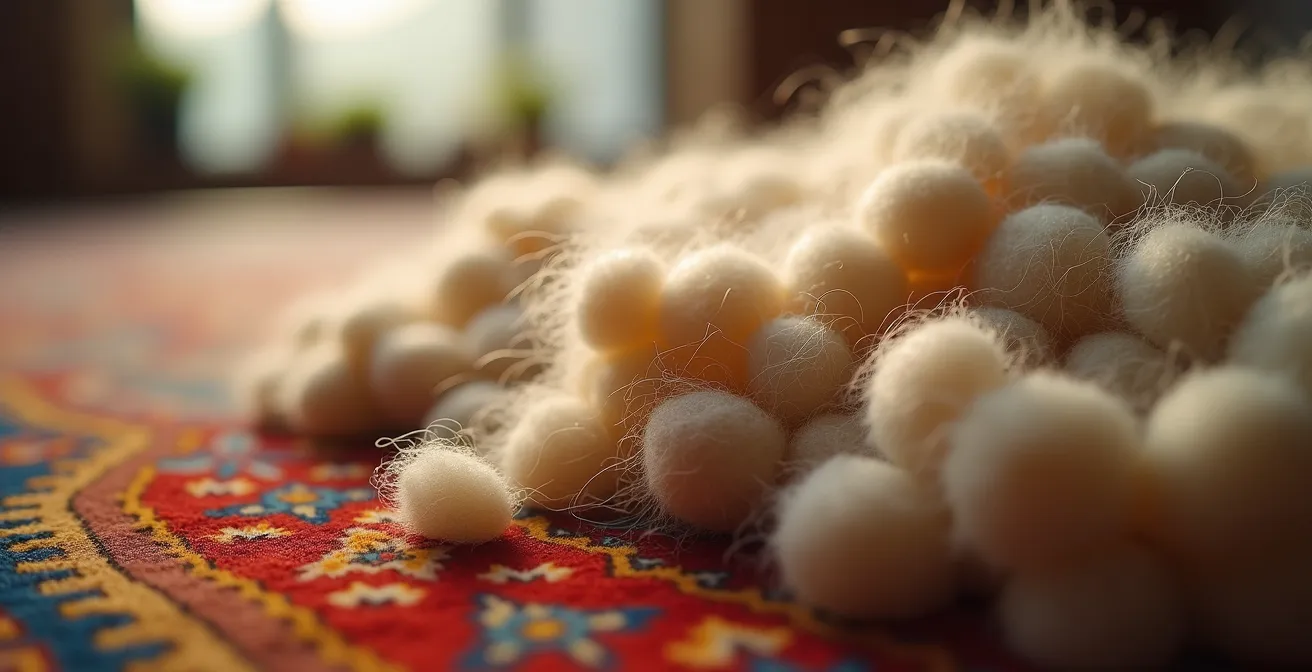
Contrary to popular belief, a high knot count is not the ultimate sign of a valuable vintage rug; the quality and life within the wool itself is the true measure of a lasting investment.
- Authentic, hand-spun “living wool” contains natural lanolin, giving it a signature luster and resilience that appreciates over time.
- Understanding market dynamics, like the value of “semi-antique” pieces and where to look, allows you to acquire high-quality rugs before they are marked up.
Recommendation: Shift your assessment from simple visual checks to a material-first approach by learning to test for wool quality, a skill that separates a decor purchase from a genuine investment.
The search for the perfect vintage rug is a pursuit of more than just a floor covering; it’s a quest for a piece of history, a story woven in wool and dye. For the decor enthusiast, a genuine Persian or Turkish rug is the soul of a room, a timeless anchor that promises sustainable beauty. Yet, the online marketplace is fraught with peril. The fear of investing a significant sum into a clever fake—a lifeless imitation masquerading as a storied antique—is a valid and paralyzing concern for many buyers.
Common advice often revolves around simple visual cues: check for a mirrored pattern on the back, look for minor imperfections, or obsess over the knot count. While not incorrect, these tips only scratch the surface. They fail to address the fundamental qualities that give a rug its value, longevity, and character. They teach you to inspect an object, but not to understand a material.
But what if the most crucial factor of authenticity wasn’t about counting knots, but about recognizing life? The true secret lies in developing an appraiser’s eye, one that can distinguish “living wool” rich with lanolin from its “dead,” processed counterparts. This guide moves beyond the platitudes. We will delve into the material science that dictates a rug’s ability to age gracefully, the preservation techniques required to protect your investment, and the market strategies that uncover hidden value. By the end, you will have the framework to not only identify an authentic rug but to curate a home filled with pieces of genuine, lasting worth.
This article provides a comprehensive framework for developing that discerning eye. We will cover everything from the material science of wool to the strategic placement that preserves value, equipping you to invest with confidence.
Summary: How to Identify Authentic Vintage Rugs and Spot Fakes Online?
- Why Knot Count Matters Less Than Wool Quality for Rug Longevity?
- How to Remove Red Wine from a 50-Year-Old Wool Rug Safely?
- Persian vs Moroccan: Which Rug Style Hides Dirt Better in High Traffic?
- The Placement Error That Fades Your Vintage Rug Value by 50%
- Where to Find Undervalued Vintage Rugs Before Dealers Buy Them?
- How to Turn Glass Jars into Functional Storage Without Looking Tacky?
- How to Use Rugs and Curtains to Dampen Sound Without Looking Cluttered?
- How to Start an Art Collection with a $500 Budget?
Why Knot Count Matters Less Than Wool Quality for Rug Longevity?
In the world of vintage rugs, knot count—or knots per square inch (KPSI)—is one of the most frequently cited metrics of quality. It’s an easy number to market, and the logic seems simple: more knots, more labor, better rug. However, this is a dangerous oversimplification. An appraiser knows that the structural integrity and long-term value of a rug are dictated not by the density of its knots, but by the intrinsic quality of its wool. A rug with a lower KPSI woven from superior, lanolin-rich “living wool” will outlast and outperform a high-KPSI rug made from brittle, over-processed “dead wool” every time.
Living wool, typically sourced from mountain-raised sheep, retains its natural lanolin. This vital oil gives the fibers elasticity, a subtle luster (known as ‘lumière’), and a natural resistance to dirt and stains. As the rug ages, this lanolin helps the pile develop a beautiful patina, enhancing its character and value. Dead wool, conversely, is dry and brittle. It may feel soft initially but lacks resilience, breaks underfoot, and absorbs spills, leading to premature decay. This is why some high-quality antique wool rugs can appreciate by 5-10% annually; their material excellence allows them to improve with age. Focusing on KPSI alone is like judging a classic car by the number of bolts used in its assembly, rather than the quality of its engine.
Distinguishing between these wool types online requires moving beyond static photos. You must engage the seller and ask for specific evidence. A true connoisseur doesn’t just look; they investigate the very soul of the material.
Your Action Plan: The Live Wool vs. Dead Wool Test
- Request the Bend Test: Ask the seller for a short video where they gently bend a single fiber. Living wool will spring back immediately, while dead wool will stay bent or break.
- Look for Lanolin Sheen: Examine high-resolution photos and videos for a natural, soft glow rather than a dull, matte finish. This ‘lumière’ is the hallmark of high-lanolin content.
- Inquire about Elasticity: Ask the seller to gently stretch a small, inconspicuous part of the rug. High-quality wool will snap back to its original shape without distortion.
- Examine Fiber Variation: Authentic hand-spun wool is never perfectly uniform. Look for subtle variations in fiber thickness in close-up shots, a sign of artisanal production.
- Ask About Wool Origin: A knowledgeable seller should be able to tell you about the wool’s source. Wool from sheep raised in high-altitude, cold climates is superior due to higher lanolin production.
Ultimately, a rug’s ability to last for generations is woven into the very DNA of its fibers. By prioritizing wool quality over a simple knot count, you shift from being a mere buyer to a knowledgeable investor.
How to Remove Red Wine from a 50-Year-Old Wool Rug Safely?
The moment a glass of red wine tips over onto a cherished vintage rug is a moment of pure panic. With antique textiles, however, the response must be one of calm, deliberate preservation, not frantic scrubbing. The primary goal is not just to remove the stain but to do so without damaging the delicate, aged wool fibers and natural dyes. Aggressive cleaning, hot water, or harsh chemicals can cause irreversible harm, such as color bleed, fiber shrinkage, and stripping of the essential lanolin that protects the rug.
Your immediate actions in the first few minutes are critical. The key is to blot, not rub. Rubbing grinds the stain deeper into the wool’s core. You must also use cold water, as hot water will set the tannins in the wine, effectively cooking the stain into the fibers permanently. Preparing a small, dedicated “rug first-aid kit” can make the difference between a minor incident and a catastrophe. This includes white cotton towels (to avoid dye transfer), club soda (its carbonation helps lift fresh spills), and salt to draw out moisture.
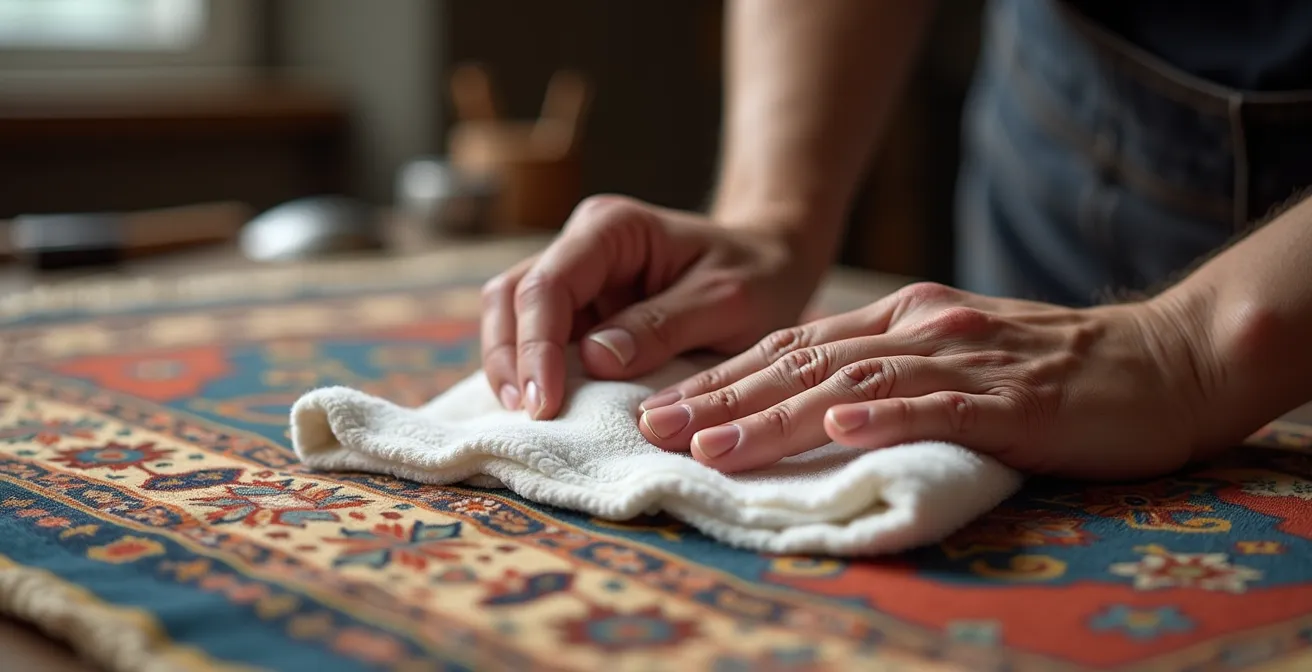
As the image above illustrates, the proper technique is a gentle, patient process. While immediate first aid can mitigate damage, many aged or significant stains require professional intervention. A trained conservator has access to specialized immersion washing techniques and spotting agents that are pH-balanced for antique wool. They don’t just clean; they preserve the rug’s integrity.
Case Study: Professional Restoration of a Wine-Stained Heirloom
An inherited Persian rug, clouded by years of accumulated dirt and a prominent old wine stain, was brought to a professional restoration service. After a controlled immersion wash, the rug’s colors brightened by an estimated 40%, revealing crisp deep blues and ivories. The team then hand-repaired the fringe and used specialized spotting techniques to lift the final traces of the wine stain. The client remarked that the rug looked as it did in their childhood home, its value and sentimental importance fully restored.
Treating a stain on a vintage rug is an act of stewardship. By understanding the material and respecting its age, you can manage accidents effectively and ensure the piece continues its story for decades to come.
Persian vs Moroccan: Which Rug Style Hides Dirt Better in High Traffic?
When selecting a vintage rug for a high-traffic area like a hallway or living room, practical considerations become as important as aesthetics. The ability of a rug to camouflage everyday dust, dirt, and foot traffic is a crucial functional advantage. Persian and Moroccan rugs, two of the most sought-after styles, offer surprisingly different approaches to this challenge, rooted in their distinct weaving traditions, patterns, and material properties.
Persian “city” rugs, like Kirman or Tabriz, often feature intricate, all-over patterns such as the Herati (fish) or Mina Khani motifs. This dense “visual noise” is incredibly effective at masking small particles and dust; the eye is too busy following the complex design to notice minor debris. Conversely, many Moroccan rugs, particularly from the Beni Ouarain tribe, use simple geometric designs on a vast field of cream or white wool. While this would seem to show dirt easily, their defense is a deep, shaggy pile that creates “shadow camouflage,” where dirt simply falls to the base of the fibers, hidden from view until the rug is shaken out. Furthermore, tribal Moroccan and some village Persian rugs often use wool with extremely high lanolin content, which acts as a natural dirt and stain repellent.
The choice between them depends on your maintenance style and aesthetic preference. A Persian rug requires more frequent surface vacuuming, while a Moroccan rug benefits from a periodic, vigorous shake-out. The following table breaks down these functional differences.
This comparison is essential for a strategic purchase, as highlighted by a recent analysis of rug characteristics that affect daily use and long-term value.
| Feature | Persian Rugs | Moroccan Rugs |
|---|---|---|
| Pattern Complexity | Intricate all-over patterns (Herati, Mina Khani) create ‘visual noise’ that masks dust | Simple geometric patterns show dirt more readily |
| Pile Height | Low to medium pile (5-12mm) | High pile (15-25mm) creates ‘shadow camouflage’ effect |
| Dirt Management | Dirt sits on surface, requires regular vacuuming | Dirt falls to base, can be shaken out rather than vacuumed |
| Lanolin Content | City rugs: moderate lanolin from processed wool | Tribal rugs: high lanolin from less-processed wool acts as natural repellent |
| Wear Pattern | Creates desirable patina in traffic areas | Pile flattens but maintains overall appearance |
Ultimately, selecting the right rug is a balance of form and function. By appreciating how each style is uniquely equipped to handle wear, you can choose a piece that is not only beautiful but perfectly suited to its environment.
The Placement Error That Fades Your Vintage Rug Value by 50%
An investor would never leave a valuable painting in direct sunlight. Yet, every day, decor enthusiasts unwittingly make an equivalent and costly mistake with their vintage rugs. The single most destructive element to a rug’s value is not foot traffic, but prolonged exposure to ultraviolet (UV) light. Sunlight acts as a slow-acting bleach, causing irreversible color fade that can slash a rug’s market value in half. The vibrant crimsons, deep indigos, and rich saffrons derived from natural dyes are particularly vulnerable, turning into pale, washed-out versions of their former glory.
This damage is not a “patina”; it is a flaw. A desirable patina is an even, gentle softening of colors and pile that occurs from balanced use over many decades. Sun fading, by contrast, is almost always uneven, creating harsh lines or “sun squares” where a piece of furniture once sat. An appraiser can spot this damage instantly, and it represents a significant and permanent deduction in value. Protecting your investment requires a proactive strategy of light management. This means understanding how natural light moves through your room during the day and establishing “safe zones” and “danger zones” for your valuable textiles.
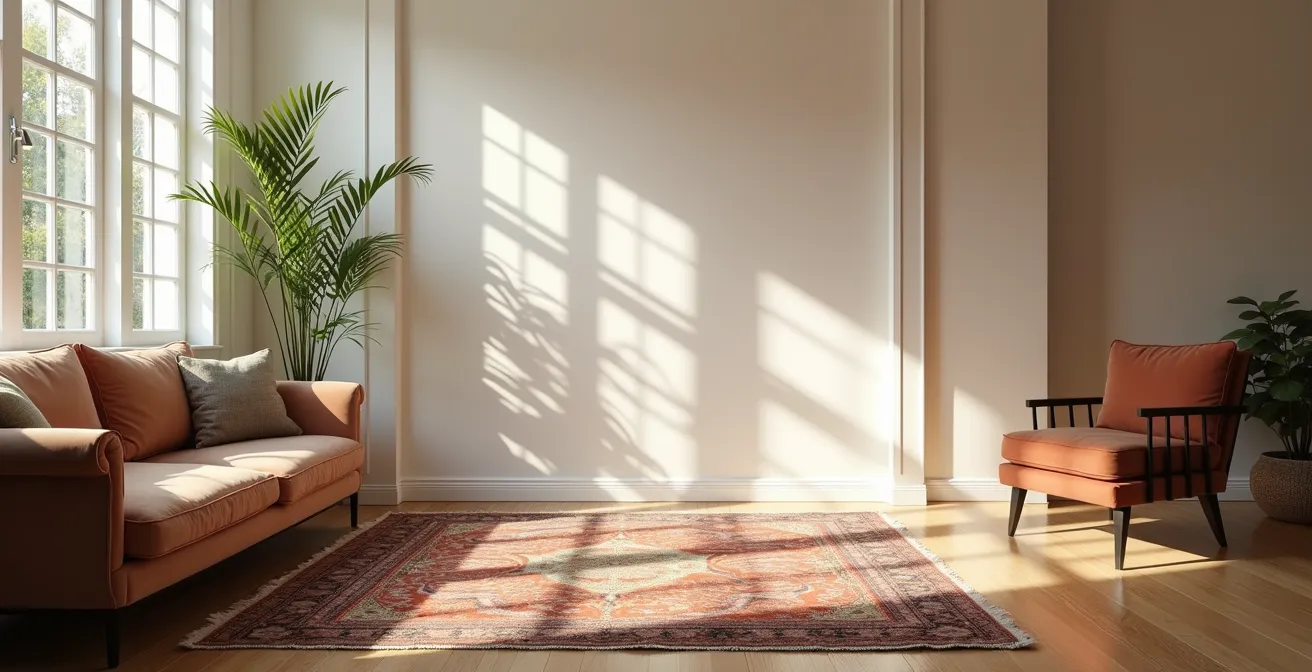
As this visual demonstrates, a rug’s placement should be a conscious decision based on light patterns, not just furniture arrangement. The most effective long-term solution is to treat the source of the problem. Applying a high-quality, nearly invisible UV-protective window film prevents irreversible color fade by blocking up to 99% of harmful rays without darkening your room. This, combined with a quarterly rotation schedule to ensure even exposure to any ambient light and foot traffic, is the gold standard for preserving the life and value of your rug.
Finally, a quality rug pad is not a mere accessory; it is structural insurance. It absorbs the impact of footfalls, prevents slipping, and allows the rug to breathe, further protecting its foundation from the stresses of daily life.
By treating your vintage rug as the light-sensitive asset it is, you become its steward, ensuring its beauty and value endure for the next generation to appreciate.
Where to Find Undervalued Vintage Rugs Before Dealers Buy Them?
The vintage rug market operates on a significant level of information asymmetry. Professional dealers have the knowledge, network, and speed to acquire the best pieces at low prices from estate sales, private sellers, and obscure auctions, before marking them up for retail. For a decor enthusiast to find a truly undervalued gem, the goal is to bridge this information gap and learn to hunt where the dealers hunt. This requires moving beyond curated online storefronts and into the digital equivalent of flea markets and back-alley auctions.
The key is a combination of unconventional search tactics and timing. Dealers often rely on their trained eye, but they also use systematic strategies. You can replicate these by setting up alerts for commonly misspelled keywords like “Persian rugg” or “oriantal carpet.” Listings from sellers unfamiliar with the proper terminology are often priced incorrectly. Similarly, targeting auctions that end at off-peak times—like midday on a Tuesday—can reduce competition from casual buyers. The most significant opportunity often lies in the “semi-antique” category. A knowledgeable buyer knows that semi-antique rugs aged between 50-80 years often possess superior craftsmanship and materials from the mid-20th century without carrying the premium price tag of a true antique (100+ years).
Building relationships is another dealer tactic. Following independent “pickers” on social media platforms like Instagram can give you first-look access to their finds, often shared in temporary stories before being formally listed. Engaging in specialized Facebook groups can also provide insider tips and leads. When you do find a promising piece, act like a professional: always request additional photos in different lighting conditions (natural daylight, evening indoor light) to verify colors and condition before committing. A seller’s reluctance to provide this is a major red flag.
- Set up alerts for misspelled terms: ‘Persian rugg’, ‘Morocan carpet’, ‘oriantal rug’, ‘old family carpet’.
- Target off-hour auctions: Focus on listings ending midday on weekdays or in the very early morning to avoid peak bidding wars.
- Follow independent ‘pickers’ on Instagram: They often reveal new finds in their stories before they hit their shops.
- Join niche Facebook groups: Search for groups dedicated to antique and vintage Oriental rugs to learn from seasoned collectors.
- Scan estate sales in affluent, older neighborhoods: Executors unfamiliar with rug values can severely underprice items.
By thinking and searching like a dealer, you change the dynamic from being a passive consumer to an active, discerning collector, capable of finding exceptional value where others aren’t looking.
How to Turn Glass Jars into Functional Storage Without Looking Tacky?
The same curatorial eye that assesses the value of a vintage rug can be applied to the most mundane of household objects: the glass jar. The challenge is to elevate this utilitarian item from a remnant of pantry goods to a piece of intentional, functional decor. The difference between a collection of jars that looks like chic, organized storage and one that simply looks like un-recycled clutter lies in a few key appraiser’s principles: consistency, materiality, and presentation.
First, prioritize consistency in form. Instead of an eclectic mix of salsa jars and pickle containers, invest in a uniform set. Look for simplicity in shape—straight-sided cylinders or classic apothecary forms often work best. The goal is to create a cohesive visual rhythm, not a chaotic jumble. Remove all labels cleanly. The beauty of the arrangement should come from the contents within, not from distracting branding.
Second, focus on the quality of the material. Just as you assess the life in wool, assess the quality of the glass. Look for clarity and a pleasing weight. Thin, flimsy glass feels cheap, whereas thicker, clearer glass has a substance that feels more permanent and valuable. Consider the lid as well—acacia wood, bamboo, or matte metal lids provide a sophisticated, uniform finish that ties the collection together. The interplay between the natural texture of a wooden lid and the smooth glass can be particularly effective.
Finally, consider presentation. Group the jars together to create a visual statement on an open shelf or a countertop. Play with the contents as a decorative element. Storing items with visual appeal—like pasta, colorful lentils, coffee beans, or bath salts—turns the functional into the beautiful. For items that are less visually pleasing, consider using amber or smoked glass jars to create a uniform, mysterious look that conceals the contents while maintaining the elegant form.
By applying these principles of form, material, and curation, glass jars are transformed from tacky afterthoughts into a sophisticated and organized system that enhances your decor.
How to Use Rugs and Curtains to Dampen Sound Without Looking Cluttered?
Beyond their visual impact, textiles like rugs and curtains serve as crucial tools in a room’s acoustic architecture. In modern homes with hardwood floors and minimalist design, sound can bounce aggressively, creating an environment that feels harsh and unwelcoming. The strategic use of textiles is the most effective way to absorb sound, reduce echo, and craft a space that feels calm and serene. The key is to achieve this acoustic comfort without sacrificing a clean, uncluttered aesthetic.
The sound-dampening capability of a rug is directly related to its mass and pile height. Thick, dense, natural fibers are exceptionally effective at trapping sound waves. As a market analysis of rug materials shows, wool consistently outperforms synthetic materials in acoustic dampening. High-pile varieties are the champions of sound absorption. A shaggy Moroccan Beni Ouarain or a thick Persian Gabbeh acts like an acoustic sponge on your floor. In contrast, a flat-weave Kilim, while beautiful, offers minimal sound absorption on its own. However, its effectiveness can be dramatically increased by layering it over a thick, high-quality felt pad, combining aesthetic appeal with acoustic function.
For curtains, the principles are similar: mass and texture are key. Heavy materials like velvet, wool, or lined linen are far more effective than sheer, lightweight fabrics. To avoid a cluttered look, opt for a single, wall-to-wall curtain track rather than multiple small rods. A floor-to-ceiling curtain creates a clean, architectural line that makes the room feel taller and more cohesive, all while providing a large surface area for sound absorption. The color should complement the walls to create a monolithic, serene backdrop rather than a jarring visual interruption.
The choice of rug can have a measurable impact on a room’s acoustics, as detailed in industry data on sound absorption ratings.
| Rug Type | Pile Height | Sound Absorption Rating | Best Room Application |
|---|---|---|---|
| Moroccan Beni Ouarain | 20-30mm high pile | Excellent (NRC 0.35-0.45) | Home theaters, bedrooms |
| Persian Gabbeh | 15-25mm thick pile | Very Good (NRC 0.30-0.40) | Living rooms, studios |
| Turkish Tulu | 25-40mm shag pile | Superior (NRC 0.40-0.50) | Music rooms, apartments |
| Kilim (flat-weave) | 3-5mm no pile | Minimal (NRC 0.10-0.15) | Layer over thick pad for effect |
| Persian City Rug | 8-12mm medium pile | Good (NRC 0.25-0.35) | Dining rooms, hallways |
Sound is an invisible layer of decor. By selecting the right textiles, you can sculpt a room’s acoustic character to be as beautiful and considered as its visual design.
Key Takeaways
- Prioritize Material Over Metrics: The longevity and value of a vintage rug are determined by the quality of its “living wool,” not just its knot count.
- Sunlight is the Greatest Threat: Irreversible UV damage is the fastest way to destroy a rug’s value. Proactive light management and rotation are non-negotiable.
- Develop a Universal ‘Curatorial Eye’: The same principles used to assess a valuable rug—material quality, form, and preservation—can be applied to elevate all objects in your home.
How to Start an Art Collection with a $500 Budget?
The prospect of starting an art collection can feel intimidating, synonymous with elite auction houses and astronomical prices. However, the foundational skill of a collector is not a vast budget, but a developed curatorial eye—the very same eye you are honing for vintage textiles. Collecting art, even with a modest budget of $500, is entirely achievable by applying the same principles: research, identifying undervalued markets, and trusting your aesthetic instincts while being informed by market realities.
First, specialize to maximize impact. With a limited budget, you cannot be a generalist. Choose a niche that genuinely interests you. This could be contemporary prints from local artists, vintage photography, or small-scale ceramic sculptures. Focusing your research and attention on one area allows you to quickly develop expertise, recognize quality, and spot opportunities that others might miss. Instead of a single, larger purchase, a $500 budget might allow you to acquire two or three excellent pieces from emerging artists, which is the start of a true collection.
Second, hunt where value is born, not where it is established. Established art galleries are often out of reach. Instead, look to graduate shows at art schools, local art fairs, and online platforms like Etsy or Instagram where artists sell directly to buyers. Following artists early in their careers allows you to acquire their work before they gain gallery representation and their prices increase. This is the art-world equivalent of finding a semi-antique rug before a dealer does. You are investing in potential.
Finally, buy what you love, but do so with an informed perspective. Research the artist. Do they have a consistent body of work? What is their story? A piece with a strong narrative and clear artistic intent has more long-term potential than something purely decorative. Your $500 is not just a purchase; it’s a vote of confidence in an artist’s career. It’s an investment in culture and creativity that will pay dividends in daily enjoyment and, potentially, in future value.
Begin your journey today by applying these principles of assessment, not just to rugs or art, but to every piece you consider for your home. By doing so, you transform your space from a decorated house into a curated collection of personal and lasting value.