
Your grocery bill isn’t just about inflation; it’s a real-time indicator of global geopolitical stability and supply chain fragility.
- Distant conflicts and trade disputes directly impact your costs through hidden channels like shipping insurance, raw material tariffs, and energy volatility.
- Strategic stockpiling isn’t about panic-buying; it’s a calculated process of using predictive economic signals to acquire essentials *before* price hikes and shortages hit.
Recommendation: Shift from being a reactive consumer to a proactive household supply chain manager by learning to read these global signals and build a resilient budget.
If you’ve felt the sting of a grocery receipt that seems to climb higher each week, you’ve likely blamed it on “inflation.” While that’s part of the story, it’s a dangerously incomplete picture. The reality is that your shopping cart is at the very end of a long, complex, and increasingly fragile global supply chain. Events happening thousands of miles away—a border skirmish, a new trade tariff, or a diplomatic standoff—create ripple effects that inevitably land on the price tag of your milk, bread, and coffee.
Most advice focuses on generic budgeting tips like using coupons or buying in bulk. These are reactive measures that treat the symptom, not the cause. They fail to address the fundamental shift in our interconnected world: geopolitical instability is no longer a distant news headline; it is a direct and measurable risk to your household’s economic security. Understanding this connection is the first step toward building genuine financial resilience.
But what if the key wasn’t just to save money, but to anticipate these shocks? This guide adopts the mindset of a supply chain analyst to decode the invisible wires connecting global events to your local supermarket. We will move beyond the headlines to identify the real predictive indicators of a coming price hike or shortage. You will learn not just to react to empty shelves, but to see them coming and act strategically before the crowd.
This article will provide a framework for analyzing these risks, adjusting your purchasing strategy, and building a smart, rotating stockpile—a “living pantry”—that ensures stability without wasting money on panic-buys. It’s time to transform your approach from passive consumer to empowered household strategist.
text
To help you navigate these complex dynamics, we’ve structured this guide to build your understanding step-by-step, from the fundamental mechanisms to practical, inflation-proofing strategies you can implement immediately.
Summary: A Household Manager’s Guide to Navigating Global Supply Shocks
- Why a Border Conflict 3,000 Miles Away Doubles Your Gas Price?
- How to Adjust Your Shopping List During International Trade Embargoes?
- Real Crisis vs Media Hype: Which Geopolitical Events Should You Worry About?
- The Panic-Buying Error That Wastes $500 a Year During Global Instability
- Spotting the Next Shortage: 3 Signals Before the Shelves Go Empty
- When to Buy Non-Perishables: Creating a Stockpile Before the Next Price Hike
- How to Read Your Utility Bill to See If Selling Power Back Is Profitable?
- How to Inflation-Proof Your Household Budget Without Sacrificing Quality of Life?
Why a Border Conflict 3,000 Miles Away Doubles Your Gas Price?
The link between a distant conflict and the price you pay at the pump seems obvious: war disrupts oil supply. But this is a surface-level understanding. The true impact is deeper, rooted in the mechanics of the global supply chain. When geopolitical tensions rise in a key shipping lane like the Strait of Hormuz or the Suez Canal, the first and most immediate effect is on risk. The cost of cargo and vessel insurance skyrockets for any ship passing through the area. This “risk premium” is immediately passed down the line, affecting not just oil tankers but every container ship on the water.
Secondly, these conflicts force logistical rerouting. A vessel that can no longer safely pass through a chokepoint may have to add weeks and thousands of nautical miles to its journey, burning vast amounts of extra fuel. This doesn’t just delay shipments; it fundamentally increases the base cost of transportation for everything, from crude oil to the finished plastic goods made from it. The price at the pump isn’t just a reflection of crude oil supply; it’s a direct measure of the cost and risk of global movement.
Therefore, a household strategist should monitor not just oil prices, but the cost of shipping insurance and major route diversions. These are the predictive indicators that signal a coming wave of price increases, long before it’s officially reported as “inflation.” Understanding this mechanism of supply chain fragility allows you to anticipate, rather than just react to, rising energy costs that will ultimately affect your entire budget.
How to Adjust Your Shopping List During International Trade Embargoes?
Trade embargoes and tariffs are the economic weapons of geopolitical conflict, and their impact is felt directly in the grocery aisle. When a country imposes tariffs, it’s a direct tax on imported goods. This isn’t just a problem for luxury items; it strikes at the heart of the food supply chain. A tariff on aluminum, for instance, doesn’t just affect car manufacturing—it makes every single canned good, from soup to vegetables, more expensive to produce and package.
A smart household manager must practice what we can call “geopolitical arbitrage” in their shopping. This means understanding which products are most vulnerable to these shocks. A product’s vulnerability depends on two factors: its import dependency and the availability of local substitutes. Coffee, for example, is almost entirely imported in many Western countries, making it highly susceptible to price shocks from disruptions in producing nations. A clear example of this was seen in the sharp rise of canned goods prices following tariff hikes. This is reflected in NielsenIQ data on Thanksgiving food prices, which show the average unit price for canned cranberry sauce leaping from $2.02 in November 2024 to $2.52 by October 2025 due to these pressures.
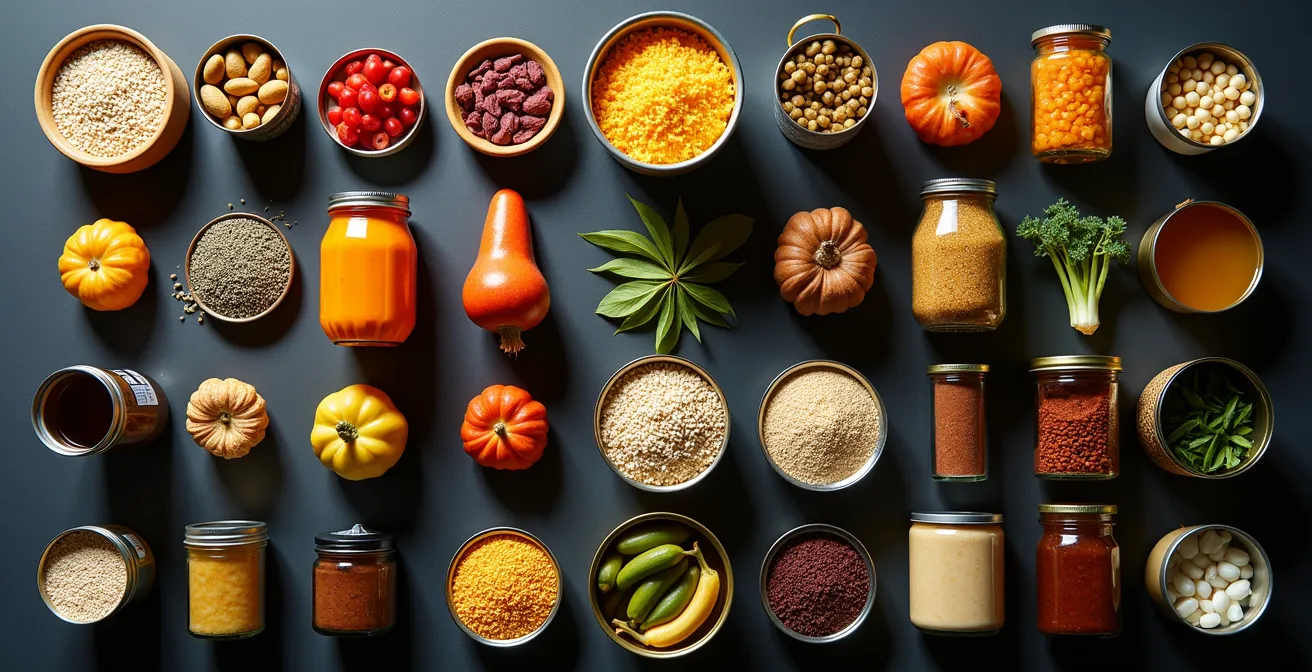
The visual above conceptualizes this vulnerability. The key is to assess your regular shopping list and identify these high-risk items. For every vulnerable product, identify a “local alternative” you can pivot to during a trade crisis. This proactive substitution strategy is a powerful tool to insulate your budget from targeted economic policies. The table below offers a starting point for this analysis.
This comparative analysis highlights how dependency on international trade directly influences shelf prices during a geopolitical event. Shifting consumption to local alternatives can mitigate a significant portion of the financial impact.
| Product Category | Import Dependency | Local Alternative | Price Impact During Embargo |
|---|---|---|---|
| Coffee | Nearly 100% imported | Chicory, grain coffee | +20% in 2025 |
| Tropical fruits | 100% imported | Seasonal local fruits | +15-25% |
| Rice | Variable by region | Local grains, potatoes | +10-15% |
| Canned goods | Container dependent | Home canning, fresh | +25% (aluminum tariffs) |
Real Crisis vs Media Hype: Which Geopolitical Events Should You Worry About?
In an age of 24/7 news cycles, it’s easy to feel a constant sense of impending doom. Every regional conflict is presented as a world-ending crisis, prompting anxiety and the urge to panic-buy. However, a supply chain analyst learns to filter the signal from the noise. Not all geopolitical events have the same impact on your grocery bill. The key is to differentiate between localized, contained issues and those that threaten major global chokepoints—both in shipping and production.
A political dispute in a landlocked country with no major exports, for example, is tragic but unlikely to affect global supply chains. Conversely, even minor instability near a critical maritime strait, or a drought in a “breadbasket” region that is a primary global supplier of wheat or rice, is a major red flag. These are the events to watch closely, as they have a disproportionately large impact on the entire system. Academic research confirms this is not just a perception; it’s a measurable economic reality.
Key findings show that geopolitical risks significantly raise the level of food price inflation, with a more pronounced effect observed in developing countries.
– Academic study authors, Applied Economics Journal
To avoid falling for media hype, focus on the “so what?” factor. Ask yourself: does this event directly threaten a major production zone for a staple commodity? Does it endanger a critical shipping lane? Does it involve countries that are dominant players in energy or fertilizer production? If the answer to these questions is no, you can likely afford to monitor the situation without taking immediate action with your household budget. This discerning approach separates strategic preparedness from wasteful, fear-driven reaction.
The Panic-Buying Error That Wastes $500 a Year During Global Instability
The most common reaction to a perceived crisis is panic-buying. We see images of empty shelves and immediately rush to buy anything we can get our hands on. This is not only an inefficient strategy but also an incredibly wasteful one. People buy items they don’t normally use, which end up expiring in the back of the cupboard. Or they buy massive quantities of perishable goods that go bad before they can be consumed. This reactive behavior leads to significant financial loss and does little to improve long-term security.
The superior strategy is to create a “living pantry.” This concept, also known as a “working pantry,” treats your food storage not as a static, sealed-off emergency bunker, but as an integrated part of your daily life. The core principle is simple: you only store what you actually eat, and you use a strict First-In, First-Out (FIFO) rotation system. When you buy a new can of beans, it goes to the back of the shelf. When you need beans for a meal, you take one from the front. This ensures nothing ever expires and your stockpile is always fresh.
This approach transforms stockpiling from a frantic, one-time event into a calm, continuous process. Instead of spending hundreds of dollars in a single panic-fueled trip, you gradually build your reserve by adding just one or two extra items to your regular weekly shop. This eliminates waste, spreads the cost over time, and builds a truly resilient and useful supply that reflects your family’s actual needs. Auditing your pantry regularly is key to making this system work.
Action Plan: Auditing Your Living Pantry with FIFO
- Inventory Points: Create a simple spreadsheet or notebook listing all your non-perishable items, noting purchase dates and expiration dates.
- Label & Collect: Use removable stickers or a marker to label every new item with the month and year of purchase. Group similar items together on your shelves.
- Rotation & Coherence: Physically move the newest items to the back and oldest items to the front. This forces you to use the oldest stock first, ensuring rotation.
- Consumption Check: Set a monthly calendar reminder to quickly check your stock. Note what you’re actually using and what’s sitting untouched. This tells you what to buy more of and what to stop buying.
- Integration Plan: Based on your consumption check, adjust your weekly shopping list. If you’re not using canned corn, stop buying it for the stockpile and replace it with something you do use, like pasta or rice.
Spotting the Next Shortage: 3 Signals Before the Shelves Go Empty
The ultimate goal of a household strategist is to move from reacting to shortages to anticipating them. While you can’t predict the future with certainty, there are several powerful predictive indicators in the global supply chain that can give you an early warning. Learning to watch these is like seeing the weather forecast before the storm arrives. These signals are far more reliable than frantic news headlines.
The first and most powerful signal is the Baltic Dry Index (BDI). This obscure index measures the cost of shipping raw materials like coal, iron ore, and grain across the globe. It is a pure measure of global demand and shipping capacity. When the BDI spikes dramatically, it means demand for shipping is outstripping supply, and higher costs for everything are on the horizon. Extreme volatility is a major red flag, as shown when, after a period of lows, a key indicator like the Baltic Dry Index, which saw extreme volatility, with the index jumping 88.3% in 2025 alone. A sustained, sharp rise is a clear signal to begin stocking up on staples.
The second signal is rising cargo insurance premiums. As we saw earlier, this is one of the first costs to react to geopolitical risk. Financial news outlets that cover the insurance or logistics industry will report on these spikes, and they are a direct financial measure of perceived risk in the global system. The third signal is a significant currency devaluation in a key producer country. If the currency of a major coffee or grain exporter suddenly weakens, it can disrupt their ability to trade, leading to supply shocks down the line. Monitoring these three signals provides a powerful, data-driven dashboard to forecast and prepare for the next wave of shortages.
When to Buy Non-Perishables: Creating a Stockpile Before the Next Price Hike
Knowing you need a stockpile is one thing; knowing the right time to build it is another. The worst time to buy is when everyone else is: during a crisis. Prices are high, shelves are empty, and decisions are driven by fear. The strategic time to build your “living pantry” is during periods of relative calm and stability. Your guiding principle should be to buy when it’s boring.
A smart approach is a tiered replenishment strategy. This method balances readiness with budget realities.
- Tier 1 (3-Day Supply): This is your immediate emergency kit. It should contain ready-to-eat foods and water. This tier is small and can be refreshed easily during your weekly shopping.
- Tier 2 (2-Week Supply): This is your working pantry of shelf-stable items that you use regularly (pasta, rice, canned goods). You should review and rotate this stock monthly, using the FIFO method.
- Tier 3 (3-Month+ Supply): This is your deep reserve of core staples with a long shelf life (1+ years), like dried beans, white rice, and flour. You build this tier slowly and strategically, buying these items only when prices are stable and geopolitical tensions are low.
This tiered system prevents you from having to make massive, expensive purchases all at once. You maintain a constant state of readiness (Tiers 1 and 2) while opportunistically building your long-term resilience (Tier 3) during “quiet periods.” This requires a shift in mindset from “emergency prep” to continuous supply chain management for your household. The goal is to make preparedness a routine, not a reaction.
How to Read Your Utility Bill to See If Selling Power Back Is Profitable?
The same geopolitical forces that drive up the cost of gasoline and groceries also create immense volatility in energy markets. Your monthly utility bill is a direct reflection of this instability. Wars and diplomatic tensions in energy-producing regions can cause sudden, dramatic spikes in the price of natural gas and oil, which are often the primary fuels for electricity generation. As S&P Global analysis indicates, conflicts in key regions are directly fueling spikes in energy and food prices, which central banks and, ultimately, consumers cannot ignore.
This has led to a major strategic shift among governments. There is now an accelerating focus on national security and energy independence, sometimes at the expense of pure economic efficiency. This macro trend creates opportunities for individual households. As the grid becomes more decentralized to improve resilience, policies encouraging home energy production (like solar panels) become more attractive. The profitability of selling power back to the grid is directly tied to the price volatility you see on your bill. A high “price to compare” or peak-hour energy cost on your statement is a signal that the grid is under stress and values decentralized power more.
To determine if this is profitable, you must analyze your utility bill for two key figures: the rate at which the utility buys back power (net metering or feed-in tariff rates) and the peak and off-peak electricity rates you pay. If the buyback rate is high, or if you can generate solar power during expensive peak hours and draw from the grid during cheaper off-peak hours, the financial case becomes very strong. In an era of geopolitical uncertainty, generating even a portion of your own power is not just a “green” choice; it’s a powerful hedge against energy price shocks and a move toward household resilience.
Key Takeaways
- Your grocery bill is a lagging indicator; predictive signals like shipping costs and insurance premiums offer an early warning of price hikes.
- A “living pantry” with a strict FIFO rotation system is superior to panic-buying, eliminating waste and building true resilience.
- Strategic substitution—swapping import-dependent goods for local alternatives—is a powerful defense against trade-related price shocks.
How to Inflation-Proof Your Household Budget Without Sacrificing Quality of Life?
Ultimately, true resilience in the face of geopolitical and economic instability is not just about what you can buy, but about what you can do. Stockpiling goods is a crucial buffer, but developing skills and capabilities provides a permanent defense against inflation and shortages. When the price of packaged bread doubles, the ability to bake your own from basic ingredients doesn’t just save money; it makes you independent of a fragile supply chain.
The most powerful inflation-proofing strategy is to systematically reduce your dependence on finished goods and external services. This involves a one-time investment in quality tools for food preservation (canners, dehydrators) and a continuous investment in learning. Mastering basic home repairs eliminates costly service calls. A small container garden for herbs can save a surprising amount each month. Building relationships with local farmers allows you to bypass the volatile global logistics chain entirely for certain products, often at a lower cost and higher quality.
This approach fundamentally changes your quality of life. Instead of sacrificing by “doing without,” you maintain or even enhance your quality of life through self-sufficiency and smart substitution. You are no longer just a consumer at the mercy of global markets; you are a producer and a manager of your own household economy. The table below illustrates how strategic substitutions, driven by an understanding of supply chain pressures, can yield significant savings.
| Inflated Product | Price Driver | Smart Substitute | Savings |
|---|---|---|---|
| Imported rice | Shipping costs +15% | Local potatoes/grains | 30-40% |
| Beef | Feed costs, labor | Locally sourced poultry | 25-35% |
| Packaged bread | Wheat + transport | Home-baked | 80-90% |
| Canned vegetables | Aluminum tariffs +50% | Frozen or fresh seasonal | 20-30% |
Start implementing this analytical approach today. By viewing your household through the lens of a supply chain manager, you build a resilient and prosperous budget that can withstand the next global shock, ensuring your family’s quality of life is protected no matter what happens on the world stage.