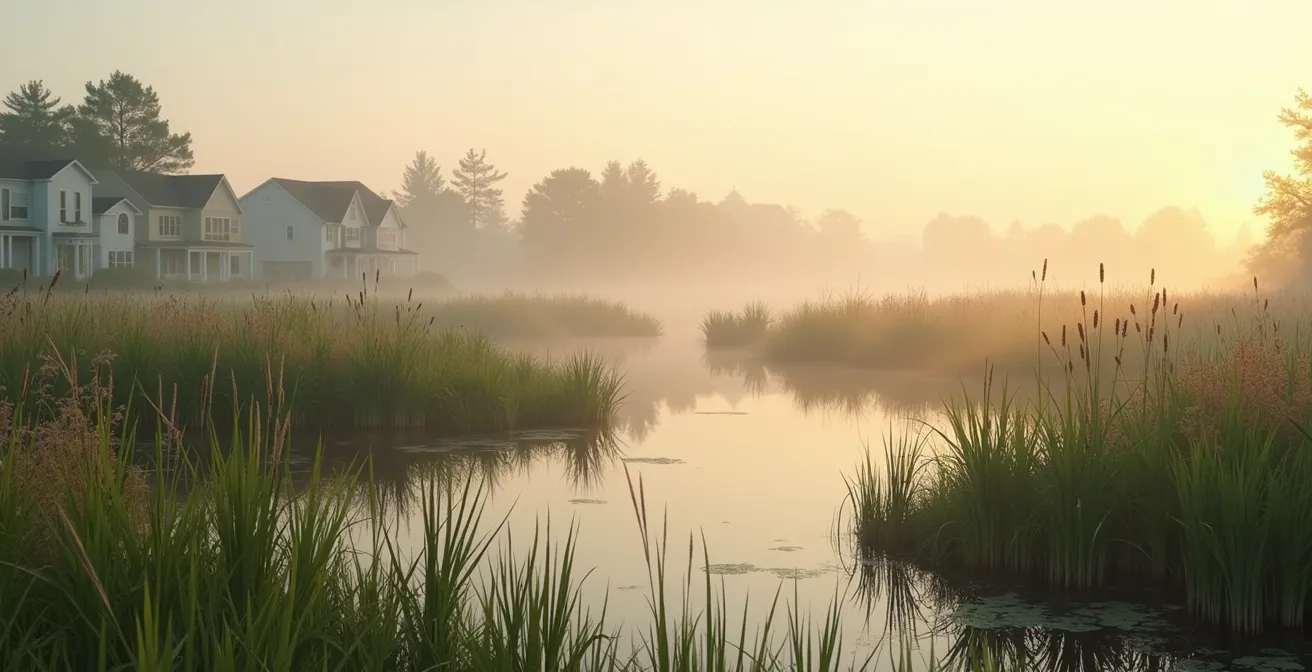
Contrary to common fears, a nearby wetland is one of the most effective, low-cost flood protection systems a property can have.
- Wetlands are not a liability but a high-performance “natural infrastructure” that actively absorbs storm surges and lowers flood risk.
- This natural protection directly translates into measurable financial benefits, including significantly lower flood insurance premiums and enhanced property value when managed correctly.
Recommendation: Instead of avoiding properties near marshlands, learn to evaluate them as a critical asset. Assess the wetland’s health and understand local buffer zone regulations to maximize your home’s safety and financial standing.
For many prospective homeowners, the sight of a marsh or wetland bordering a property triggers an immediate alarm bell: flood risk. The conventional wisdom suggests that proximity to “swampy” land is a liability, a potential source of water damage, and a future headache. This fear often leads buyers to overlook otherwise perfect homes, assuming that solid ground and concrete drainage systems offer superior protection. It’s a common and understandable hesitation, rooted in a visual assessment of risk.
But what if this assumption is fundamentally flawed? What if the very ecosystem that appears to be a threat is, in fact, a sophisticated and powerful form of natural infrastructure? The key to understanding a wetland property isn’t to view it as a risk to be mitigated, but as a high-performance asset to be valued. This guide reframes that perspective, moving beyond the myths to the science and economics of why a healthy wetland is one of the best flood defenses your home can have.
We will explore the hydrological mechanics that make wetlands superior to artificial drainage, the specific financial benefits you can realize, and the practical steps for landscaping and building in harmony with these vital ecosystems. By the end, you will be equipped to re-evaluate the true risk and reward of a home near a wetland, transforming uncertainty into a confident investment decision.
text
This article provides a complete overview of the subject. Below is a summary of the key points we will cover to help you navigate this essential topic.
Summary: Why a Healthy Wetland is Your Property’s Best Ally
- Why Wetlands Absorb Stormwater Better Than Concrete Drains?
- How to Landscape Your Yard Without Violating Wetland Protection Laws?
- Waterfront View or Flood Risk: Is the Premium Worth the Insurance Cost?
- The Draining Mistake That Turns Your Dry Basement into a Swamp
- What to Plant Near Wetlands: Species That Thrive in Soggy Soil
- The Zoning Mistake That Could Lower Your Property Value by 15%
- How to Find the “Activity Exclusions” in Your Policy?
- How to Verify if Your Reforestation Donation Actually Plants Trees?
Why Wetlands Absorb Stormwater Better Than Concrete Drains?
The primary function of a wetland during a storm is not simply to hold water, but to perform a process known as hydrological attenuation. Unlike a concrete drain or channel, which is designed to move water away as quickly as possible, a wetland is designed to slow it down, store it, and release it gradually. This fundamental difference is the key to its superior flood protection capability. A fast-moving volume of water has destructive power; a slow-moving, dispersed volume does not.
This natural infrastructure works through a combination of factors. The dense vegetation—grasses, reeds, shrubs, and trees—creates immense surface friction, acting like a brake on surging water. The porous, organic-rich soil has a tremendous capacity for absorption, drawing water down and away from the surface. As a system, it functions as a massive, living buffer. Studies confirm the staggering effectiveness of this process, showing that flood peaks may be reduced by as much as 80 percent in watersheds with healthy wetlands compared to those without. This dramatically reduces the likelihood of flash floods overwhelming downstream properties.
The value of this natural service is so significant that it is often more effective than expensive, engineered solutions. A prime example is the Charles River in Massachusetts. The U.S. Army Corps of Engineers, tasked with protecting Boston from floods, conducted a thorough analysis and concluded that preserving the 8,100 acres of upstream wetlands was the most cost-effective flood control strategy. They opted to purchase and protect this natural infrastructure rather than building new dams and levees, a powerful testament to the engineering prowess of nature.
How to Landscape Your Yard Without Violating Wetland Protection Laws?
Living next to a wetland means becoming a steward of its edge, known as the buffer zone. This area is legally protected because its health is critical to the wetland’s function. Landscaping in this zone is not prohibited, but it is regulated to prevent damage. The goal is not to have a hands-off, overgrown yard, but to work with the ecosystem. The most common framework for this is a three-zone buffer system, which provides clear guidelines for homeowners.
This system balances property owner needs with environmental protection. It’s a gradient of activity, moving from nearly untouched at the water’s edge to more managed closer to your home. Understanding these zones is the first step to planning any landscaping project, from planting a garden to removing a dead tree. Here is a typical structure you might encounter:
- Zone 1 (0-50 feet from wetland edge): The “No-Disturb” Zone. This area must be maintained in its natural state. No cutting of trees or clearing of vegetation is typically allowed here without a specific permit. This zone is the wetland’s first line of defense, providing critical habitat and maximum erosion control.
- Zone 2 (50-100 feet from wetland edge): The “Limited-Activity” Zone. In this area, selective tree cutting and removal of invasive species may be permitted, but it almost always requires prior approval from the local Conservation Commission. The goal is to enhance the buffer, not remove it.
- Zone 3 (Beyond 100 feet): The “Managed” Zone. Generally, work outside the 100-foot buffer zone does not require special permitting, as long as it does not directly impact drainage into the buffer. This is where you have the most freedom for traditional landscaping.
Always consult your local Conservation Commission before starting any work. They are not an obstacle but a resource, helping you enhance your property while protecting the invaluable natural infrastructure next door.
Waterfront View or Flood Risk: Is the Premium Worth the Insurance Cost?
The premium price for a property with a water view often comes with a perceived trade-off: higher flood insurance costs. However, when the “waterfront” is a healthy wetland, this equation changes dramatically. The risk is not what it seems. Insurance companies and climate adaptation models are increasingly recognizing the immense, quantifiable value of wetlands in mitigating flood damage. This recognition is beginning to translate into direct financial savings for homeowners.
This isn’t just a theoretical benefit. Research from institutions like the Intact Centre on Climate Adaptation at the University of Waterloo provides hard numbers. Their analysis estimated that leaving wetlands intact could reduce the financial costs of floods by up to 38% for nearby communities. This risk reduction is a powerful argument when negotiating insurance premiums. A property buffered by a functional wetland is demonstrably safer than one on an open coastline or a channelized river, and your insurance should reflect that.
The illustration below visualizes this protective dynamic, showing how the wetland acts as a natural barrier, absorbing storm surge and protecting the property behind it—a stark contrast to an exposed home.
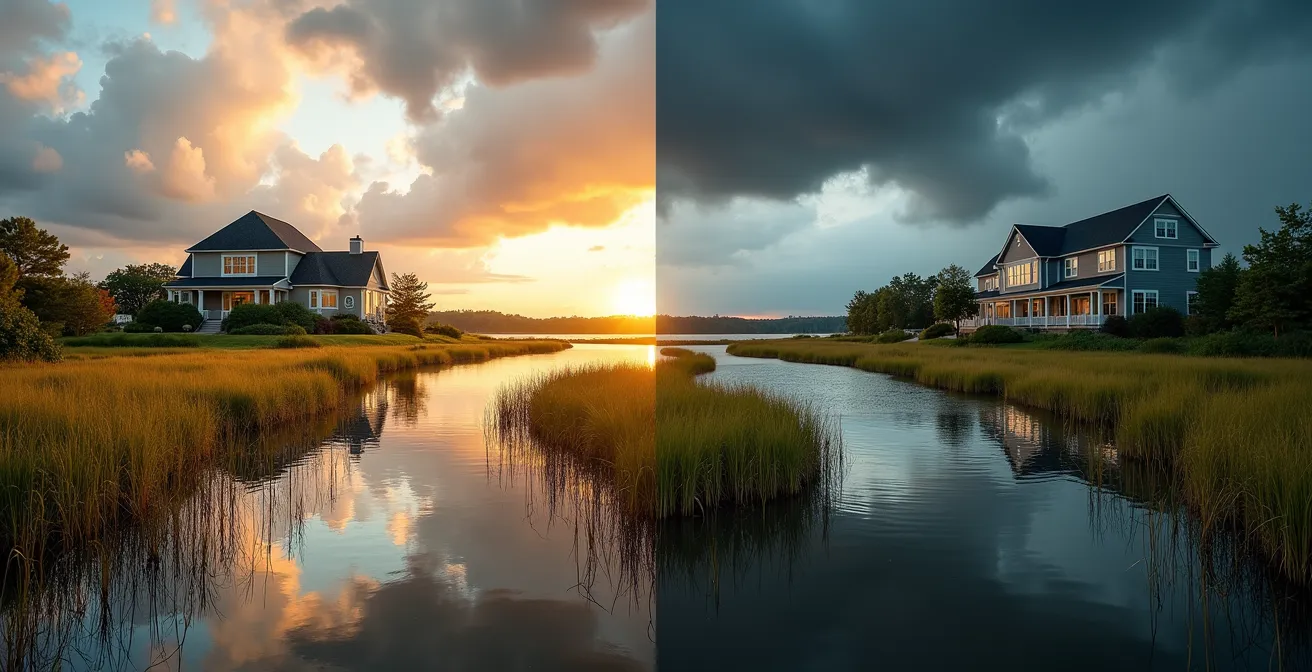
Therefore, when evaluating a property, the question becomes: “Am I paying a premium for a high-risk view or for a home with a built-in, self-maintaining flood defense system?” A healthy wetland provides not just scenic beauty but also a powerful, economic argument for long-term financial resilience. The premium may be for the view, but the true value lies in the protection.
The Draining Mistake That Turns Your Dry Basement into a Swamp
A common but dangerous misconception is that “improving” a wet area of a property by draining it will make the land safer. In reality, this action often has the opposite effect, increasing flood risk not only for your property but for the entire downstream area. Draining a natural wetland is a critical error that fundamentally alters the land’s ability to manage water, often with catastrophic results for basements and foundations.
When a wetland is drained, typically through ditches or subsurface tiles, the area’s natural water-holding capacity is destroyed. The soil compacts, the vegetation that slowed water flow dies off, and the land transforms from a sponge into a chute. As experts from Tinkers Creek Watershed Partners explain, this alteration has profound consequences. They note:
When a natural wetland is drained, the soil and water flow patterns are usually changed.
– Tinkers Creek Watershed Partners, Wetlands as a Tool for Flood Control and Prevention
This change means that during heavy rainfall, water is no longer held and released slowly. Instead, it rushes off the surface and downstream much faster. This not only increases the peak flood height but can also locally raise the water table, creating saturated ground where it was previously stable. For a homeowner, this can mean a chronically damp or flooded basement, as the ground surrounding their foundation can no longer absorb excess moisture. The attempt to create a “dry” yard paradoxically creates a swampy foundation.
What to Plant Near Wetlands: Species That Thrive in Soggy Soil
Effective landscaping near a wetland is not just about aesthetics; it’s about reinforcing the natural infrastructure that protects your home. Choosing the right native plants is one of the most proactive steps you can take. These species are adapted to moist conditions and contribute directly to flood mitigation through their unique root structures and growth habits. This is the essence of soil biomechanics: using plants as living engineering tools.
Rather than picking plants at random, it’s best to select them based on their specific flood-mitigation function. Some are excellent at holding soil in place, others are champions of water absorption, and some are best at slowing the flow of surface water. The macro-level view below shows the intricate network of roots and soil that forms this protective barrier.

By understanding these roles, you can create a robust, multi-layered defense. Here are some examples of native plants, categorized by their primary function in reinforcing your property’s natural flood defenses, based on insights from resources like guides on flood-proofing with native plants:
- Soil Stabilizers: These plants have dense, fibrous root systems that act like rebar in the soil, preventing erosion. A prime example is the Red-osier Dogwood (Cornus sericea), a rapidly growing shrub whose thick root mat is ideal for stabilizing banks.
- Super Absorbers: These species are experts at taking up large quantities of water. Cattails (Typha latifolia) and Soft Rush (Juncus effusus) are excellent choices; their rhizomatous roots also trap sediment and purify water.
- Flow Tamers: These plants have sturdy stems and a dense structure that slows down the velocity of moving water, reducing its erosive force. Buttonbush (Cephalanthus occidentalis) is highly tolerant of flooding and creates a thicket that effectively brakes surface flow while providing valuable wildlife habitat.
The Zoning Mistake That Could Lower Your Property Value by 15%
One of the most significant and often overlooked financial risks when buying property near a wetland has nothing to do with flooding, but with zoning. Misunderstanding or violating buffer zone regulations can lead to stop-work orders, costly remediation, and a significant hit to your property’s resale value. The protected land around a wetland, known as the buffer zone, is not just a suggestion; it is a legal boundary with strict rules.
In many jurisdictions, this buffer zone is a clearly defined area. For example, it is common for regulations to state that a buffer zone is the area of land that extends 100-feet outward from the boundary of the wetland. Any activity within this zone—from building a shed, to installing a patio, to extensive landscaping—typically requires a permit from the local Conservation Commission. An unpermitted structure or alteration within this zone creates a zoning violation that will be flagged during a future sale, potentially scaring off buyers or forcing you to bear the cost of removal and restoration.
This is not a minor issue. A known zoning violation can make a property difficult to finance and insure, directly impacting its market value. Before you purchase, or before you begin any project, a thorough audit of your property’s relation to the buffer zone is non-negotiable. It protects the wetland, and it protects your investment.
Your 5-Point Wetland Zoning Audit
- Locate the Boundary: Obtain the official wetlands map from your town or county. Identify the precise boundary line of the wetland resource area on your property survey.
- Measure the Buffer Zone: Using the official boundary, measure and mark the 100-foot (or locally specified) buffer zone line on your property plan. Note any existing structures (decks, sheds, patios) within this zone.
- Inventory Past Work: For any structures or significant landscaping within the buffer zone, check with the local Conservation Commission for a record of permits. An absence of a permit for existing work is a major red flag.
- Review Local Bylaws: Go beyond the state law. Read your specific town or municipality’s wetland protection bylaw. It may have stricter rules, such as a “no-build” zone or different buffer distances for streams versus ponds.
- Plan Future Projects: If you plan to build or landscape, create a clear plan that shows the work is outside the buffer zone or, if it’s inside, is designed to meet permitting requirements. Presenting this to the Conservation Commission upfront is the best path forward.
How to Find the “Activity Exclusions” in Your Policy?
Your homeowner’s insurance policy is a contract, and like any contract, the fine print matters—especially when you live near a sensitive environmental area like a wetland. While a policy may cover water damage, it will almost certainly contain “activity exclusions” that can void your coverage if the damage results from an unapproved action on your part. Finding and understanding these exclusions is crucial for ensuring you are truly protected.
These exclusions are rarely listed on the declarations page. You’ll need to look deeper into the policy document, typically in a section titled “Exclusions,” “Conditions,” or “Property Not Covered.” You are looking for language related to damage caused by or resulting from:
- Work done without required permits or licenses.
- Landscaping, grading, or changes in land elevation.
- Construction or alteration of structures on the property.
- Violation of any ordinance, bylaw, or law concerning the use or construction of property.
Imagine a scenario: you build a small, unpermitted retaining wall within the wetland buffer zone to create a level garden. A major storm hits, the wall fails, and water is channeled directly into your basement. Even if you have flood coverage, the insurance company could deny your claim, arguing that the damage was a direct result of an unpermitted activity explicitly excluded by the policy. Your attempt to “improve” the property became the reason your coverage was voided. Before you lift a shovel, read your policy. If the language is unclear, call your agent and ask for a written clarification: “Does my policy contain exclusions related to unpermitted work in a designated wetland buffer zone?”
Key takeaways
- A wetland’s primary value is its ability to perform “hydrological attenuation”—slowing and absorbing storm surges far more effectively than concrete infrastructure.
- This natural protection translates to direct financial savings, with studies showing that intact wetlands can lower flood damage costs by up to 38%.
- Working with nature is key: understanding buffer zone laws and planting native species based on their function (stabilizing, absorbing, or taming flow) enhances your property’s resilience and value.
How to Verify if Your Reforestation Donation Actually Plants Trees?
While the question of verifying charitable donations for environmental projects like reforestation is a valid and important aspect of global conservation, for a homeowner, the most immediate and impactful “green investment” is understanding the verifiable value of the natural asset that is already protecting their property. The healthy wetland adjacent to your home is not a passive landscape; it is an active, economic powerhouse providing immense, measurable services.
Thinking of the wetland as a component of regional infrastructure helps to quantify its immense scale and value. Its flood control function isn’t just protecting your home; it’s protecting entire communities and economies. This has been quantified in large-scale studies. For instance, one analysis found that wetlands in the Midwest provide an estimated $23 billion in annual flood control benefits. This isn’t an abstract number; it represents real damages avoided, real homes saved, and real economic stability provided by this natural infrastructure.
Your property benefits directly from being part of this multi-billion dollar protective system. Unlike a sea wall that requires maintenance or a drainage system that can be overwhelmed, the wetland is a living, self-maintaining asset that works 24/7. Verifying its value doesn’t require tracking a donation; it requires a new perspective—seeing the marsh not as a risk, but as the most reliable form of flood protection you can have.
The next logical step is to conduct a thorough site assessment. Use this guide to ask informed questions of your real estate agent, insurance provider, and local conservation commission to fully quantify the benefits of your potential property.
Frequently Asked Questions About Living Near Wetlands
What activities require a permit in buffer zones?
Under regulations like Massachusetts General Law Chapter 131, § 40, and local bylaws, most activities within a designated buffer zone require a permit. This includes, but is not limited to, construction of any kind, landscaping, grading the land, and even extensive vegetation removal. It is always safest to assume you need a permit and consult the local Conservation Commission before starting any project.
What is the difference between wetland and riverfront buffer zones?
The size of the buffer zone often depends on the type of water body. For static or slow-moving water bodies like ponds, lakes, marshes, and swamps, the buffer zone is typically 100 feet measured horizontally from the wetland’s edge. For moving water bodies like rivers and perennial streams, the protective area is often larger, commonly extending to 200 feet, and is referred to as a “riverfront area.”
Are vernal pools protected?
Yes, vernal pools are highly protected, whether they are officially “certified” or not. These temporary pools are critical breeding grounds for many species of amphibians. Any work within a vernal pool or its 100-foot buffer zone requires review and permitting from the Conservation Commission before it can begin, due to their high ecological significance.